By Ana Good
Vestavia Hills residents are one step closer to heading to the polls May 9 to vote on a proposed tax increase aimed at funding area school improvements.
The Alabama Senate on March 23 voted in favor of Senate Bill 63, which would authorize the city of Vestavia Hills to hold a special election on a 9.8-mill property tax increase. SB63 is now with the Alabama House.
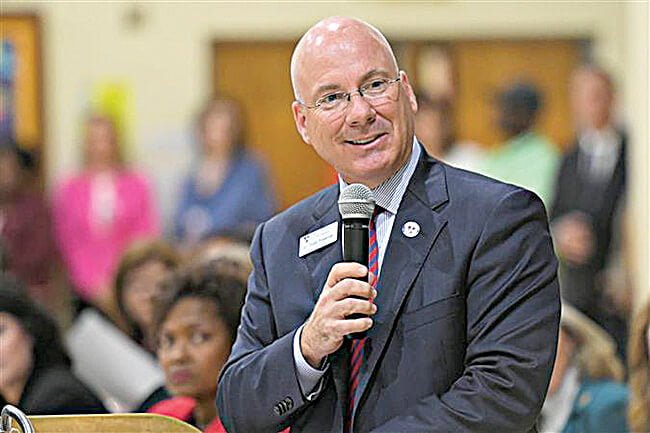
Vestavia Hills Superintendent Todd Freeman, who proposed the increase, said he is hopeful the bill will be passed shortly after spring break.
Freeman proposed the plan, which is known as 1Rebel 1Future, in the summer after nearly two years of planning with several design teams composed of teachers, parents, students, school administrators, chamber members and financial advisers. The millage increase would mean an additional $8.2 million annually for the school system, which Freeman said is necessary to accomplish the plans’ objectives.
“The plan has two priorities,” he said. “The priorities are that we would focus on profound learning experiences for our students and that we would do that in vibrant facilities.”
Broken down, the plan would be spent the following: 44% for improving and renovating existing facilities, 22% for new academic programs, 17% for new and renovated arts and athletics spaces, and the remaining 17% for school operations.
In describing plans to expand learning experiences, Freeman explained two electives would be added at the city’s elementary schools – one would be a STEM-focused class and the other would be a world languages experience class. These additions would complement the art, music and library electives already in place, he said, so that students in elementary school would receive instruction in five total elective areas.
“We think that is really important to give them a more well-rounded, enrichment experience in the sciences and math,” Freeman said, “and in the humanities and the arts.”
If residents vote to approve the increase, Freeman said, the elective changes would be in place at the start of the new academic year in August.
Additionally, Freeman said this first priority of the 1Rebel plan is to improve counseling support resources for students and implement instructional coaches at each school. Freeman clarified that the instructional coaches are not administrators but are “exceptional instructional leaders” that would help ramp up already strong programs in the schools.
Aging Infrastructure
Speaking on the second priority, which focuses on vibrant facilities, Freeman emphasized that the age of the school facilities is beginning to show.
“The reality for us is that our facilities on average are 49 years old,” he said. “We have a very large school plan that we have to maintain, so much of this has to do with focusing on our existing facilities in four primary areas.”
Those areas, he said, include safety and security, accessibility, healthfulness and comparability. Some of these improvements would cost money on the front end but are geared toward improving the overall energy efficiency of the schools. Freeman said the system spends about $3.2 million a year on energy costs.
Across the schools, Freeman said, roughly 239,000 square feet of roofing needs to be replaced, along with 330 heating and air conditioning units. The lighting systems in all the schools, he said, also need to be replaced.
A big component of the plan is ensuring the schools have comparable facilities, Freeman said.
Other renovations would include typical bathroom improvements as well as painting and science lab upgrades.
“All of our schools have unique characteristics — which we love about them and which makes them different in a good way — but there are some comparable things we want to take care of,” he said.
The two oldest campuses, East and West, are in need of larger gyms, meeting spaces and classrooms because of their size. Dolly Ridge, he said, needs a kitchen addition, and Liberty Park Middle needs a new auxiliary multipurpose gym to ensure it remains comparable to Pizitz Middle.
“At the high school, we would be addressing some inadequacies with space in the arts and athletics areas,” Freeman said.
Many of the facilities at the high school are more than 50 years old, he said, and the school’s population has surpassed the allotted space. The band room, for example, was built to accommodate roughly 100 students, but the marching band now has more than 280 students participating. The same is true of the wrestling team’s facilities, Freeman said, which were built to accommodate 30 to 40 wrestlers. Today, however, the state champion team is composed of nearly 100 wrestlers.
If the tax increase is approved, physical space improvements would begin in the winter of the 2023-24 school year at East, West and Dolly Ridge campuses. Collectively, the projected time period for completion is approximately four years.
“The whole idea is to protect the legacy of excellence in our schools,” Freeman said, “it is about building upon the success, the legacy of excellence in our school system that we’ve had for 53 years.”
How Much?
Asked to address concerns some residents may have about the proposed millage increase, Freeman said the questions are justified.
“The first thing I would say is to be fully informed when making a decision,” he said.
Numbers provided by the school system project that a resident with a house appraised for $300,000 would see an increase of approximately $24.38 per month in property taxes. A home with a value of $500,000 – about the average price of a home in the city – would cost homeowners an additional $40.63 a month.
“Naturally, there are going to be questions asked when a school system says we need additional funding,” Freeman said. “Those are questions that ought to be asked. We have tried to, in our messaging, demonstrate the financial need. The reality is that 82% of our budget is spent on people. We invest in people, which we think is the best way to help our students be successful.”
Freeman went on to say the needs of Vestavia Hills students continue to evolve, and he believes the school system must meet those needs to ensure students are well prepared when they graduate.
“The idea is that this is an investment,” Freeman said. “For those who are concerned about it, my perspective is that the school system is intricately linked to quality of life, economic vitality and property values. The success of the school system equals the success of all those things.”