By Sarah Owens
Photos by Jordan Wald and Sarah Owens
When McGowin Miller lines up a putt, he doesn’t hear the cheers, the wind or the crack of the club. What he hears—through years of practice, patience and perseverance—is focus. Born with profound hearing loss, the Mountain Brook golfer has spent his life adapting to a world that doesn’t always meet him halfway. Now, that determination is taking him all the way to Tokyo this November, where he’ll represent the United States in golf at the 2025 Deaflympics.
A Silent Start
“The story goes, when I was like 18 months old, a bunch of people were at the house, gathering and calling my name, and I never would respond,” Miller recalls. “I think my grandfather was the one that kind of brought it to my parents’ attention.”
Soon after, doctors at the University of South Alabama confirmed that he was born more than 90 percent deaf in both ears. “So, from 18 months to about six years old, I went to a South Alabama speech pathologist five days a week and worked with a lady named Fredda Crenshaw. She was wonderful,” he says.
Miller says his time working with Crenshaw as a child allowed him to start kindergarten on time, and he was able to speak and read lips.
His wife, Celina, credits his parents’ persistence for that lifelong advantage. “His parents were really adamant that he learn how to speak,” she says. “In the Deaf community everybody signed, but his parents are hearing, and they didn’t sign, so they were really persistent about him learning to speak.”
That decision, and the support of staff at South Alabama and Vanderbilt, helped Miller find his voice—and eventually, his game.
Finding Golf—and Himself
Miller grew up in Brewton, Alabama, a small town where golf became his outlet. “It just so happened that back in the late ‘70s and early ‘80s, everybody played golf,” he says. “I just started off chasing my brother and his friends, and when I got a little older, my friends started playing. It was just kind of the thing you do in small towns.”
He also excelled in other sports, earning two state championships in the 400 meters in high school. But golf’s individual rhythm suited him best. “It was easier for McGowin to play individual sports,” Celina says.
Over time, that small-town hobby turned into a competitive passion. “This past July, he won the senior United States Deaf Championship because he had just turned 50,” Celina says proudly. “He finished third in the World Deaf Championship three years ago.”
Now, Miller will represent the U.S. alongside two other golfers—Kevin Hall from Cincinnati and Pono Tokioka from Hawaii—in the Deaflympics.
Playing Through Silence
Though he wears hearing aids in daily life, all Deaflympics competitors must play without hearing devices to ensure a level playing field. “When I play in these tournaments, in the Deaf tournament, you have to play with your hearing aid out,” he says. “Or if you have a cochlear implant, you have to take it out.” The result, he says, is an entirely different atmosphere. “You’re out there for four and a half, five hours, and it’s just silence—complete silence,” he says. “It’s interesting.”
But Miller doesn’t see that quiet as an obstacle; it’s part of the game. Years of experience have taught him to adapt. “Everyday golf is just more relaxing, you know, playing with your friends,” he says. “Tournament golf [is] a little more serious, a little more pressure-packed. The more tournaments you play in, the more comfortable you get in the situation.”
Celina adds that mindfulness plays a major role in how he approaches competition. “McGowin has worked with a sports psychologist in the past,” she says. “We do focus on mindfulness with golf.”
Overcoming Barriers, Counting Blessings
Life off the golf course hasn’t always come easily. Because Miller relies primarily on lip reading to communicate, large crowds and group settings can be overwhelming. “I do better here in person, one-on-one,” he says. “The more people you add, the more difficult it gets.” In noisy spaces, he can’t look at more than one face at a time, and if someone speaks while he’s turned away, he often has no idea they’ve spoken to him.
That sometimes leads people to think he’s ignoring them. He remembers playing in a tournament where his competitors thought he was being unfriendly. “My caddie came up to me and said, ‘Those guys you’re playing with don’t think you’re very nice,’” Miller recalls. “They’d been talking to me for the last four holes, and I hadn’t said a word to them. My caddie told them, ‘If he’s not looking at you, he won’t hear you.’”
Even in school, those obstacles were constant. Miller attended the University of Alabama but eventually left after realizing how difficult it was to follow lectures without visual cues. “In high school, I took my core classes one-on-one with teachers, and that was great,” he says. “But I never felt comfortable asking for help in college. The only classes I passed, pretty much were math, where they would put the work on the board, and I could see it.” At the time, accessibility programs for deaf and hard-of-hearing students were limited, leaving him to navigate most of it on his own.
The COVID-19 pandemic brought a new challenge. “When everyone started wearing masks, it was a nightmare,” he says. Without visible lips to read, conversations became nearly impossible, even after mask mandates were lifted. Celina remembered the frustration vividly: “We would go to a restaurant, and let’s say a waiter had their mask on. And I always say, ‘Hey, just want to let you know my husband has a hearing impairment. He reads lips. If you’re comfortable, could you please take your mask down?’ And we got people that were actually rude.”
While Miller doesn’t use sign language, as he’s grown older, he and Celina have made a point to connect with others who share his experience. “That’s why we started playing in these golf tournaments,” Celina says. “We didn’t have any friends with hearing loss, and we decided we needed some.” Those friendships, built through the game he loves, have given Miller a renewed sense of belonging. “They’re just a great group of happy people,” he says. “Always laughing and smiling and having a great time.”
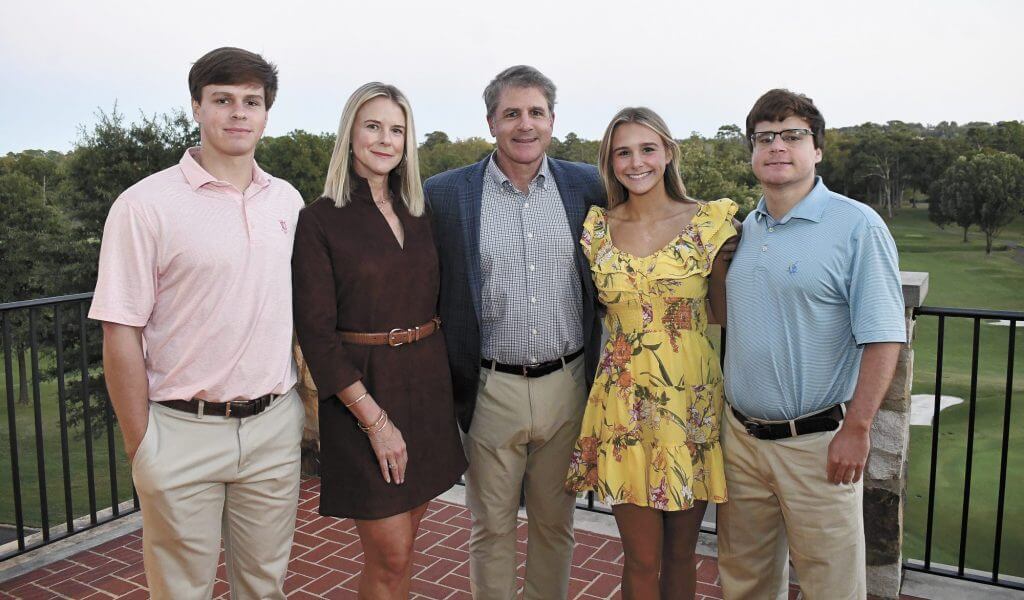
Despite the challenges, Miller’s life has been full of blessings too. He and Celina, who were high school sweethearts, have been together more than 30 years and married for 25. They moved to Mountain Brook years ago for their oldest son, Jim. “Jim was born extremely prematurely,” Celina says. “He had some severe and significant health challenges as a young child, and then he was diagnosed on the autism spectrum with Asperger’s. We decided to move to Birmingham so that he could go to a good public school. And now I teach there.”
Miller runs DMS Construction & Services, a company he founded in 2020 offering services like right of way clearing, emergency remediation, site prep, debris removal and more. “I thought to myself, I think I can do this and use my hearing as a way to kind of get in the door,” he says. “I’ve got a handful of certifications with my hearing, what they call DOBE, which is a disability-owned business enterprise. It’s been good.”
Miller continues, “It’s been definitely challenging, very challenging. But I’ve just been lucky that family and friends have all just kind of accepted me for what it is.”
Representing More Than Himself
Behind Miller’s calm presence on the course, Celina sees something deeper—a moment that symbolizes his lifelong resilience. “He will not tell you how challenging it’s been for him to have a hearing impairment,” she says. “So, for him to be able to play in this tournament where they’re representing this community, I think, is just amazing.”
Miller agrees. “I think it’s obviously really cool to be there,” he says. “Anytime you can represent your country in any capacity, it’s a pretty neat deal. We’ve never been to Japan, and I’ve heard nothing but great things about it.”
After Tokyo, he’ll be back to work, family and regular life—but with another milestone already on the horizon: representing the USA again at the World Deaf Championship in Sweden in 2026.
Through it all, he keeps his sense of humor—and perspective. “I think it’s like anything else in life,” he says. “There are pros and cons to everything, right? As much as I’d like to be able to hear sometimes…I kind of think, ‘lucky me. I don’t hear the bird outside that drives everyone else crazy.’”