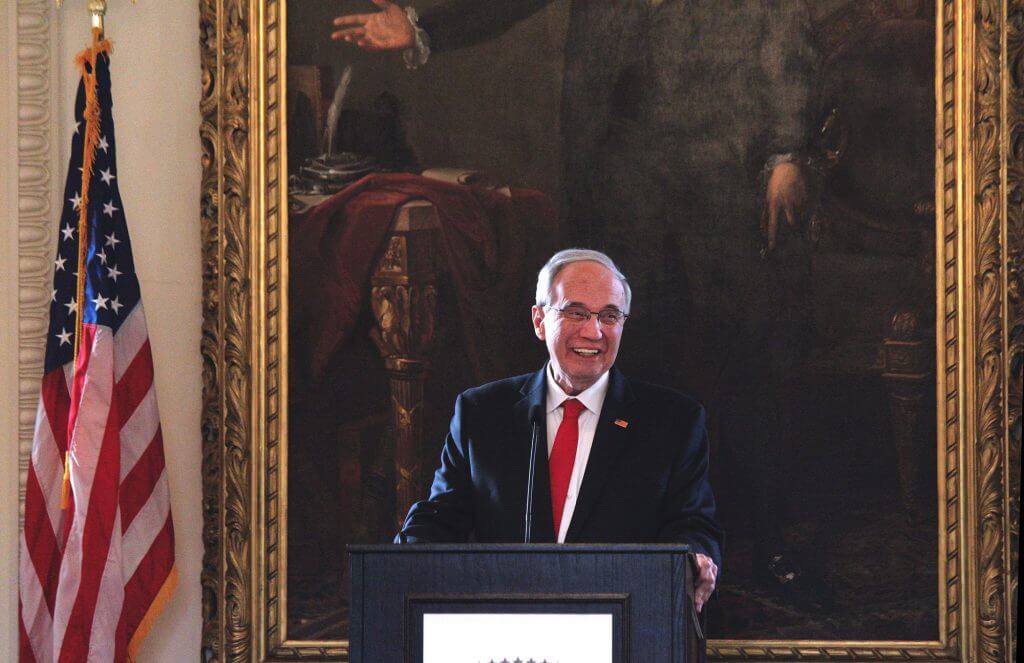
By Gordon G. Martin
In 1997, the future of American civic education was pitched in an unlikely setting—the Alabama Power business office in Montevallo, a relic of the 1970s, complete with “harvest gold” and
“avocado green” appliances.
Into this room walked Thomas G. Walker, Jr. and his trusty sidekick, Beth Hamer. I was the external affairs manager for Alabama Power in Shelby County, and they were in our Montevallo office to share their vision for building good citizens on the cornerstone of liberty.
The “Impossible” Pitch
Tom began to articulate his dream. It was no small dream. He described a sprawling educational campus, a place where American history and civics would come alive, designed to inspire and prepare young people for their future roles as citizens and leaders. He called it the American Village.
Yet, a stark disconnect existed between the grandeur of the vision and the reality of the man making the pitch. While I loved the vision, I said to myself: “He’ll never pull this off.”
This juxtaposition of profound idealism against practical skepticism defines the legacy of Tom Walker. His vision seemed too grand, too pure for a world of budgets and bureaucracy. But Walker possessed a rare, disarming power. He was so sincere and inspiring, so earnest and idealistic, that you just wanted to be a part of making his dream come true.
His earnest idealism was a force more powerful than any practical objection. I had the privilege of serving on the American Village Board of Directors for 25 years, witnessing firsthand how Tom Walker’s “impossible dream” became an immovable reality.
The Making of a Citizen-Leader
To understand the American Village, one must first understand the man who built it. Tom was a native of Albertville, Alabama, and from his earliest days, his family instilled in him a deep love of God, country, and family—the three pillars that would define his life’s work.
His path was set at his beloved alma mater, the University of Montevallo. This was not just a place of study; it was an incubator for his civic identity. He served as the Student Government Association President, getting his first taste of practical leadership and representative government. In 1975, he graduated with Honors, earning a B.A. in history and political science. These were not just academic pursuits; they were the raw materials for his future.
A Career in Public and Civic Service
After earning a master’s in political science from Mississippi State University, Tom served as city manager and city clerk for Northport, Alabama, gaining ground-level experience in the daily operations of local government. He then moved to Montgomery to serve as the executive officer of the Alabama Association of Realtors, honing his skills in managing a large, complex, state-level organization.
Eventually, he was called back to his alma mater to serve as special assistant to the President at the University of Montevallo. It was here, in the late 1980s, that the idea for the American Village was conceived. His service to higher education ran deep; he was also the founding chair of the Alabama Higher Education Partnership and later served as vice chair of the University of Montevallo’s Board of Trustees.
Tom Walker’s life was a case study in the principles he would later teach. He had been a student leader, a public administrator, a state-level executive, and a university advisor. He didn’t just study civics; he lived it.
The Core Conviction: “They Cannot Cherish What They Do Not Know”
Tom was driven by a single, powerful conviction, which he once articulated in a quote that became the philosophical foundation of the American Village: “Our young people cannot safeguard what they do not cherish, and they cannot cherish what they do not know.”
Tom had diagnosed the core failure of modern civics: it often stopped at “know,” drowning students in dry facts and dates, but never inspiring them to “cherish.” The American Village was built, stone by stone, to be the bridge between knowing and cherishing.
In this conviction, Tom was not an innovator but a restorationist. He was channeling the central, urgent anxiety of the American Founders. They, too, were obsessed with the idea that their experiment in self-government was only as durable as the character of its people.
Tom’s thesis is a direct echo of Thomas Jefferson, who warned, “If a nation expects to be ignorant and free, in a state of civilization, it expects what never was and never will be.” Ignorance and freedom, he argued, were mutually exclusive.
But the Founders knew, as Tom did, that knowledge alone was insufficient. It had to be coupled with “cherish,” which they called virtue. John Adams, perhaps the most ardent proponent of this idea, wrote unequivocally: “Public Virtue cannot exist in a Nation without private, and public Virtue is the only Foundation of Republics.”
Tom Walker understood that the greatest threat to a Republic was not a foreign army, but a generation of citizens who had never been taught to cherish the principles they were meant to safeguard. He was not just a history buff; he was a political philosopher who, having diagnosed the ailment, dedicated his life to building the antidote.
From a Napkin Sketch to a National Campus
The answer to the skepticism of that 1997 meeting is now spread across 188 acres in Montevallo. When meeting with architect Mike Hamrick, Tom drew out his idea for the campus on a napkin. From that napkin sketch, a world was born. The idea, conceived in the late 1980s, led to the American Village Citizenship Trust being chartered in 1995. On November 30, 1999, the campus held its grand opening.
Today, that campus consists of more than 20 historically inspired structures. Visitors can stand before a replica of Washington Hall, inspired by George Washington’s Mount Vernon, or walk the grounds of a colonial village. Walker led the efforts not only to build this physical campus but also to design the widely acclaimed and engaging history and civics programs that would take place within it.
An Experiential Revolution
The success of the American Village lies in its method, which is a direct extension of Tom Walker’s personal, inspiring character. The Village’s official philosophy states it clearly: it is “not about its buildings; rather, it is about building in the hearts and minds of young people what it means to be an American.”
This is not a passive field trip. It is experiential learning where history is tangible. Tom recruited Alabamians to portray the figures in American history, allowing students to step out of their textbooks and into a debate with Thomas Jefferson or Abigail Adams.
Tom successfully scaled his own personality into an institution. The American Village is Tom Walker’s earnest idealism made permanent, an engine designed to build in the hearts and minds of young people the very love of country he exuded.
The Legacy, in Numbers and in Hearts
The impossible dream, quantified, is staggering. The American Village campus has served over three-quarters of a million students from across the southeastern United States.
The quality of its vision has been validated at the highest levels. The Village’s work, and Tom’s leadership, received the American Bar Association’s highest national award for excellence in K-12 law-
related education. He was also the recipient of the DAR Medal of Honor and the SAR Gold Citizenship Medal—the highest national honors awarded by the Daughters of the American Revolution and the Sons of the American Revolution, respectively.
A National Legacy: From Montevallo to the Semiquincentennial
Tom’s work did not stop at the Alabama state line. His success was so profound that when the United States Congress began to plan the nation’s 250th birthday, they sought his expertise.
In 2017, Tom was one of only 16 citizens appointed by Congressional leaders to serve on the United States Semiquincentennial Commission. This commission was tasked with leading the entire nation’s celebration of American Independence in 2026. At the commission’s first meeting in Philadelphia, the city where the nation was born, Tom was unanimously elected as its Vice Chairman.
This was the ultimate validation. The man who, in 1993, had a dream in Montevallo was, almost 25 years later, recognized by Congress as a preeminent leader in shaping the nation’s memory. The journey from the napkin sketch to the vice chairmanship of the Semiquincentennial Commission is a testament to the sheer, undeniable power of his singular vision.
The Crowning Achievement: A Poetic and Profound Finale
Tom’s vision for the American Village campus had one final, crowning achievement: a full-scale, permanent replica of Philadelphia’s Independence Hall, the sacred room where both the Declaration of Independence and the U.S. Constitution were signed.
This building was the capstone of his life’s work. In a moment of profound, almost novelistic poetry, the ribbon-cutting ceremony for Independence Hall—the event that officially completed founder Tom Walker’s vision for the civic education center—took place just hours after his passing.
His work was, quite literally, finished. He had seen his vision through to its absolute completion. He had built the hall, he had taught the students, and he had inspired the nation.
The Dream That Became a Duty
The 1970s-era Montevallo business office is now part of the University of Montevallo, and the avocado-colored appliances are long gone. But the American Village is there, its 188-acre campus a testament to what one earnest, idealistic man can achieve against all doubt.
Tom Walker’s legacy is not in the brick and mortar, but in the 750,000 hearts and minds he helped to shape. He reminded us of the Founders’ core truth: that a republic is not a machine that runs itself. It is a fragile covenant that must be renewed by every generation.
In the end, Tom Walker did more than make his own dream come true. He turned that dream into a national duty, inspiring countless others to join him in the essential work of the American experiment. He taught us that to safeguard our republic, we must first cherish it; and to cherish it, we must first know its story.
Thomas J. Walker, Jr. devoted his life to telling that story.
Gordon G. Martin, a retired executive at Alabama Power Company, now directs the Kennemer Center for Innovation at The University of Alabama. He served on the American Village Board of Directors for 25 years.