By Nausicaa Chu
In 1939, Henry Aizenman was a fun-loving, adventurous child: the kind who had a girlfriend at age six, loved skating on frozen rivers and imagined a little man lived inside the radio.
He was also a Polish Jew during the Nazi invasion.
In 1945, Americans liberated him from the Wöbbelin concentration camp after one of the worst mass genocides in history. For more than three years, Aizenman was known as “B-21” to his Nazi captors, who referred to Jewish people as “rats” and “parasites.” He drank beer to stave off starvation, carried 80-pound sacks to avoid the gas chamber and witnessed the murder of his parents.
The Holocaust is often seen in terms of staggering figures—Nazis murdered six million European Jews and millions of others, with around 1.5 million Jewish children killed alone. But the Alabama Holocaust Education Center (AHEC) also views it as a story of individuals, whose stories explain the tragedy in a way statistics cannot.
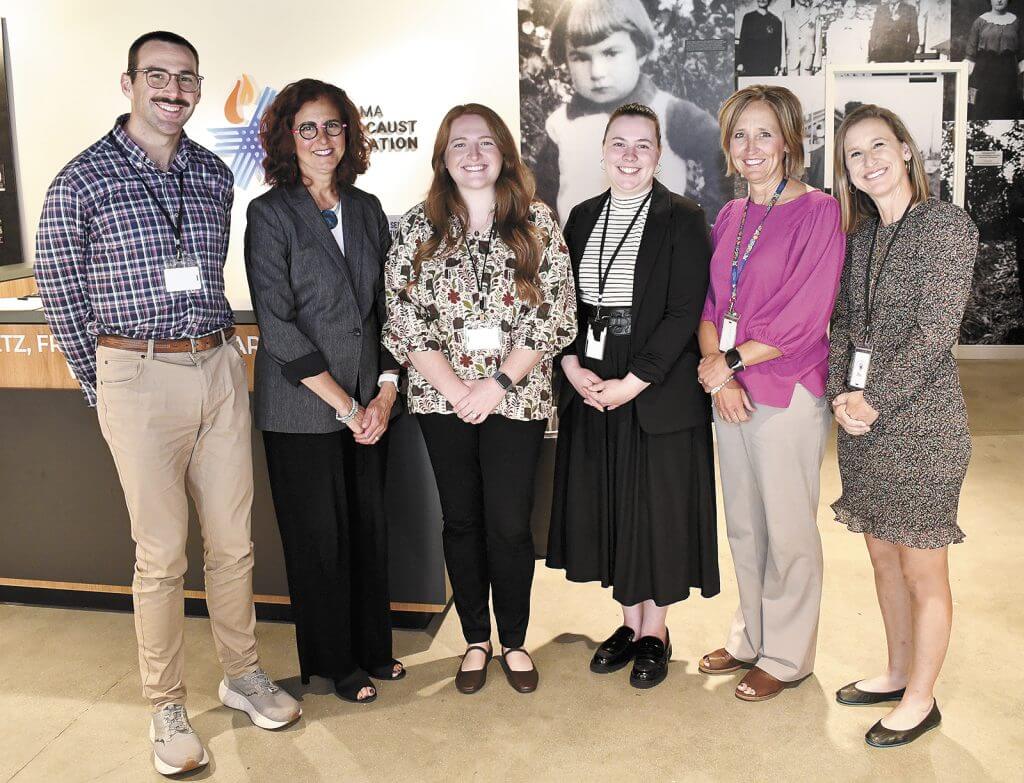
The center collects the testimony of Holocaust Survivors who came to Alabama, as Aizenman and over 170 other Jewish people did. It educates schools, workplaces and community spaces with these stories through exhibits and speaker series, alongside an online hub of resources for teachers. “We are stewards of memory, educating the community about the history of the Holocaust and its lessons for our world today,” says the front page of the AHEC website.
But Americans are forgetting.
According to the Claims Conference, a nonprofit organization that conducted the first ever 50-state survey on Millennial and Generation Z Holocaust knowledge, 50 percent of Alabamians in that demographic cannot name a single concentration camp. From the same survey, it was found that 63 percent of those surveyed did not know six million European Jews were murdered in the Holocaust, and nine percent believe that Jewish people caused the Holocaust. “The surprising state-by-state results highlight a worrying lack of basic Holocaust knowledge, a growing problem as fewer and fewer Holocaust Survivors—eyewitnesses to a state-sponsored genocide—are alive to share the lessons of the Holocaust,” the report says.
AHEC was founded to change that. The organization started as a subgroup of the Alabama Holocaust Commission, a state-led agency, where Survivors, educators and community members pushed for more robust Holocaust education standards. In 2014, it filed for 501(c)(3) nonprofit status, and in 2023, opened its new center—complete with exhibits, a library and an events space.
AHEC helped achieve a major victory last December, when the Alabama State Board of Education passed new standards for Holocaust education. “The last time they were reviewed was in 2010, and all it said for social studies was that teachers had to mention the Holocaust as a consequence of World War II,” says AHEC’s Executive Director Lisa Bachman. “We rewrote the standards.”
Now, teachers must discuss Adolf Hitler’s rise to power, the use of propaganda, the Nuremberg Trials and more. “Based on some of the research we’ve done, we feel that we have the most robust standards of any other state in the country,” says Bachman.
AHEC maintains a “living library” of Holocaust Survivors who moved to Alabama, whom it considers “Alabama Holocaust Survivors.” In the lobby of the center, their photos are arranged in a honeycomb pattern on the wall. Some are black-and-white pictures of children holding dolls and The Soldiers Violin; others are color photos of adults, taken decades after the Holocaust.
Twenty of their stories are featured in the next room. The exhibit, titled “From Darkness Into Life,” displays photographs of Survivors by Becky Seitel and oil paintings of them as children by Mitzi J. Levin. Featuring interviews with the artists and Survivors, the exhibit chronicles the Holocaust’s devastating impact on real people.
The center constantly reminds visitors that the Holocaust did not just change history—it overturned day-to-day lives. The gleaming silver teapot and typewriter behind a glass display are items from the Knurr family, hastily shipped to America in the wake of Nazi persecution.
Though many of the Alabama Holocaust Survivors have passed away—Aizenman died in 2008—AHEC carries on their legacy of courage and advocacy. In the future, the organization is preparing to launch a campaign that promotes compassion and unity, alongside its ongoing commitment to educational events.
At the entrance to the center there is a book titled And Every Single One Was Someone by Phil Chernofsky. The book has the word “Jew” written six million times. Each repetition stands for a Jewish life taken in the Holocaust. “A line could be a family, a page could be a community,” says Bachman. One could create an education center out of their stories. AHEC did.
For more information about AHEC and its upcoming events, visit ahecinfo.org.