
By Brent Thompson
Craig Legg discovered a need, and he decided to fill it. The Birmingham-based artist recognized that there was a missing piece in the documentation of Birmingham’s storied rock and roll history. “A book (Magic City Nights) had been written about the history of rock and roll in Birmingham, but it had zero photographs,” he says, sitting among his paintings at East Village Arts studio in Birmingham’s East Lake neighborhood. “When I read the book, I found myself wondering what some of these people looked like, and that’s when I got the idea.”
In 2023, Legg’s exhibit History of Birmingham Rock & Roll was unveiled, featuring more than 350 paintings of local musicians, venues and influential people associated with the scene. Playfully called a “trading card” series, the exhibit is a collection of vibrant interpretations of Legg’s subjects.
But the project didn’t end there. In late 2025—thanks to the help of some Birmingham music stalwarts—Legg’s exhibit became available in book form. The 144-page A History of Birmingham Rock & Roll: A Trading Card Collection reached local music lovers just in time for the holidays. “It came to book form through Travis Morgan and Mark Harrelson,” Legg says. “Mark owns Boutwell Studios, he’s been on the scene for 50 years, and he’s really into history. Both of them pitched the idea to me and I said, ‘Sure.’ I would not have taken it on—I just came off a book project that took three years to put together, so I didn’t want any part of a book project—but they did the heavy lifting, especially Mark.”
Once the idea was hatched, the matters of funding, design and distribution had to be addressed. “Travis funded it and ran the Kickstarter campaign,” Legg recalls. “The goal was $20,000, and they raised $22,000 or something like that. Mark took hold of the book—the layout, design, finding and dealing with the printer, and he learned it every step of the way, which is a complex process. We had a couple of good layout people—Ben Burford and Lilla Hood of the famous Hood family in Muscle Shoals. They made a great team and knocked it out of the park. It’s one thing to get it laid out and organized, but dealing with the printer is the critical thing. You can do all the great work you want, but if the printer doesn’t get it right, it comes back as a defective product.”
Anyone familiar with Legg’s exhibit won’t be surprised to learn that the book version was an immediate success. “At first, we had 700 (copies), and we sold 200 through the Kickstarter campaign,” Legg says. “As soon as the book came in—and especially after our book signing at WORKPLAY—we saw the interest was really strong. Travis began to distribute them, and they were really selling. We worried about selling out before the holiday season ended, so we took the profits and ordered another 500 so we wouldn’t run out. The timing was spectacular on all of this. The book got here in October, so we had a month or so to strategize. It came out just in time for the holidays.”

One noteworthy aspect of A History of Birmingham Rock & Roll is that, while including some household names, the book touches on many corners and eras of the local scene. If names like The Ramblers, Telluride, Hotel, Wayne Perkins, Damon Johnson, Eddie Hinton and Through The Sparks ring familiar, then this book is for you. Also, unlike the studio exhibit, Legg’s book can easily reach people all over the country.
“It’s documentation, and the book takes it to a whole different level,” Legg offers. “I’m not just dealing with the stars. If you were in the scene, I tried to get you in the book. It can also get to people who were not able to see the exhibit, especially people who were in the scene years ago and are out of town. We’ve heard from people in New York and California.”
But while photos and information are easily obtainable these days, Legg reminds us that such access wasn’t always the case. “From the ‘90s on, you can pretty much count on finding a photograph of somebody, but I couldn’t find photographs of bands even from the ‘70s and ‘80s,” he says. “There was not a lot of concert photography back then, especially in bars. We’re all kind of responsible for documenting ourselves these days. Sometimes it’s a matter of the squeaky wheel gets the grease. If I could find a photo of (a given artist), they got in. If I couldn’t find a photo, they didn’t get in no matter what the merit was.”
And, keeping in step with the baseball trading card theme, sometimes you can’t bat a thousand. “There were so many exclusions, and we’re hearing from people that were excluded,” Legg says with a laugh. “The thought has entered my mind of doing 100 more as a limited, revised edition. But I won’t be doing it anytime soon. Right now, Mark and I are working on a history of Southern Rock, so I’m deeply into that now. But a year or two down the line, we might come out with another edition.”
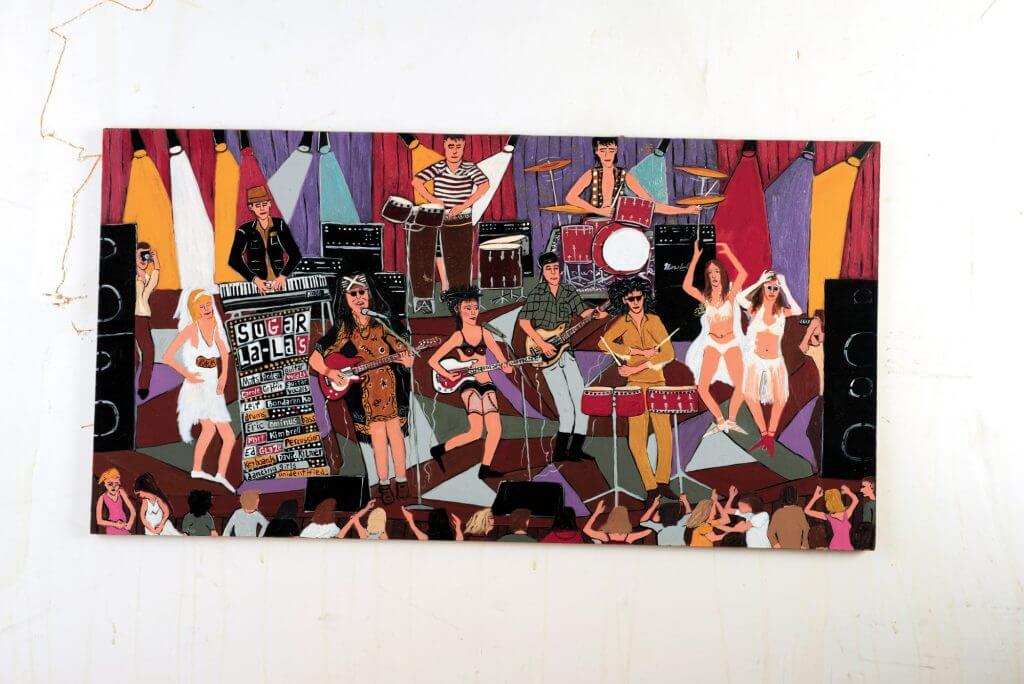
Legg also mentions that his concept isn’t unique to Birmingham: “One thing that I came away with—long after I hung the exhibit—was that this history could be done by any artist in any city of any size in the country. The history is the same, it’s just different people.”
I ask Legg if there are any other scenes he would like to document with his paintings in addition to Birmingham. “I would do Austin (Texas) because I’ve lived there,” he says. “There’s not a book that has really captured the history of Austin punk. There have been several tries, but they’ve never really made it all the way. That history is in danger of being lost. So, I would do Austin punk.”
In lieu of offering exact renditions of his subjects, Legg’s paintings capture a feel. “It’s folk art, and you’ve got a little bit of leeway,” he says. “I’m not a good enough painter to do a fine-art painting of somebody. Plus, I can’t spend that much time on people. I’ve got it down to where I can do these in a day, but I need to get on to the next one.”
For more information or to purchase the book visit Craiglegg.com