By Lee Hurley
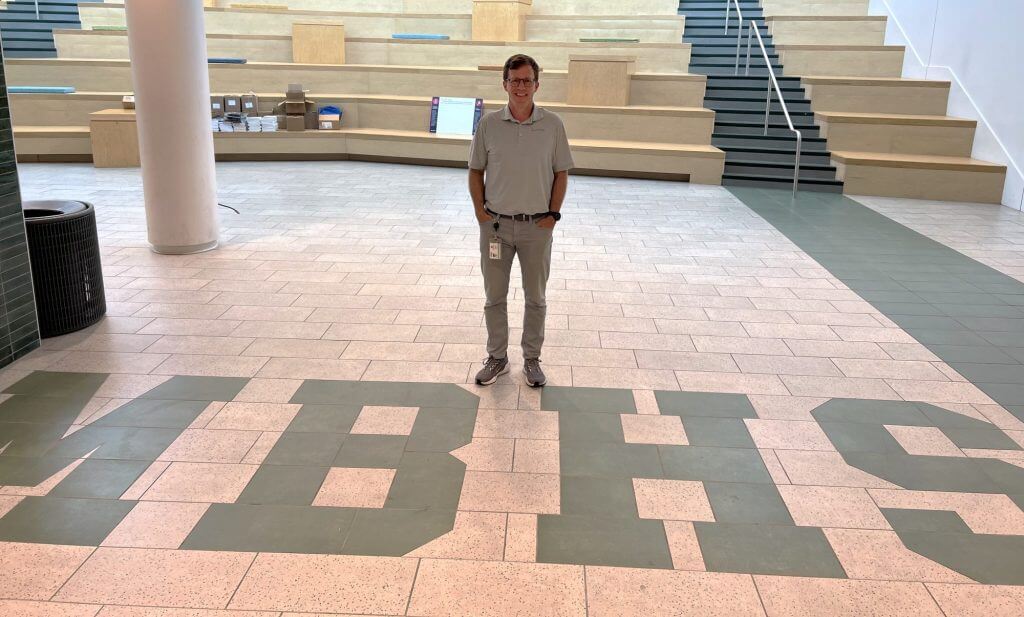
Lars Porter is stepping into the principal’s office at Mountain Brook High School with a mix of humility, energy and familiarity with the kind of community he now leads. Growing up in Vestavia, Porter describes a path to school leadership that was anything but scripted; part youth minister, part coach, part classroom teacher, part technology coordinator and ultimately an administrator shaped by years of working closely with students, teachers and families. That varied background now informs his vision for one of Alabama’s most high-achieving high schools.
Porter’s journey into education began in a season of uncertainty. Newly married and “poor as dirt,” he and his wife Dana were trying to figure out life while working at Birmingham-Southern. A connection through St. Luke’s Episcopal Church led Porter into youth ministry, but a part-time coaching opportunity at Mountain Brook Junior High changed the direction of his career. He realized that “being in a school setting is where I feel most alive. This is where I’m supposed to be.”
That realization led him back to school himself. Porter entered an alternative master’s certification program at Samford University while teaching at Homewood High School, where he taught math and coached cross-country and track for six years. From there, he joined Mountain Brook Junior High as a math teacher and coach, then took on the role of technology coordinator as a stepping stone to administration. About three and a half years ago, he moved to Mountain Brook High School as an assistant principal, first overseeing student support, discipline and operations before shifting into instruction and curriculum. Now, he is taking the next step as principal.
Even with that upward trajectory, Porter does not present himself as someone arriving to remake the school in his own image. He praised former principal Carrie Busby and described the school as a strong system that does not need an overhaul. His goal, he said, is to preserve what works while identifying targeted, high-impact improvements. As Porter put it, “The school is strong, and the task ahead is not sweeping change but careful stewardship.”
That mindset matters at a school like Mountain Brook, where expectations are high across the board. Porter describes an “achievement culture” that extends far beyond academics. State championships in athletics, strong arts programs, successful academic teams and a busy student life all contribute to a culture where excellence is expected. He spoke with pride about everything from cross-country and tennis to theater, debate, robotics and the student-run broadcast program.
But Porter also sees the pressure that can come with that culture. One of the major challenges he identified is helping students find balance in an environment where it is possible—and often tempting—to do everything. He noted that many students take on intense academic loads while simultaneously participating in demanding extracurricular activities. For some, that works well. For others, it creates chronic stress.
That concern connects to one of his priorities: student mental health. Porter says the job of a principal today requires supporting students not just academically, but emotionally. He talks about the need to help teenagers understand stress in a healthier, more seasonal way—recognizing that some periods of challenge are normal. “Not every day can be a five-alarm academic fire,” he says. He describes one of the hardest parts of school leadership as communicating that balance in a way that is individualized, because what one student can handle may look very different from what another can.
Safety, in the broadest sense, sits underneath all concerns. Porter says physical safety remains foundational, especially in an era when schools must prepare for threats they wish did not exist. At the same time, he emphasizes mental and emotional safety as equally important. For him, the school environment must be one where students feel protected, supported and able to grow.
He is also thinking about technology, especially artificial intelligence. Porter calls AI a “major and growing challenge” for schools, not because it should be feared outright, but because educators must learn how to use it wisely. He frames the challenge as twofold: teaching students to live and learn in a world shaped by AI while preventing it from replacing too much of the human thinking and effort that education is supposed to develop. Rather than focusing only on the amount of screen time students have, he suggests schools pay closer attention to the quality and value of what they are engaging with.
His reflections on student phone use show a similar nuance. Mountain Brook has now completed its first year under Alabama’s FOCUS Act, which requires phones to be turned off and kept off a student’s person during the school day. Porter acknowledges that implementation has not been perfect, but he says student feedback has been surprisingly strong. Some seniors told him they felt more connected to one another during the day when phones were out of sight. In shared spaces, he says, students were more likely to look up, say hello and engage with one another.
The idea of community may be the most personal part of Porter’s vision. He says he wants to help break down the invisible walls that can divide athletes, artists, musicians and other student groups. Too often, he observes, students spend their early high school years defining themselves against one another, only to appreciate those differences more fully by senior year. Porter wants to speed up that process—helping students see one another’s humanity earlier, building empathy and encouraging a broader sense of school identity. “I want to drive our students toward one another,” he says, adding that he wants students to value “the Spartan by our side.”
As he prepares for his first year leading Mountain Brook High School, Porter is focused on practical work such as scheduling and leadership transitions. But underneath those immediate tasks is a larger goal: to protect what makes the school strong while guiding it toward a healthier, more connected future. Collaboration is also on the new principal’s mind. In addition to strengthening the culture inside Mountain Brook High School, he wants to build stronger ties across schools and communities. That instinct fits with both his coaching background and his philosophy of leadership. As Porter says, “A rising tide lifts all boats.”