Story and Photos By Karim Shamsi-Basha
The love in the hall at Saint Luke’s Episcopal Church does not announce itself. It shows up in small things. A smile that lingers. A gaze that holds steady across a table, patient and kind. A hand resting on a shoulder. A hug at the door that turns into two.
The tenderness passes back and forth so easily that no one seems to notice.
“Who did the explorer Richard Byrd meet at the North Pole?” A pause. Then the answer: “Santa Claus!” The table erupts. “Which president was born in Texas?” comes the next question. “The 34th?” “Dwight Eisenhower,” comes the answer.
The questions are from volunteers at Founders Place, a ministry of Saint Luke’s dedicated to people living with memory loss and their caregivers. Around the tables in the church’s large hall sit participants and volunteers together, laughing at the same jokes, reaching for the same answers.
You would never know one from the other. And that is by design.
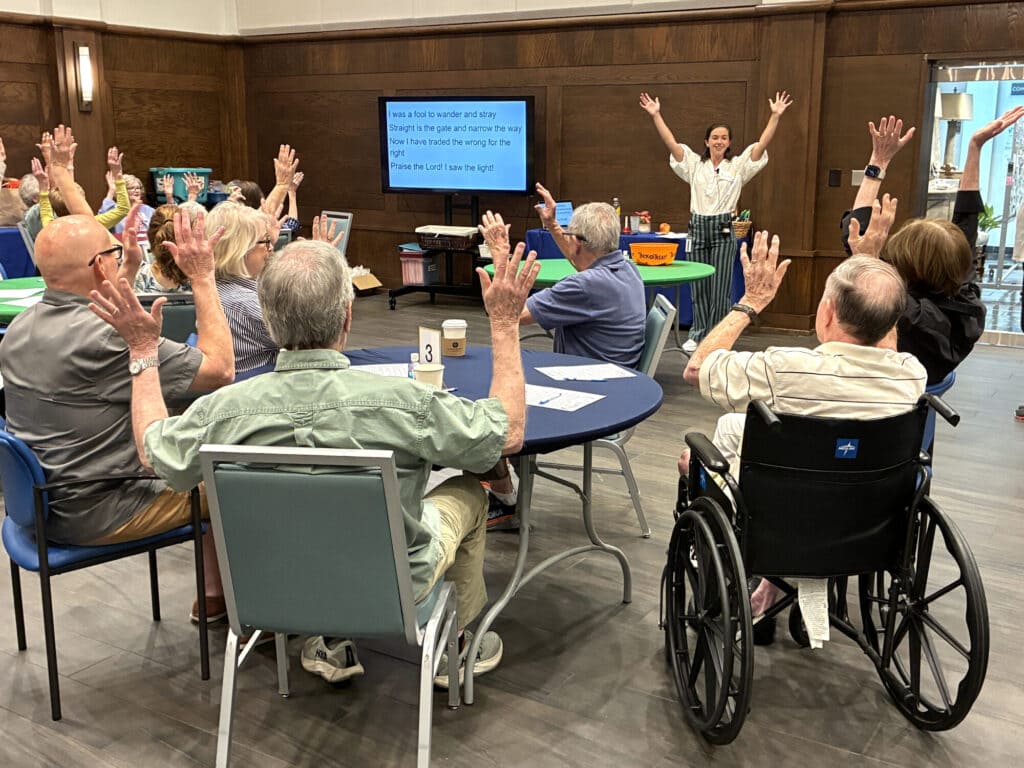
After the questions game, the participants and volunteers sing Hank Williams songs together, and his lonesome tunes don’t sound so lonesome. It is the kind of sound a family makes at a holiday table, noisy and joyful, the way it should be.
Founders Place grew out of a recognition that families living with dementia needed more. Ashley Anthony is director of administration, operations and community engagement. “As conversations around dementia care and caregiver support became more common, it became clear that many families were navigating this journey with limited opportunities for meaningful social connection and respite,” Anthony says.
At the same time, the Respite for All model, which began in Montgomery, was spreading to other communities, including Birmingham. Saint Luke’s brought it home.
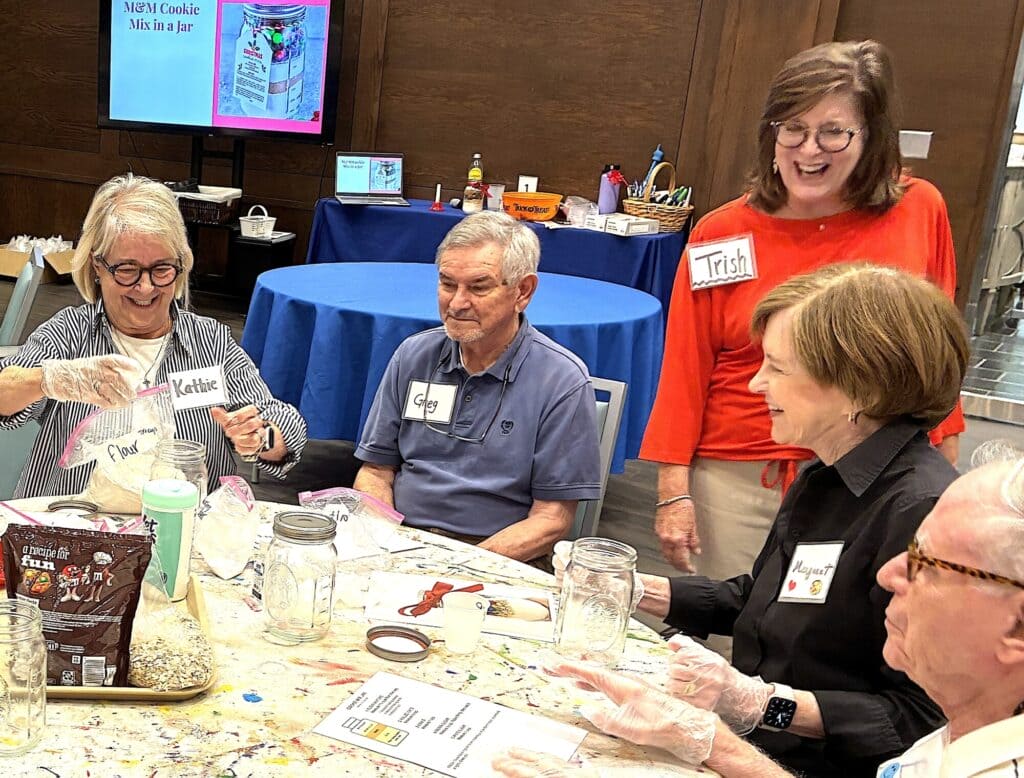
Trish Hoover was there at the beginning, on the founding board in 2020, just before the pandemic. A retiree whose career includes work with United Way and the Area Agency on Aging, she has seen the need up close, and she still volunteers today. “I wanted to make a difference at our church,” Hoover says. “Everything we do is methodical, including our brain engagement activities, like making cookie mix and playing games. We sell what we make in the gift shop, and the money goes back into the art program.”
Anthony says the staff gets to know each participant before they ever walk through the door: their interests, work, hobbies, family, favorite music. “Rather than focusing on what someone may have lost,” she says, “we focus on who they are and what still brings them joy.”
When the group steps out into the courtyard for lemonade, Ed LaMonte, 83, is among them, a man with a lifetime of stories behind him. He grew up in Ohio and went to Harvard on a scholarship to study American history and civil rights. In the 1960s, he was part of a Harvard group chosen to work with Miles College in Birmingham, where he tutored in the history department and worked on Head Start—at a time when public schools were turning it down rather than desegregate. He went on to earn a Ph.D. in political science.
“This is a wonderful, engaged group, with a variety of interesting projects,” LaMonte says, with the steady gaze of a man who saw Birmingham at its hardest and never lost faith in its people. “I’ve done a lot in my life. Here, we just enjoy each other’s company.”
John Blalock, a retired surgeon, puts it simply. It was too hot to fish, he says, and he likes helping people. “It’s about giving of yourself,” he says.
The heart of the Respite for All model is its one-to-one ratio of volunteers to participants. One of those volunteers is Emily Elliott, who came to Founders Place by way of her own family. She watched her mother struggle with memory loss, and she saw what something as simple as singing together could do. “When we all sing together, these old songs bring back memories that are sweet,” she says. “It brings me so much joy.”
For participants, the gift is connection. As memory loss progresses, many people grow more isolated. “Here, they’re surrounded by peers, volunteers, laughter, conversation, music and friendship,” Anthony says. “They’re part of a community that sees them as people first, not diagnoses.”
For their care partners—often spouses and grown children—a few free hours can mean a doctor’s appointment, an errand, lunch with a friend or simply rest. “Caring for a loved one with dementia is rewarding, but it can also be emotionally and physically demanding,” Anthony says. “Founders Place lets them do it with the peace of mind that their loved one is safe and cared for.”
Near the end of the morning, participants gather to sing “I’ll Fly Away,” an old hymn most of them have known their whole lives. It is one of the songs the group sings most often, Anthony says, and one line, about a land where joy never ends, is how Founders Place feels. “It’s an extraordinarily joy-filled place,” she says. “Our volunteers probably say it best: they arrive expecting to give, and by the end of the day they often feel they’ve received far more than they offered. I feel the same way.”
Then the song ends, and the room goes back to the joyful and noisy sound of friends talking all at once. And beneath it, the small things keep moving around the room. A smile that lingers. A gaze that stays. A sweet touch. One more hug at the door. Nobody announces them. Nobody has to.
Joy, it turns out, remembers the way home.
For more information, email [email protected], or call 205-802-6217.