
By Lee Hurley
Russell Levenson Jr. has spent much of his life helping people wrestle with questions of faith. Now, the retired Episcopal priest and Mountain Brook native is exploring those questions through a different lens: a thriller novel involving murder, moral failure and the struggle between good and evil.
After nearly 17 years as rector of St. Martin’s Episcopal Church in Houston, Levenson returned home in 2024 with Laura his bride of over 40 years, where retirement has kept him busy making pepper sauce, soap and of course, writing.
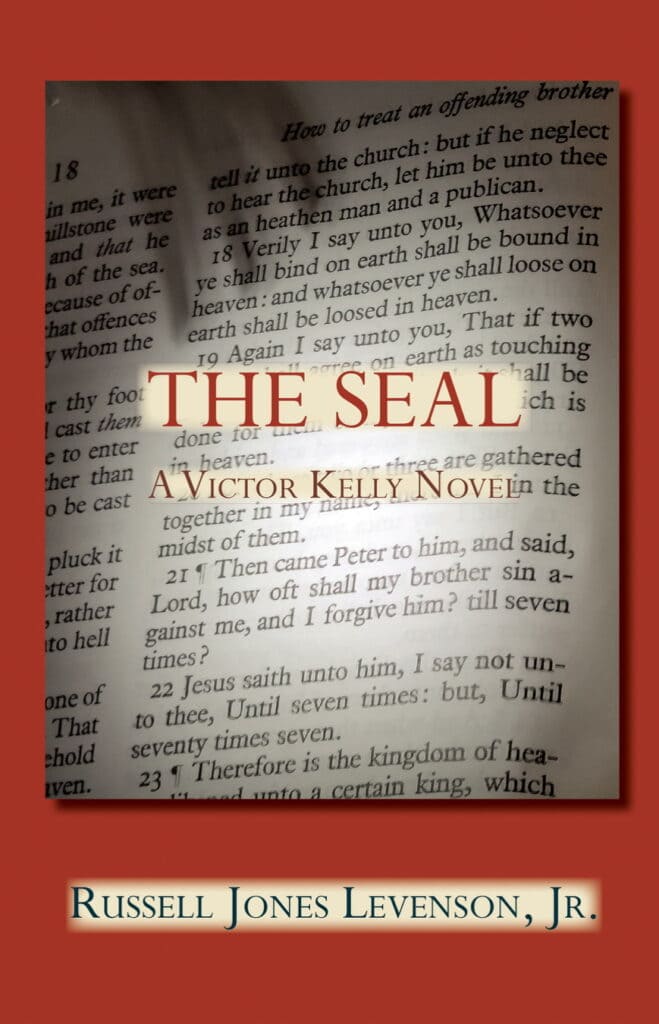
While Father Russ has published several nonfiction books over his career including Witness to Belief featuring his interviews with 12 renowned people of faith, his debut novel, The Seal: A Victor Kelly Novel, takes readers into darker territory.
Following Victor Kelly from a Southern childhood through seminary and into ministry, the book draws on settings familiar to its author.
You’ve written several nonfiction books. Why a novel?
Ha! I wanted to prove one of my high school English teachers wrong. Seriously, I have dabbled in fiction, writing some short stories and poetry. I enjoy thrillers by authors like James Patterson and James Lee Burke, so I thought I would give it a whirl.
This is very different from my other books. I have warned readers that it is a “spiritual thriller,” with some dark twists and turns. The characters experience both the joy that comes with faith and the consequences of moral failure. It includes some mild language, infidelity, murder and suicide. It is not a children’s book.
How much of Victor Kelly’s story comes from your own life?
A good friend who is a successful author says every writer’s first novel is autobiographical. That is not the case here. The first part follows Victor’s birth and early life in a fictional Southern town during the 1960s. The second follows him to seminary in Alexandria, Virginia, with his wife and sons. The third concerns his experience as a new cleric. I have lived in those times and places, but that simply helped set the stage.
What questions did you want the novel to explore?
The book opens with the church’s codification of the seal of confession at the Fourth Lateran Council in the 1200s, then turns quickly to a gruesome murder in a chapel in metropolitan Washington, D.C. Woven throughout is a reminder that evil is real, even in places where we least expect it. Readers meet both despicable and noble characters, along with some trying to find themselves somewhere in between. Kelly is a complex character who reveals human nature, even in the life of a clergyman.
One of my mentors, the Anglican priest John Stott, wrote about the dignity and depravity within each of us. If we are honest, that struggle is familiar to most of us. But beneath the dark themes in The Seal is the conviction that God wins in the end.
Was writing fiction different from writing nonfiction?
Most of my other books came directly from my own experience. The Seal, at nearly 400 pages, took a few years. Although it is fiction, I wanted the historical details of its times and places to be accurate, which required research. Frankly, it was also difficult at times to get into the head of “Chi Rho,” the central evil character. But I had some help with that!
What kind of help?
One of my readers, whom I acknowledge in the book, was an experienced Houston police officer who helped solve some horrific crimes. I also confess—which is appropriate for someone writing about the seal of confession—that I am a bit of a crime drama and true crime junkie. I have watched Law & Order and Dateline for years. Part of the appeal is that the crimes are usually solved in an hour or so, and usually the bad guy or gal gets their just desserts.
Your interest in Law & Order also led to a friendship with Sam Waterston. How did that happen?
I was particularly taken with his character, Jack McCoy. After learning Sam was an Episcopalian, I invited him to participate in a Lessons and Carols service at Martin’s (in Houston). He accepted and did not charge us a dime. When I asked why he had said yes, he replied, “Because you would not leave me alone!”
Sam has a wonderful sense of humor. During his visit, some of our volunteers, including the young acolytes, were a little starstruck. I gathered them together, pointed at Sam and said, “You all better be on your best behavior, because this guy can have you arrested, tried, convicted and sentenced inside of an hour!” Without missing a beat, Sam smiled and said, “Forty-three minutes with commercials.”
People often say we are living in especially troubled times. Does your experience support that?
My friend and pastor Huey Gardiner, rector of St. Mary’s-on-the-Highlands, and I have discussed this. We reached the same conclusion: We are always living in troubled times. Are things as dire now as during World War II? Probably not. But we live in a world where evil is real, and God is also at work.
Some years ago, during a politically divided season in Houston, I preached a sermon called “In the Meantime.” My point was that in “mean times,” we should live out Christ’s teachings by treating everyone with charity, dignity and respect.
What do you most want readers to take away from The Seal?
It is a story about the battle between good and evil and how the Christian faith can empower individuals to defeat evil, both in their own lives and in the world around them.
Book signing at St. Luke’s Episcopal Church Nov 19, 4:30 – 6:30