By Lee Davis

You may not know Dirk Walker’s name, but there’s a good chance you’ve seen his work.
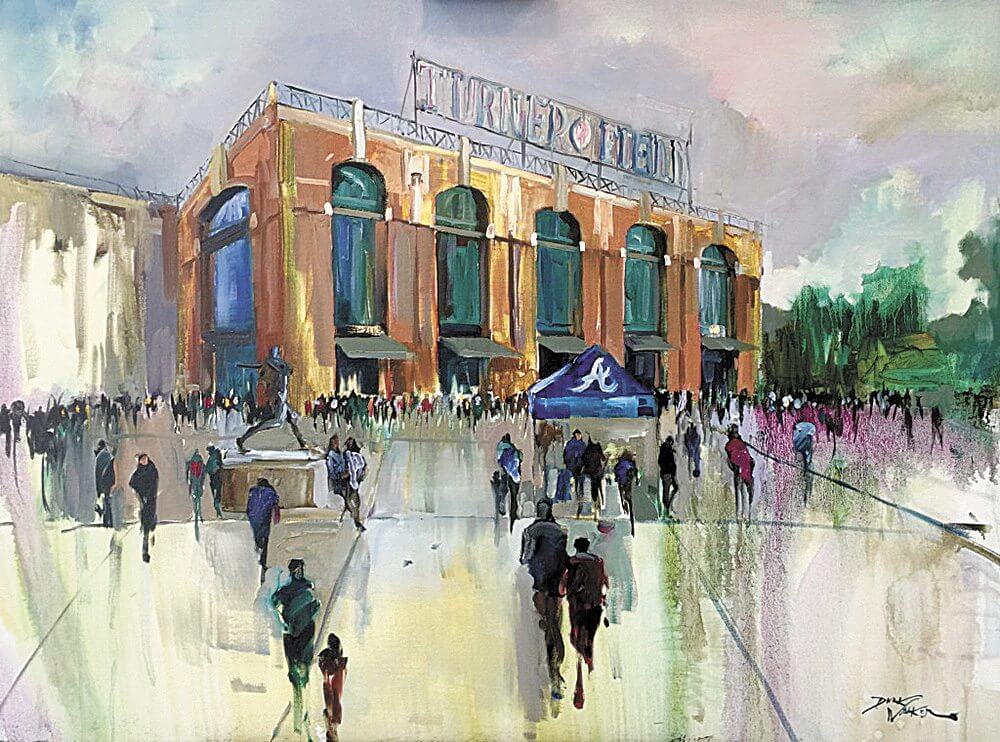
Walker, 62, is one of the top urban landscape artists in the Southeast, with his artwork hanging in corporate buildings and hospitals throughout the region. His artwork depicts landmarks in Birmingham such as Sloss Furnaces, the Alabama Theatre, the Railroad Park area, the city skyline and scenes from places as diverse as New York City, Moscow and Turner Field in Atlanta.
In 2016, Walker was the featured artist chosen to have his paintings hanging throughout the orthopedic floor of Grandview Hospital on U.S. 280. He is also the only Alabamian to be on a short list of artists being considered to have their work hang in the new Atlanta Braves Stadium scheduled for opening in 2017. Walker is represented by galleries in Birmingham, Atlanta, Nashville and Houston.
He was named the 2013 Grand Prize Winner of the Energen Corporation Art Competition and the 2014 Employee’s Choice Winner of the same art competition.
Those are impressive accomplishments for someone who never dreamed of a career as a professional artist until adulthood.
“I never painted as a child,” said Walker, who grew up in Vestavia Hills. “My father was a talented watercolorist and I spent a lot of time watching him. I did a little sketching in pen and ink, too.”
Walker graduated from Auburn University and began a 20-year career with Central Bank of the South, but his artistic instincts never left him.
A visit to the Loretta Goodwin Gallery in Birmingham ignited his desire to put his talents on canvas.
“I realized I had a love for painting and I wasn’t going to let it get away,” he said.
Once Walker began to paint, his work began an immediate personal evolution.
“In the early days, I was a traditional painter,” he recalled. “I did a lot of still lifes, landscapes and pastoral scenes.”
Soon, he expanded his work into urban landscapes, with Sloss Furnaces being his first subject. His painting style of abstract realism was inspired in part by the work of New York painter David Leffell, a pupil of the Dutch and Flemish masters such as Rembrandt. Some critics have compared his style to 1920s icon George Bellows.
“The interplay of light and shadow through texture, shapes and color transforms the simple objects of everyday life into rich creations,” Walker said. His goal is for the viewer to see the work and create his or her own memories. “For example, if someone sees my painting of the Alabama Theatre, I want them to see more than just the structure,” he said. “I want to inspire their own memories, such as if they watched cartoons there on Saturday as a child.”
Walker said his approach to artistic work is a mixture of drawing and painting. “Drawing is linear and has to be very exact,” he explained. “Painting is more like sculpture, where the artist pulls shapes to give the work a greater sense of depth.”
The nation’s economic climate led Walker to see the art world from the business side.
“About 25 years ago, mergers in the banking industry eliminated my job in that field, so I directed the Loretta Goodwin Gallery,” he said. “It was beneficial to see the art business from the commercial side.” He directed the Gallery until its closure in 2014.
Walker said he has no plans to retire from painting. In fact, he said he learns more every day.
“Years later, the only absolute statement I profess to make regarding the language of painting is that it is a life-long struggle but one that is well worth the journey,” he said. “It has taken me close to 30 years to realize that success as an artist doesn’t come from sales, having showings or being acknowledged for your talent. It comes from that pivotal moment when you realize the sheer joy you get from taking a painting from concept to completion. Painting has given me so much joy in my life; it’s a spiritual gift for which I’m sure I’m not worthy.”
Dirk Walker may feel unworthy, but for nearly 30 years art lovers everywhere have embraced his work.