By Meredith Hornsby
Being a special needs parent is a journey no one ever expects to take. It can be overwhelming, confusing, frustrating – and wonderful.
My daughter, Caroline, has cerebral palsy, and I’ve learned so many things since we began this adventure when she was born 4½ years ago.
Life Isn’t Over
When a child first receives a difficult diagnosis, it’s easy to succumb to the mindset that your life is over. To be honest, “life as you know it” does cease to exist. Things really won’t ever be the same.
The dreams I had for my daughter definitely changed. I was no longer concerned with whether she’d be a dancer like her big sister, or whether she’d prefer team sports like her big brother.
After her CP diagnosis, my goals were things we usually take for granted: I wanted only for Caroline to one day walk and talk. But I never stopped having dreams for her; those dreams just changed. Life may be different than I’d imagined, but it’s not some horrible thing, and it’s certainly far from over.
Be Proactive
Parents of special needs children have gotten a bad rap over the years, known for fighting the school systems or lobbying for equality in some form for their child. I used to think, “Why is it such a big deal? Why does this even matter?”
What many people don’t understand is that we are our child’s advocate, and often we are their only advocate. It’s our job to question doctors and therapists, to learn the new languages and many, many acronyms of the world we live in, for the benefit of our child.
We’ve all heard the phrase, “No one knows your child better than you do,” and that’s even more true in the case of a child with differing needs. We’re the ones who are there on a daily basis; we see what they can do and the areas in which they need further support. I had to move out of my comfort zone of just saying, “OK, that’s fine,” when a doctor or therapist told me something and start questioning the decisions being made by those who cared for my daughter.
In my case, Caroline can’t speak for herself to say what hurts and what she needs, so it’s up to me to be that voice on her behalf. I quickly learned that there’s not a thing in the world wrong with that.
Patience is a Virtue
Patience is a virtue, and nowhere is this more true than when parenting a child with special needs. I can’t begin to count the hours of simply waiting that I’ve had to do in the past four years – waiting in doctors’ offices, waiting on hold talking to the insurance company, waiting for someone to call me back to answer a question I may have.
I’ve also had to be patient with my child, because she does things at a different pace than her typical peers. She has always been developmentally delayed, so I constantly felt like I was waiting for the “next big step.” Over time, I’ve learned that even the small things, the “inchstones” she accomplishes rather than milestones, are just as important and should be celebrated with as much gusto.
In the same realm as patience, flexibility has become an important factor in my day-to-day life. Nothing, nothing as a special needs parent ever goes the way you plan. I can make list after list and plan for Scenarios A through Z, and Caroline will still find a way to make me change everything I thought I had prepared!
Being flexible and understanding that everything will most certainly change just as I think I finally have it all together has helped me keep my sanity, or most of it, anyway.
“Bless Their Hearts” and Move On
Even in a seemingly progressive 2016, people can be thoughtless, making comments or asking rude questions about Caroline when we’re out in public. I’ve gotten a Forrest-Gump style, “So is she stupid or something?” more than once.
Last year at my son’s baseball game, Caroline was crying and upset; since she doesn’t talk, crying is a way for her to communicate. Another mom said, “If she’s going to act like that, you really shouldn’t bring her here. She’s bothering everyone.”
I learned early on that some people are not at all understanding, and others are just plain rude.
I love when someone asks me an appropriate question about my daughter’s disability, because it gives me the opportunity to talk about it and hopefully educate someone else. Education brings awareness and acceptance, so talking about her diagnosis, abilities and needs is important to me.
When someone asks, “Why does she use a walker?” or “Do you think she will eventually be able to talk?” I’m more than happy to discuss her CP. More often than not, the questions people ask are genuine and well-meaning.
I can’t try to correct everyone who says something disrespectful or always take the time to explain to an inconsiderate person that Caroline has different needs and can’t help some of her responses to stimuli or situations. Instead, I just smile and think the Southern standard “Bless their heart” phrase, and move on.
You Just Have to Laugh
When parenting a child with special needs, most days you will encounter a “laugh or cry moment.” One afternoon a year or so ago, Caroline was sitting on the floor and discovered an unidentifiable object under the couch. She picked it up and immediately fed it to the dog! To this day, I still have no idea what it was she fed poor Barkley, but she picked it up using a pincher grasp! Her occupational therapists had been working on that for months, and she did it!
Last week, Caroline got angry because someone changed the TV channel off of Mickey Mouse, so she threw her sippy cup across the room. I thought, “Well, at least she recognized that Mickey wasn’t on anymore, she was trying to make her feelings known – and her arm muscles sure are strong!”
She bumps into things, falls down, has what we have dubbed “diva moments” when she will lie down wherever she is (home, outside, church, school, anywhere) and refuse to move. She just lies there! I don’t try to make her get up or even say anything to her anymore. Instead, I pull out my phone and take a picture to put on her Instagram page that details life with cerebral palsy.
When it comes to situations like that, I figure I could either be upset and cry or just roll with it and laugh. My best advice to parents of special needs children, or any child, for that matter, is to always choose to laugh.
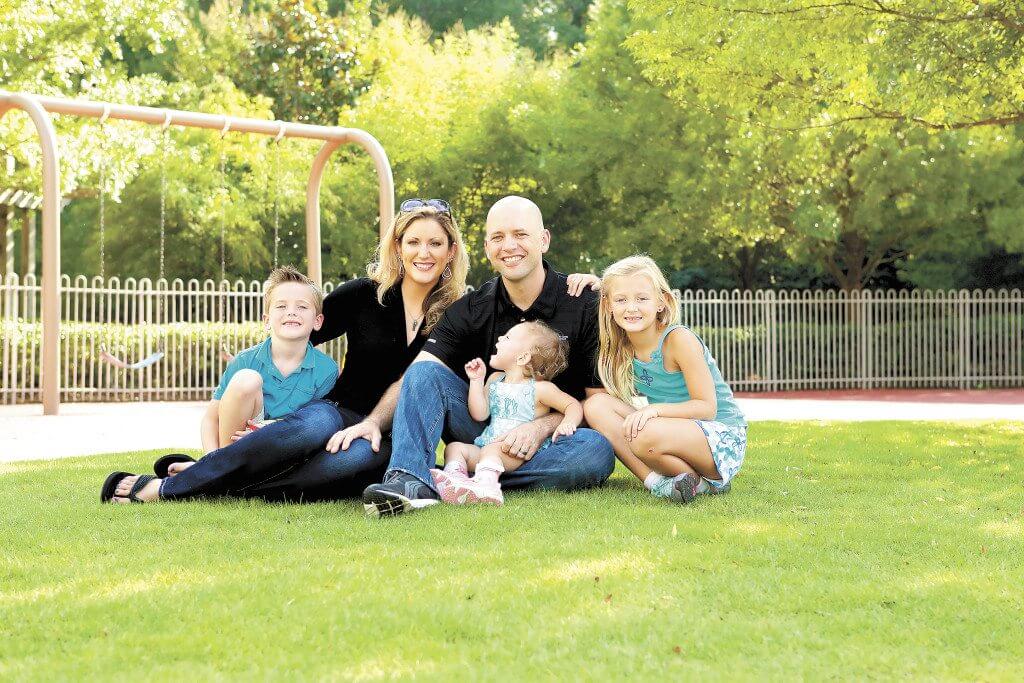
Meredith Hornsby volunteers with and uses programs offered through United Cerebral Palsy of Greater Birmingham. She teaches fourth grade science and math at Gardendale Elementary. Hornsby and her husband, Jonathan, reside in Hoover with their three children.