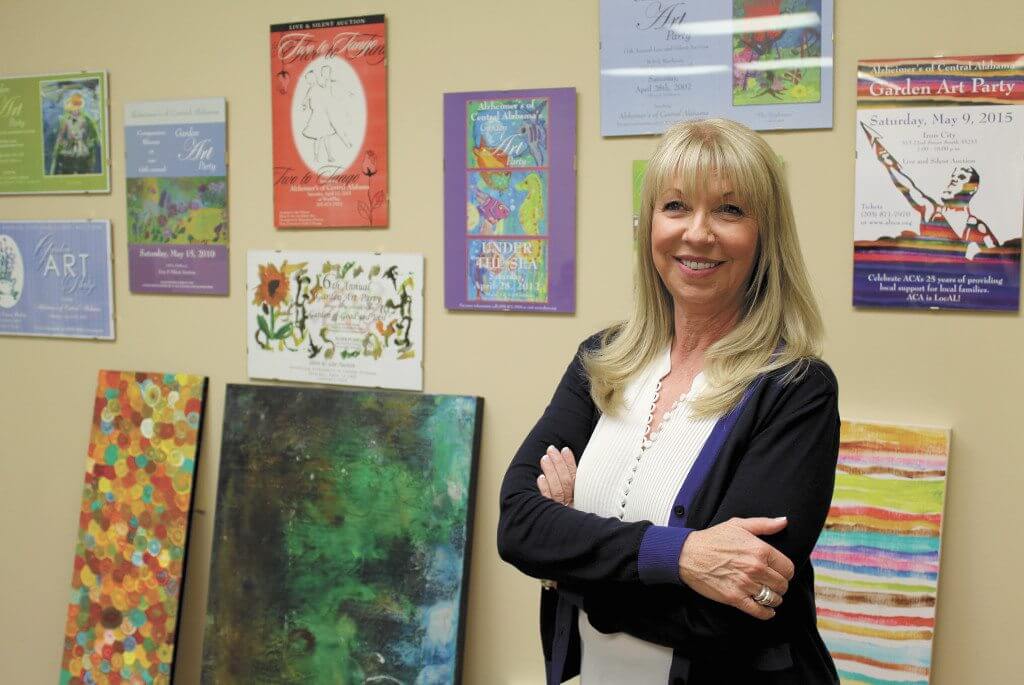
By Emily Williams
When Pam Arenberg was first introduced to Alzheimer’s of Central Alabama, it was a somber visit to one of the organization’s family support groups.
Her father had been diagnosed with vascular dementia, most likely due to a small stroke, and she found herself unprepared for the rapid deterioration of his mind and body.
“One of the best things about the support group is that you realize that you are not the only person going through this and that it is not so uncommon,” Arenberg said. “You also get a better idea of what’s down the road so you aren’t so shocked or alarmed.”
Flash forward to today and Arenberg is celebrating three years as the organization’s vice president of development. She still attends support groups, this time because her mother has Alzheimer’s. Though losing another parent to dementia is a tragedy, she found that the knowledge she gained through her father’s illness left her stronger for her mother.
“It was much harder with my dad because I was so unprepared,” she said. “To watch him lose his abilities so rapidly was a real shock.”
Both dementia and Alzheimer’s most notably strip the patient of their memories, but what Arenberg said she wasn’t prepared for was her parents’ complete loss of independence or self-sufficiency.
“Patients need care constantly,” she said. “A person with Alzheimer’s or dementia can’t be left alone because they can’t care for themselves. They don’t know whether they should sleep or shouldn’t sleep, whether they should eat or whether they shouldn’t or whether they should drink or shouldn’t.”
Arenberg said that one of her most enlightening realizations, found through the support group, was that even though she feels frustrated at times, she can’t place the blame on her mother.
“There is no way for me to make her remember that she asked me that same questions three times, because the knowledge simply isn’t there for her,” Arenberg said.
She has had to come to terms with knowing that certain family memories will be lost with the disease.
When her mother first received her diagnosis, she gave Arenberg a large box of family photographs.
“I wanted her to go through the pictures and mark down who was in the photos or where they were taken, but she just never got around to it,” she said. Arenberg later realized that part of the reason her mother couldn’t finish the project was due to the early symptoms of the disease.
“I had to come to terms with the fact that some of those memories are just gone. She was the person to carry on those memories, but they simply aren’t there anymore,” she said.
Though the notion seems and is tragic, Arenberg is still able to find the humor, holding fast to the idea that laughter is the best medicine. Though there is an ever-present realization that she is more of a parent to the mother who took care of her for so long, their relationship is still strong.
“She doesn’t remember why she doesn’t like me,” Arenberg said with a large smile. “The differences that we used to have or the arguments we got into have disappeared.”
ACA stresses that Alzheimer’s and dementia are “family diseases” that affect every member, and though her two sons live out of state, Arenberg’s family is no different. Her son who resides a bit closer to home has the opportunity to visit fairly often and stays heavily involved in his grandmother’s life.
“One of the great things is that even if he’s only home for four days, he goes to visit my mother every single one of those days,” she said. “I think that’s probably because he is connected to the fact that his time with her is limited.”
As of now, Arenberg said, her mother struggles with her family’s names.
“Even if she may not know my name, there is still that recognition when they look at you that says, ‘This is my person,'” she said. “One day that won’t be the case, so we have to take advantage of what is there right now.”
Another silver lining for Arenberg is the sense of community she has found in joining the ACA and the opportunities she has been given to change other Alzheimer’s families’ lives.
“I’m lucky in that I did not ever have to care for someone 24/7,” she said. “When my father was diagnosed, my mother was still well and was able to act as his caregiver.” And when her mother became unable to care for herself, the family had the means to provide her a residence at an assisted-living facility.
“It is important for me to give back to this organization because I realize how lucky I am in that both of my parents have had care. I can’t imagine what a struggle it is for people who don’t have that help,” she said.
In addition to providing lifesaver bracelets to protect patients who are prone to wander and scholarships for everyday supplies such as diapers and wipes, Arenberg said one of her favorite aspects of ACA is the adult day care scholarship. Regular mental stimulation slows the process of mental deterioration in patients, and adult day care provides that constant interaction through physical activity, artistic outlets and socialization.
“That is something that is life-changing for a patient and for their family,” she said. “It’s great for the patient because they get that stimulation and interaction, but it’s also great for the caregiver who gets a few hours to themselves.”
One aspect of ACA is its focus on Central Alabama and keeping support as close to home as possible.
“One of the best things about the organization is that for each dollar donated, 89 cents goes to the patients and the programs here in Central Alabama,” Arenberg said.
On May 7, the organization is celebrating its 25th anniversary at the annual Garden Art Party. The event will be held at Iron City from 7-10 p.m. and includes a live and silent auction. Tickets are $95 and the proceeds benefit the ACA’s many scholarship programs and services as well as medical research to find a cure for the disease.
For more information, visit alzca.org.