By Lee Davis
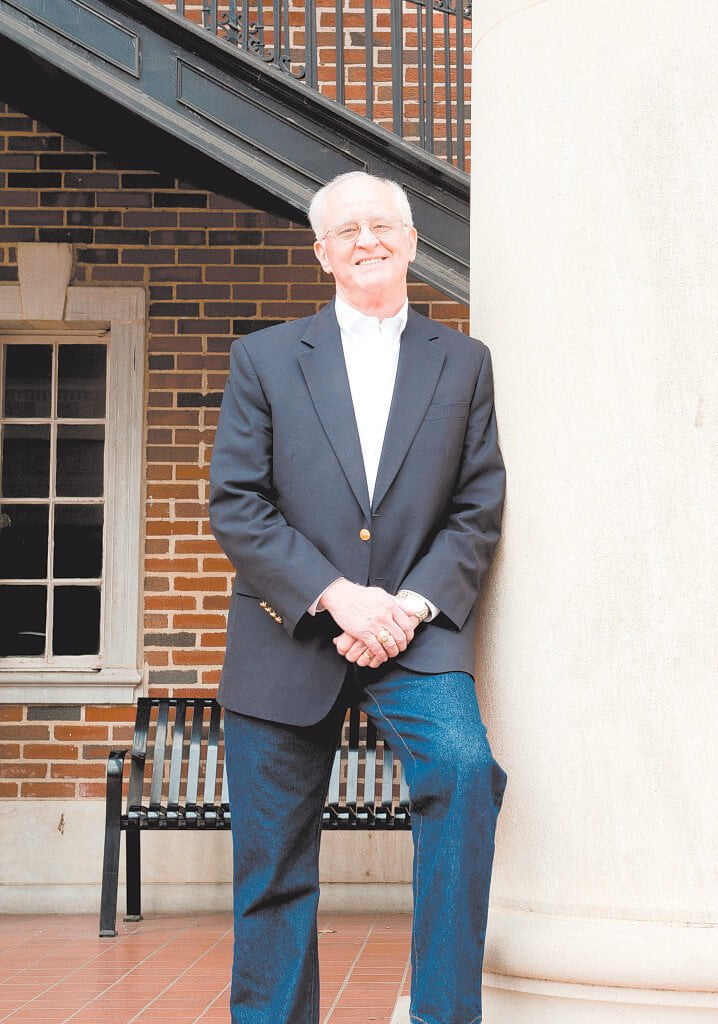
Jim Lawrence’s professorial looks and soft-spoken manner give him the appearance of a college dean or a teacher.
In fact, Lawrence has been both. But he is much more than that. The Vestavia Hills resident is a war hero – even though he disputes that description.
Lawrence, a Troy native, had just graduated from The Citadel in South Carolina when he decided to join the United States Army. Lawrence received his commission as a second lieutenant in March 1964 and joined the 2nd Battalion, 9th Infantry, 2nd Infantry Division stationed at Fort Benning, Georgia.
While there, he earned his wings from paratrooper school, often jumping from UH-1 Huey helicopters, which were being used extensively in America’s comparatively small but gradually increasing military role in helping its Southeast Asian ally, South Vietnam, halt communist aggression from the north.
“People have always asked me why I wanted to jump out of perfectly good airplanes or helicopters,” Lawrence recalled last week. “To me, I wanted to prove that I could do it. Being a paratrooper was a good way to learn how to deal with fear.”
A few months later, Lawrence’s 2nd Infantry Division was converted to the 1st Calvary Division, and he was named reconnaissance platoon leader.
After deployment to Vietnam, Lawrence was promoted to 1st lieutenant and was named executive officer of Delta Company in the early fall of 1965. To many Americans, Vietnam was still just an obscure spot on a map, but that was about to change.
Fate put Lawrence in the middle of one of the most significant battles in American military history.
The Ia Drang Valley was an area in South Vietnam just a few miles east of the Cambodian border where American troops first engaged with North Vietnamese Army regulars (PAVN) as part of Operation Long Reach.
The confrontation, which would become known as the battle at Landing Zone Albany (LZ-Albany), began in the early afternoon on Nov. 17, 1965, when U.S. forces came into a clearing. North Vietnamese troops, which had arrived from Hanoi via the Ho Chi Minh trail, launched an all-out ambush. Lawrence knew that they were in the fight of their lives. He couldn’t know that they would be a part of the bloodiest battle of the entire war.
“The enemy had the advantage of concealment and probably outnumbered us six to one,” Lawrence said. “Imagine a horseshoe. We were in the end of the horseshoe. The PAVN were in the trees and underbrush surrounding us. They hit us with all they had – grenades, mortar rocket fire, everything. We were sitting ducks. The North Vietnamese did their worst damage to us in the first couple of hours of the battle, or maybe even just the first few minutes.”
More than 50 years later, Lawrence vividly recalls the sights and sounds of the battle.
“There was smoke everywhere, and it was so loud,” he said. “There was the constant roar of gun fire and screams of agony.” The battle was graphically depicted in the movie “We Were Soldiers” starring Mel Gibson.
On that single horrific day, 155 American soldiers were killed and 124 were wounded. The North Vietnamese suffered even greater casualties.
Lawrence survived a wound causing a spinal injury that left him temporarily paralyzed.
“I spent the night on the ground and the next morning, our forces recovered me and the other wounded soldiers and collected our dead,” he said. “We thought the PAVN might come back, but they didn’t.”
Lawrence was transported to Clark Air Force Base in the Philippines, where he underwent two months of rehabilitation before resuming his tour of duty.
The battle was a turning point in the conflict, as it convinced North Vietnamese leader Ho Chi Minh that his country could win the war. In the United States, the battle brought the realization to President Lyndon B. Johnson and the nation that the Vietnam War would be long and difficult.
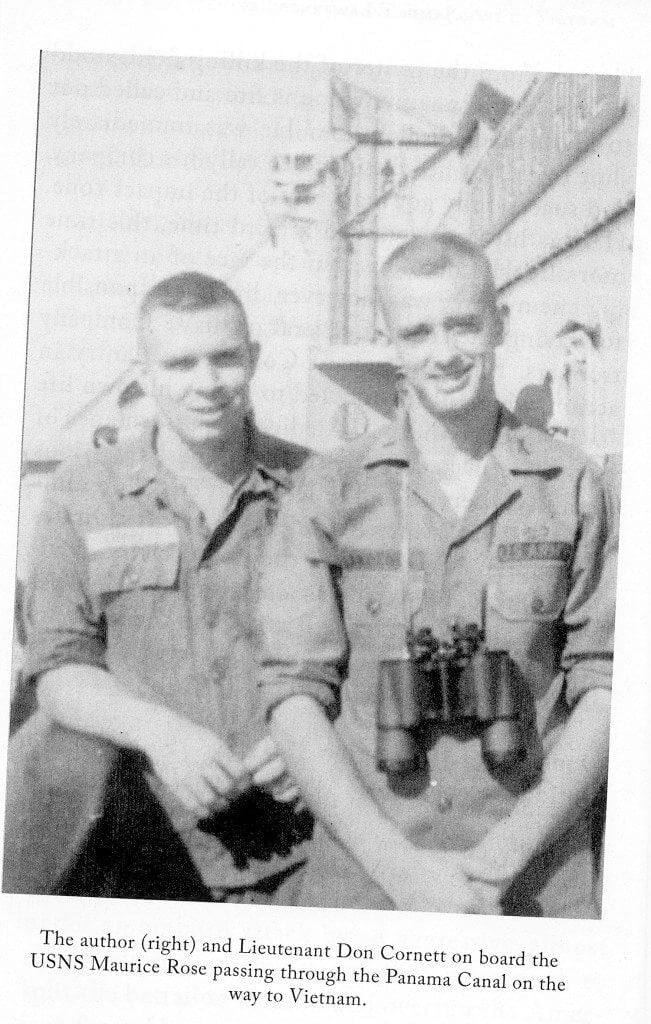
For Lawrence, the battle’s outcome had a far more personal impact. His best friend, Lt. Don Cornett, the executive officer of Charlie Company, was killed in action.
“Don Cornett was, and still is, one of the finest men I have ever known and to this day one of the best friends I ever had,” Lawrence said. “We were roommates in the Infantry Officer Basic Course, roommates in the barracks at Lawson Field, roommates on the troop ship going to Vietnam and the greatest of friends until his untimely death.
“Don represents the real tragedy of any war,” Lawrence continued. “There’s no telling what this man would have accomplished had he lived. He had uncanny abilities of leadership and friendship. He might have been a governor of a state or a CEO.”
Lawrence writes extensively of his friendship with Cornett in his 2014 book, “Reflections on LZ Albany – The Agony of Vietnam.”
Cornett’s death still has a profound effect on Lawrence even after more than five decades.
“When people go to the wall at the Vietnam Memorial, they see 58,000 names,” he said. “I see Don Cornett’s name 58,000 times. One of the horrors of war is that every single name on that wall had a mother, a father, a wife or a sister or brother. They all had relatives and friends. That’s true of the Americans, and it’s also true of the North Vietnamese that we killed.”
Although a strong believer in our nation’s military, Lawrence feels called to be a peace advocate.
“I believe God kept me alive at LZ Albany to spread the message that war should be avoided unless absolutely necessary,” he said.
In 1967, Lawrence was named the First Alabama Veteran of the Vietnam War by Gov. George C. Wallace and the Alabama American Legion.
As demonstrations against the war escalated in the late 1960s, Lawrence said, he never resented the protesters.
“I’ve got to admit that while most of us didn’t admire Jane Fonda, the right to protest was one of the things we were fighting to protect,” he said. “We are a nation that values freedom.”
Lawrence insisted that he’s not a hero. “The true heroes are the ones who died,” he said. “Memorial Day is for them. I was just doing my job like the rest of us. We should remember those who didn’t come back.”
After returning home, Lawrence enrolled in the University of Alabama and graduated with a master’s degree in English in 1973. He taught composition and literature and served as an associate dean in the school of Arts and Sciences before entering a career in real estate in 1978.
Lawrence joined Johnson Rast and Hayes in 1978 and earned awards as a top salesman. In 1992, he joined with Keith Arendall and Maurice Humphries to form Lawrence Arendall and Humphries (LAH), which grew to be the second-largest realty company in Alabama. Lawrence was named Birmingham Area Realtor of the Year in 1989 and was president of the Birmingham Board of Realtors in 2007. He sold his portion of the business four years later.
At 75, Lawrence shows no signs of slowing down. He regularly travels across the state, teaching real estate for the University of Alabama-based Center of Real Estate. Whatever he does, the memories of the Vietnam War, the Battle of LZ Albany and Don Cornett are never far from his thoughts.
“To this day, I’m haunted by the battle,” Lawrence said. “And I’m absolutely convinced that the American fighting man and the armed forces of the United States of America comprise the best fighting force in the world. There is something inside us that makes us proud, patriotic, resolved and dedicated to defend freedom and fight for what is right and good.”
The cherished memories of Lt. Don Cornett and other countless brave Americans who died in combat are honored in the lives of patriots such as Jim Lawrence.