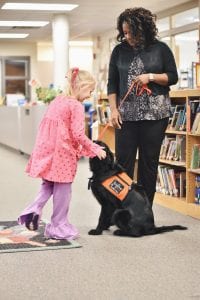
Two Homewood schools are welcoming furry friends to their hallways and classrooms this semester.
Maize, a year-and-a-half-old lab and retriever mix, joined Hall-Kent Elementary School earlier in January as a facility dog. Russel, a 2-year-old black lab, is joining Shades Cahaba this week.
“They can help reduce anxiety, feelings of loneliness, depression, all those things,” said John Lowry, principal at Shades Cahaba. “A lot of the negative emotions our kids sometimes bring to school, the facility dog can be there to comfort and help those kids. And we want him to be available to as many kids as possible.”
Leigh Cohen Long, director of guidance at Homewood City Schools, brought up the idea of having a facility dog for schools in Homewood at a principal’s meeting last spring.
“The idea of having a dog that’s a faculty member that works here every day and she can touch more lives – I was really intrigued,” said Kiana Coleman, principal at Hall-Kent.
Before she applied for a facility dog at her school, Coleman wanted to see one in action. She visited Elmore County, where a facility dog works in a school. She said she loved how excited the students were to see their dog, Popcorn, come into the classroom, and she was sold on the idea.
Lowry also visited schools to make sure a facility dog would be a good fit for Shades Cahaba.
“After seeing them in action and seeing how both kids responded and hearing the effects it’s had on their academic and behavioral successes, we decided we were ready to apply,” he said.
Facility dogs are different from service dogs. While a service dog has a 1-on-1 relationship with its human, a facility dog has additional training to serve an entire school. Service dogs typically wear vests asking others not to pet them, but the students at Hall-Kent and Shades Cahaba will be encouraged to pet Maize and Russell in the appropriate settings.
Hall-Kent was the first Homewood school to get a dog on staff. Because Coleman is Maize’s handler, the two live together, and Coleman said Maize is adjusting to life at school well.
“She loves it,” she said. “She loves when I say, ‘Get ready!’ … She turns, walks and gets ready to put her vest on.”
Maize has a few tricks up her sleeve. She can sit, shake and lie down. When students want to pet her, Coleman tells Maize to sleep. This way, students can feel comfortable, even if they don’t often interact with dogs.
“I’ve had students tell me, ‘Maize makes me so happy when I walk in the door every morning,’” Coleman said. “They beg for her to come to their classrooms and be with them. She’s just a rock star.
“She’s so happy. She likes to lick, so we’ve been working on that with the kids, telling her to leave it. And her trainer was here last week, and she said, ‘It’s just because she’s so happy.’ She loves the interaction,” she said.
Because the teachers are still getting used to handling a facility dog, Maize is usually by Coleman’s side. She walks Maize through the building and visits classrooms. Coleman’s office is right next to the counselor’s office, and she will take Maize by if she hears a student upset or crying.
“And even if they’re like, ‘I just want to be by myself right now,’ eventually they start to pet her,” she said.
In the future, Coleman said, she would like for Maize to be on a rotation to help with counseling and test anxiety.
Lowry said he is excited and nervous for Russell to move into his home this week.
“I’m thrilled to death,” he said. “Very excited. A little nervous because it is so new and different and will be an adjustment for the dog, for our kids and for me at my home as well. … My wife and 7-year-old are really excited, especially my 7-year-old.”