By Ingrid Schnader
“My kid’s not going to do that.”
Mike Vest, executive director of the Addiction Prevention Coalition, said he is one of thousands of parents who thought that about their children; they’re not going to get involved with drugs or alcohol.
That is, until his 17-year-old son came home eight months ago with a JUUL, which is a nicotine vaping device popular among teens and young adults.
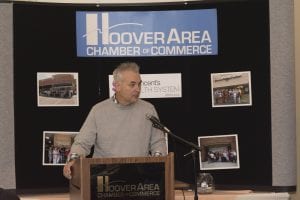
Vest found the development particularly alarming because he’s spent his whole life surrounded by addiction. As keynote speaker at the Hoover Chamber of Commerce Luncheon on Oct. 17, Vest told the room about how his father was an alcoholic, just like his father before him. Vest’s father ended up leaving his family.
“My dad didn’t leave our home because he didn’t love us; he was an alcoholic,” Vest said at the luncheon. “My mom couldn’t take it. When he got paid on Friday, he went to the bars and spent it all, so how was he going to take care of two kids?”
One day, Vest found his dad sleeping in his car behind the Southern Museum of Flight in East Lake. He talked to him and told him he forgave him.
“My life’s been so much better without you, and don’t take that the wrong way, but when you left in ‘75, my whole life changed positively,” he remembered saying to his father.
Vest’s brother was affected differently, though. Their father left at a time when Vest’s brother needed a father figure in his life.
“I found my brother in 2010 in downtown Birmingham, Uptown, walking down the streets,” he said. “He was hooked on crystal meth for 35 years.”
Even Vest’s nephew has struggled with addiction and is currently in jail. But Vest said that’s a good thing, all things considered.
“Why is that so lucky?” he said. “Because I know where he is. I know he’s got food. I know he’s got a place to sleep. I know he’s not doing drugs.”
A Message of Hope
“I’m not trying to make this a depressing thing,” Vest said at the luncheon. “I’m trying to find you guys some hope.”
The Addiction Prevention Coalition is a group of people who help those who need to be in a treatment facility get there. He said recovery is attainable if addicts want it.
When Vest found his dad sleeping in the car, he asked him how he could help. His dad was having trouble getting an apartment; there was an apartment in Springville that was only $200 to $300 a month, but he didn’t have any credit, and they wouldn’t let him in.
Vest talked to the apartment manager and convinced them to let his father move in. But if his father missed just one rent payment, they said he would get kicked out.
He moved in three weeks later, and he lived there until he died.
“My dad paid his rent for seven years on the first of the month at that apartment complex,” he said. “All he’d needed was a chance.”
But when Vest’s dad found out he had leukemia, he couldn’t put the bottle down to take his leukemia medication. So he died on his recliner in that apartment. He had been drinking since he was 9 years old.
Vest was able to help his brother for a while, too. After he found him on the streets, he took him to The Foundry Ministries, which helps addicts recover. He spent a year and a half there getting treatment before he graduated and got a job, a car and a place to live.
He was clean for about three years before he died of a heart attack three years ago.
“But God gave him one last chance, and he took it,” Vest said. “It takes a lot of guts to say, ‘I need some help.’ It took him 35 years, but he did it.”
Finding a Solution
Ever since his son came home with a JUUL, Vest started buying drug, nicotine and alcohol tests.
“I’m the bad guy,” he said he told his son. “You tell those guys and girls who want to do that, ‘My dad will kill me. He’s going to drug test me when I get home.’”
Vest said that this way, his son can use him as a scapegoat when he needs an excuse not to succumb to peer pressure.
“I’m not my kids’ friend,” Vest said. “I’m not my kids’ friends’ friend. I’m a dad. I saw it for 40 years in my life.”
Many teenagers start their opioid addictions from taking doctor-prescribed medicine after a sports injury or wisdom teeth removal. Vest encourages parents to find an alternative way of pain management.
“I say don’t give them opioids,” he said. “What else can we do? We take four Tylenol, four ibuprofen, four Tylenol, four ibuprofen, et cetera, et cetera. I’d rather do it that way.”
Getting training in Narcan could also help parents save their childrens’ lives. This nasal spray can reverse an opioid overdose, and Vest said that more than 700 people in the past two years have received this training at the annual End Heroin walk in Birmingham.
In July of 2018, one mother who had attended the Narcan training the previous year called Vest to tell him that she had been able to bring her daughter back to life by using what she’d learned.
He told this story to the crowd at the 2019 End Heroin walk and felt a tap on his shoulder after he’d walked off the stage.
“She goes, ‘I’m the mom you just talked about,’” he said. “Boy that was exciting. Not only that, she goes, ‘And right here, this is my daughter.’
“She’s alive and well thanks to Narcan training,” Vest said. “So we have one person out of 700. That’s fine.”
The Addiction Prevention Coalition also has peer-led student chapters in 15 high schools, giving students an outlet to talk about whatever topics are on their minds. This may be JUULing, nicotine or alcohol. Vest said one girl even wanted to talk about sex trafficking.
“It’s just not about smoking a joint that causes these kids to get involved in drugs and alcohol,” he said. “It’s certain things in their lives that no one knows about.”
For more information on the Addiction Prevention Coalition, visit apcbham.org. Those who need help finding recovery should call the Recovery Resource Center at 458-3377.