One of my earliest childhood memories is waiting outside of my dying grandmother’s bedroom while my parents stood at her bedside. She battled breast cancer long before we knew about early detection and cancer typing.
In my early 20s, I had three benign breast tumors surgically removed.
One of my sisters, at the age of 40, was diagnosed with Stage 1 breast cancer.
In my late 40s, I detected a lump through self-examination. After a mammogram and an ultrasound, the spot was labeled a mass. By this point in life, I had learned to brace myself for yearly mammograms, aware of my increased risk based on family history. Biannual ultrasounds were prescribed to monitor the fibroid.
At age 53, I told my gyn that I feared the lump had grown in size; the mammogram detected a large tumor. More testing led to diagnosis: Stage 3 estrogen/progesterone positive breast cancer with lymph node involvement.
I’ve been in the interior design business most of my adult life. I love the creative process and enjoy long-term client friendships. When I was diagnosed with breast cancer, my first instinct was to put my career on the back burner. However, a dear friend who preceded me in fighting breast cancer, advised me to continue working at a reduced pace.
Thankfully, she understood that staying engaged with people would likely play a vital role in my well-being.
My family, friends and clients surrounded me with love and support in ways that made the journey a surprisingly sweet season. When science looks you square in the eye and says “Stage 3 cancer,” your true values become crystal clear. My faith in God and my relationships with people rose to the top.
My clients extended flexibility to tackle design needs on my good days and the luxury to rest on bad days. My friends made a schedule of escorting me to treatment, which they entitled: Sally’s Spa Days.
Staying engaged with people and creating beauty were healthy distractions for me. It’s natural for health to become a consuming preoccupation when you’re given a diagnosis; however, relationships carried me over dark days. Numerous kindnesses, which I considered “daily manna,” looked like my favorite coffee order, cards drawn with crayons and flowers left at my door.
I went to St. Vincent’s for treatment. We have always used St. Vincent’s doctors. My St. Vincent’s gyn and several physician friends paved the way for my first oncology consultation with Dr. John Piede.
At my initial appointment, Dr. Piede looked right in my eyes while confidently explaining the path forward. I instinctively knew that he was the person I wanted to guide my fight.
My treatment included five months of chemo … a bilateral mastectomy … eight weeks of radiation … and reconstruction surgery. A team brought their medical expertise to the equation and caringly walked me through each step.
I am forever indebted to Dr. John Piede, Dr. Susan Saulter, Dr. Tim Bullock and Dr. Al Cohn. Each individual at the Bruno Cancer Center, from the lab techs to the nurses to the valet drivers showed true kindness and I thought, “Oh wow, these people were made for this.”
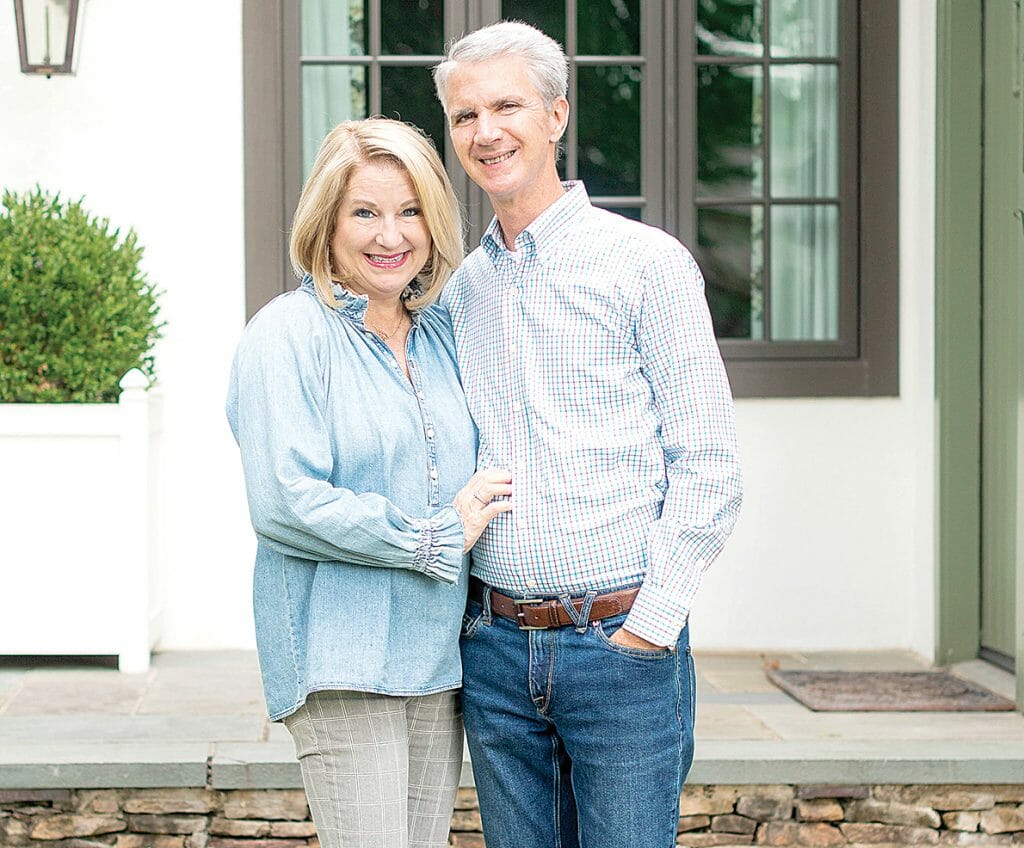
Of course, my husband, Ben, was my biggest side-line encourager. There were times when I stayed in the bed all day, but the haul felt bearable with him by my side.
However, an unexpected “plot twist” came when he decided that our leaf-covered yard needed some attention, too. I knew he had gone outside to blow leaves but never imagined that he might tackle the roof. A horrible-sounding “thud” led to me finding Ben, who had fallen 20 feet from the roof onto the concrete driveway.
Our dearest neighbors quickly came to my aid as the harsh reality set in that my biggest supporter had been sidelined. Miraculously, he suffered no head or spinal-cord injuries, but complex breaks in multiple bones required numerous surgeries, weeks of rehab and three months of confinement to a wheelchair.
A hard season of suffering had just gotten harder. Since my immunities were depleted, I could not stay at the hospital with my husband. Our boys immediately came home. In an epic role-reversal, Benjamin and Andrew stepped in and heroically alternated between staying with their father in the trauma center and their mother in chemotherapy.
Ben and I simultaneously experienced the fragility of life and health and the blessing of living in a world-class medical community. While life is cursed with disease and accidents, there are steps we can take toward preserving our health such as routine screenings and life-style choices. In my case, a postponed mammogram might have differentiated between a treatable versus a terminal diagnosis.