By Rubin E. Grant
Kevin Kozak was in elementary school, growing up in the northern New Jersey township of Old Tappan, when a musical quartet came to perform and he heard someone play a brass horn for the first time.
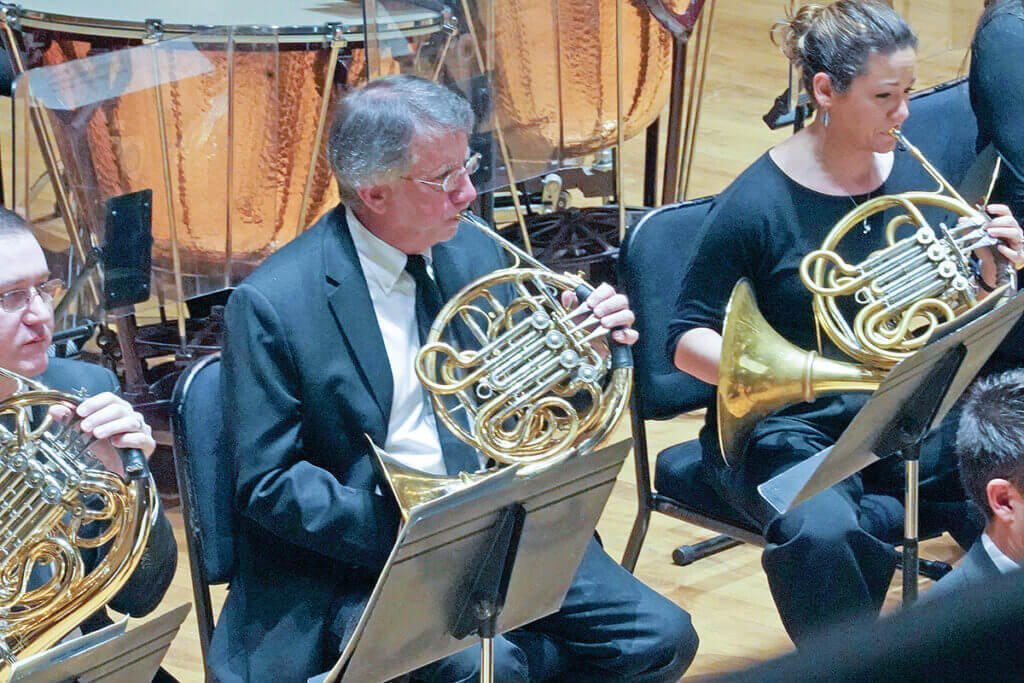
He loved the sound of it, but little did he know it would become his instrument of choice and he would play the French horn for decades in the Alabama Symphony Orchestra.
Kozak joined the ASO in 1981 at the age of 25. Now 67 and a resident of Homewood, he is one of three senior members in the orchestra. Percussionist Bill Williams and harpist Judith Sullivan Hicks also joined the ASO in 1981.
Although Kozak grew up in a music-loving family and has always been interested in music, he didn’t start playing until he was 14, during his freshman year in high school. It became his passion.
Following high school, he attended the Manhattan School of Music in New York, earning a Master of Music degree. He also was a winner of the school’s concerto competition and a recipient of the George Schick Award for Outstanding Musicianship.
After graduation, Kozak freelanced for a year in New York City before winning an audition for a position in the Alabama Symphony, one of only about 60 full-time professional orchestras in the United States. He is the second horn of the symphony.
Kozak also has performed, recorded and toured with the Atlanta Symphony, St. Louis Symphony, North Carolina Symphony and the Nashville Symphony. His performances include eight recordings with the Atlanta Symphony, as well as recordings with the St. Louis and Nashville symphonies. He has performed in Carnegie Hall with the Atlanta Symphony, St. Louis Symphony, American Philharmonic and the Alabama Symphony.
In addition to orchestral performances, Kozak has been active as a studio musician in Nashville and Atlanta, where he has recorded the theme music for CNN, Wimbledon, Imax Theatres, movie soundtracks and local news, as well as commercial recordings of religious and popular artists. He has performed throughout the United States and Eastern Europe.
He has been featured as a soloist with the Alabama Symphony, Montgomery Symphony and the Eastern Philharmonic.
In 2009, he toured the Baltic nations of Latvia, Lithuania and Estonia with the Trinity United Methodist Brass Quintet, which performed in churches, schools and public squares throughout the region.
Memorable Performance
Kozak’s most memorable performance, however, came with the ASO after he had a health scare.
“A number of years ago I had a medical issue in which one of my cerebral arteries spontaneously tore,” he said. “I was hospitalized for a bit, then put on medical leave from the symphony for six weeks in order to let the artery heal.
“One of my first concerts upon my return to the symphony was Gustav Mahler’s Symphony #9. Mahler was an Austrian composer of the late 19th, early 20th century. His ninth symphony is a complex and very beautiful paean to the human experience of living and the joy and pain that is often present in our lives.
“After a bit of a near miss, this piece particularly resonated with me. Although Mahler spends some time in this piece ‘raging against the dying of the light’ he also expresses in the most beautiful manner an appreciation of life’s beauty, and that is what I hung on to.”
Kozak took special delight in the audience being in tune with the performance.
“I knew the audience was with us on this journey,” he said. “The piece ends very quietly, so softly that the end is barely perceptible, and the audience remained absolutely quiet for quite a few seconds before applauding.”
Kozak believes symphonic music is some of the most impactful and meaningful music to listen to.
“I think people often have the wrong idea about symphonic music – that it is formal, or stuffy, or that you need some depth of knowledge in order to understand or appreciate it,” he said. “None of that is true. The music finds you where you are. It is a visceral and engulfing experience, full of color and action. To hear a melodic line dart across the orchestra and follow the sound with your eyes is one of the many joys of seeing a live orchestra concert. To hear a large group of people working collectively and individually to produce a cohesive whole is akin to watching an athletic team execute a brilliant play.
“To experience music that transcends time and manages to communicate human to human, without screens, amplification, electronics or special effects – well, that’s something not to miss.”
The ASO will give two live performances of composer Bernard Herrmann’s spine-tingling score from Alfred Hitchcock’s timeless thriller Psycho this month at UAB’s Alys Stephens Center in the Jemison Concert Hall. The performances of Psycho Live with Orchestra are set for Oct. 20 at 7 p.m. and Oct. 22 at 2:30 p.m.
Year-by-Year
Throughout the years Kozak has taught music. He has been on the faculty of the Eastern Music Festival in Greensboro, North Carolina, UAB and the University of Montevallo. He is presently a faculty member of Samford University and the Alabama School of Fine Arts. Additionally, he serves as the director of the Chamber Choir at St. Peter the Apostle Catholic Church in Hoover.
Apart from musical activities, Kozak is an avid woodworker. He and his wife, Sophie, who is a church singer, have been married for 39 years. They have two sons, Michael and Thomas, and two grandchildren, a girl and a boy, plus, Kozak said laughingly, “a mostly bonkers golden retriever named Chloe.”
During his time in the ASO, Kozak has witnessed musicians come and go, but the level of professionalism always remains.
“This is my 42nd year and different people have joined,” Kozak said. “An orchestra has personality and values, the ones who have joined are very serious and disciplined. They take pride in it, esthetically and in presentation. It has continued in the same manner.”
Kozak hasn’t decided when he will play his last concert with the ASO.
“I think I’ll probably play for a few more years, but I’m taking it year by year,” he said.