By Susan Swagler
As an interior decorator, Mary Finch is used to creating beautiful, comfortable, livable rooms. So, it made perfect sense for her to do the same with her garden – especially since the walls were already there.
When Finch and her husband, Ed, bought their Redmont Park home in 2003, the 1.5-acre property was overgrown with wisteria, kudzu and privet. Once that was gone, they found a wealth of walls and walkways and terraces, and this became the framework for a series of outdoor spaces with structure and scenic views; sculpture and antiques; and plenty of places to eat, drink, play and relax.
“This was an open slate,” said Finch, who had come to Birmingham from Montgomery with lots of ideas and several cherished pieces of antique outdoor décor. “As a decorator, your mind starts thinking about how to use what you have. When people walk into my house, I like for them to instantly feel at home, comfortable,” she said. “And even though parts of this (garden) are a little more formal, I like for them to feel like they are at home. Like they can enjoy themselves. They can play, they can eat, they can look.”
Finch enlisted the help of noted Birmingham landscape architect Norman Kent Johnson, and these friends of friends became friends themselves and set out on a decades-long partnership in this garden.
“I knew about Norman before I came up here,” Finch said. “We clicked from the beginning, and this was a pleasure to put into place because we thought alike. He listened to me, and I listened to him.”
The house itself is historically and architecturally interesting. It was designed in the 1920s by noted Birmingham architects Miller & Martin. Johnson describes it as a jewel box.
“I’d never seen this house before,” he said, “and I mean it was just complete and total ‘socks blown.’ I said, ‘Oh my God, this is maybe one of the most romantic houses in all of Birmingham.’ And the astonishing gift was – we’ve covered up a lot of the bones now actually – but you can see where the concrete walls are. They are original to the house.
“It was humbling, but it also was informative,” he said. “It was very immediately clear that we are merely part of a precedence, of a sequence. That somebody came before us and gave us such an amazing gift of the bones of this garden – the finest bones. I don’t know of another garden in Birmingham where the bones are any finer.”
Finch and Johnson have replanted the entire garden in the 20 years they’ve partnered, working around enormous 100-year-old boxwoods, honoring the original footprint.
The front garden, hidden behind hedges, is naturalistic, almost Arcadian. Varieties of spiky mahonia contrast with the smooth, sloping lawn. There’s a sculptural specimen vitex framing the front door. A small space for grilling outside the kitchen door has an intimate seating area in deep shade. It feels like a country place.

Rooms That Are the Views
By contrast, the rest of the property consists of walled and terraced spaces that create more formal and entertainment-ready spaces, almost like outdoor rooms furnished with sculptures, a water feature, antique urns and benches, dining areas, comfortable seating and shade.
Finch’s favorite place is the large, paved balcony off the home’s formal and family living rooms with its deep, comfortable seating beneath huge umbrellas, views of the side and back of the property as well as a sweeping panorama across Shades Valley to the ridges beyond.
Directly below the balcony patio, lush beds of Lenten roses – with a lone, insistent white peony poking through – offer subtle color and texture and soften a formal bowed parterre of boxwood. Form and function come together with heat-resistant, low-maintenance gaura planted in beautiful, antique white terra-cotta urns from the Galloway Foundry in Philadelphia. These, along with Japanese maples, anchor this formal space. Irises and lamb’s ears grow along the borders.
Below this garden is a tidy crescent that Finch calls her “farming” area, with apple, Asian pear and fig trees, blueberry brambles and wild strawberries. Beyond, you’ll see a neat “wilderness” of ornamental trees and grasses, all enclosed by towering hollies and magnolias.
There’s an open lawn on the side of the house, framed with walkways made of stone from the property, box hedges and a small allée of potted trees. Dining tables and chairs are ready for al fresco entertaining. The far wall of the garden offers the hint of another view.
Tucked below this level is a walled and hedged enclosure with a bocce court. Courtside chairs and benches, a games table and potted shrubs fill this fun, almost-secret space.
This is a green garden; there’s very little floral here.
“This is the only way I would do it,” Finch said, “because I don’t want to spend that much time and energy. I love green gardens.”
It’s green year-round, but in winter, the sculpture of the bare trees is what you’ll notice. In the fall, the golden rain tree shines.
Finch’s garden will be open for touring as part of the Garden Conservancy Open Days program Saturday from 10 a.m. to 4 p.m. She said she hopes visitors are inspired by what they see.
“One thing I like when I go places, I like to see something that’s doable. … I don’t like to be so overwhelmed,” Finch said. “This could be done on any kind of scale. It could be much grander, or it could be less, and it’s not that hard.”
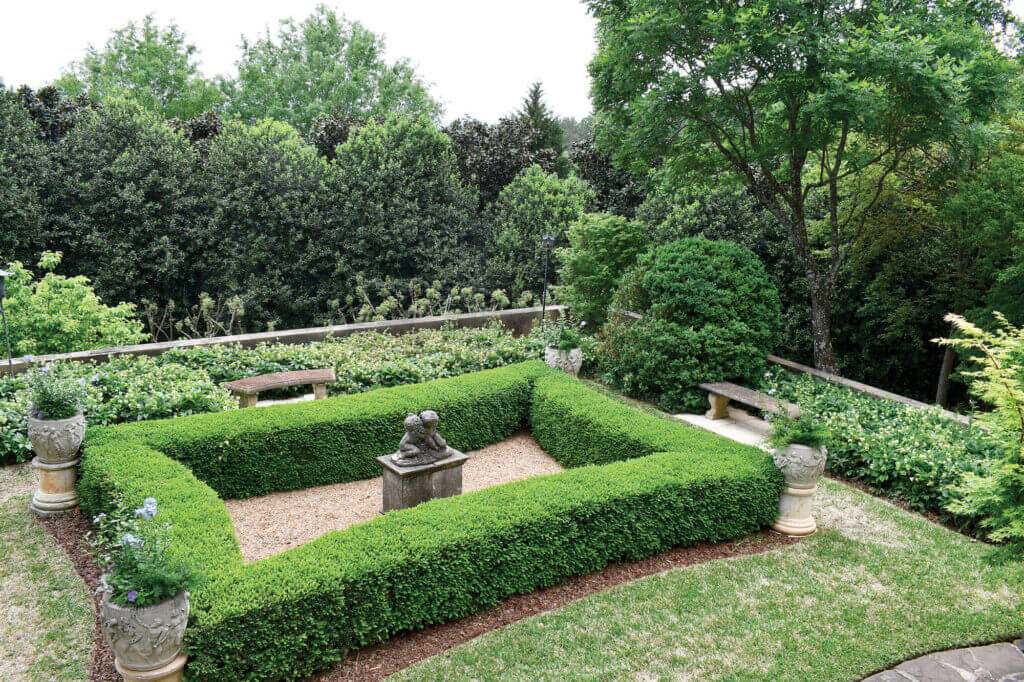
A Garden Is Never ‘Finished’
In the two decades that Finch has owned her garden, she and Johnson have worked on nearly every inch. Years ago, they planted magnolias and hollies in anticipation of development, and now she enjoys deep green privacy. As temperature extremes have affected the garden, they have added new and different plants that will weather changes better.
“So much of what we’ve done here has been evolutionary,” Johnson said.
When blight decimated her 100-year-old boxwoods, Finch and Johnson replaced them with Japanese maples and a beautiful styrax with its perfect little bell-shaped flowers.
“Almost instantly I started liking the change,” Finch said, because it opened up the garden. When the vitex broke their Italian pots in the dining garden allée, they cut out the bottoms of the pots, reinforced them with iron bands, moved the vitex elsewhere and replaced them with crepe myrtles.
“I think I can speak for my friend,” Johnson said. “We’re both very romantic, but we’re very pragmatic about a lot of stuff. Like when the boxwoods started dying, we said, ‘No, we’re not going to spend a billion dollars to airfreight in gigantic boxwoods to replace them.’ Because they could probably get the same thing and be gone quickly. So, what is our responsibility as the inheritors of this garden?
“It’s her garden,” he admitted, “but Mary is letting me play, and I feel very proprietorial about it, I guess.”
They will never be done, and that’s OK.
“You come with ideas and aspirations,” Johnson said, “but there’s also kind of always the ‘get back, Loretta.’ Reality slaps you in the face. The boxwoods get a disease, the vitexes break the pots, there’s a view to screen that we didn’t know we needed to screen 10 years ago.
“Mary is a good gardener,” he continued. “She has a gardening heart, soul, sensibility. Gardening is a continuous exploration. … In a garden, when the holes are dug and the plants put in it, you’re just getting started.”
“I compare it to interiors,” Finch said. “If you buy good things, you can move them all around the house and it looks great. Same thing out here. How many things have we dug up, taken them somewhere else and they’ve thrived … . We’ve done our share of moving around. And we have good dirt.”
“It’s not that you’re trying to reach a point,” Johnson said. “That point does not exist. There is no end; contentment is the process. The end is merely where you happen to be right now.”
Mary Finch’s garden, with its views, structure and sculpture, is just one of four private Birmingham-area gardens that will be open for rare tours during the Garden Conservancy Open Days program Saturday from 10 a.m. to 4 p.m.
Admission is $5 for Garden Conservancy members and $10 for non-members. Tickets are available at gardenconservancy.org/open-days.
The idea behind Open Days is to introduce gardeners of all levels of experience to a diverse range of garden types, sizes and traditions. Since 1995, Open Days has welcomed more than 1.4 million visitors into thousands of inspired private landscapes – from urban rooftops to organic farms, historic estates to innovative suburban lots – in 41 states.
Experience Four Gardens in Open Tours
On Saturday, visitors can tour:
• Louise Wrinkle’s Southern Woodland Garden: On Wrinkle’s 2 acres, which she designed with Norman Kent Johnson, visitors will see a variety of garden areas including a sunken boxwood parterre framed by a Belgian fence of native crabapple, a cutting garden and a natural brook that flows all year. Follow a network of paths and small stone walls and experience a thoughtful horticultural history that began with natives and extends to colorful Asian counterparts.
• The Butrus Garden: An Italianate garden surrounds a grand house of gray limestone in the middle of a 4-acre mature woodland space. The emphasis is on greenery, stone and water. Look for an antique fountain, many private nooks for entertaining, a greenhouse the stone base of which matches the house, an antique copper female figure, and a new woodland garden designed by Johnson.
• The Dancer: On the down slope of Red Mountain, a 1930s Tudor-style house is home to a beautiful, small garden inspired by water, a ballerina and roses. The space is about 2,100 square feet – 35 feet by 60 feet – and features two garden “rooms.” The fountain garden is centered on the home’s renovated kitchen’s steel-framed glass doors. Adjacent to the fountain garden is the rose/sculpture garden, centered on the living room. A display terrace for a beautiful, 8-foot-tall, bronze ballerina sculpture is surrounded by four Winter King Hawthorns with a colorful, fragrant rose garden beyond.
The tour is part of a larger weekend celebration of local gardeners, including Wrinkle, who is a nationally known proponent of native gardening.
The Garden Conservancy’s latest documentary film, “A Garden in Conversation: Louise Agee Wrinkle’s Southern Woodland Sanctuary,” premiers Sunday at 3 p.m. at the Virginia Samford Theatre. The film explores the ideas of preservation and conservation and Wrinkle’s own gardening philosophy of “letting plants develop as they will and tend to them in a way that highlights the subtle beauties of texture, rhythm, pattern, repetition.”
After the screening of the documentary, there will be a panel discussion on Southern gardens, native plants and conservation with local and regional garden experts.
Wrinkle’s book “Listen to the Land: Creating a Southern Woodland Garden,” has been reprinted and there will be a reception and book signing following the film and discussion.
This film and book event is free, but registration is required. Go to gardenconservancy.org to register.