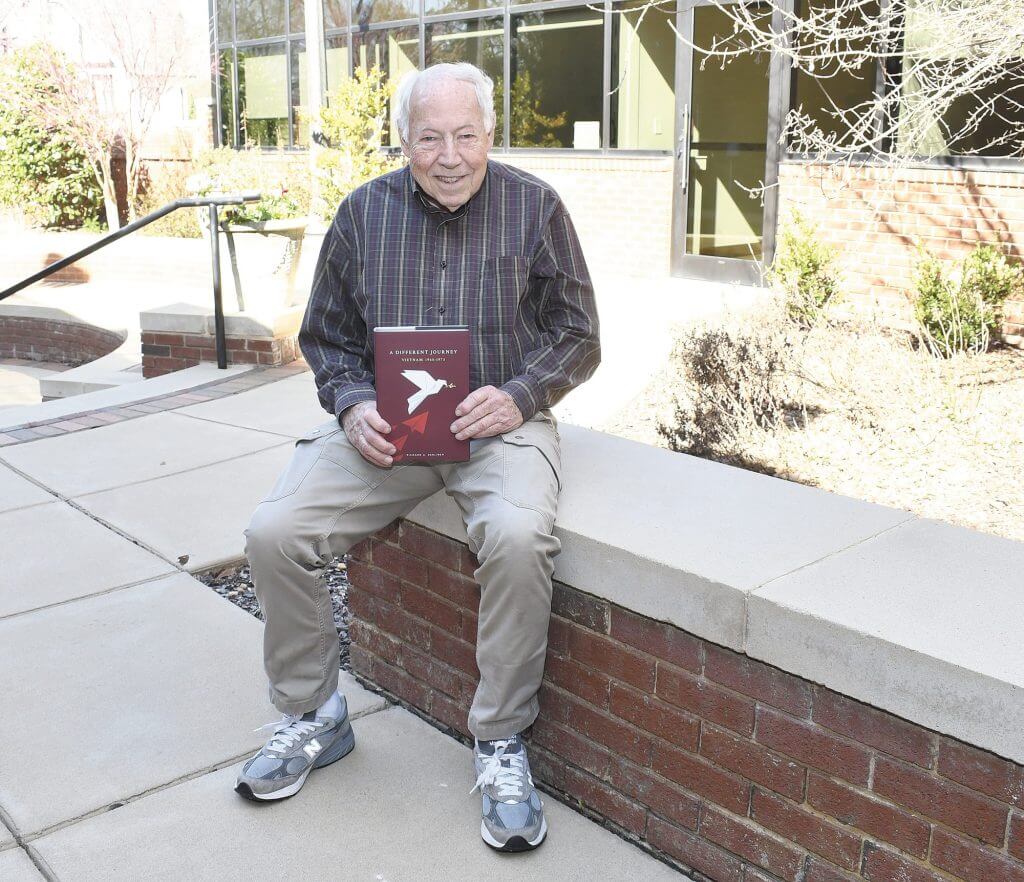
By Barry Wise Smith Photo by Jordan Wald
Richard Berliner grew up in a quiet suburb in Maryland, outside of Washington, D.C., in a family that discussed politics at dinner. Both of Berliner’s parents were journalists having met while working at the same Massachusetts newspaper, and his father spent his career covering Capitol Hill as a reporter. “I grew up in a political family,” Berliner says. “It was part of our discussions around the dinner table. But most importantly, because my dad was a writer, he insisted that we wrote accurately, clearly and well.”
When it came time for Berliner to go to college, he chose Earlham College, a small liberal arts school in Richmond, Virginia, founded by Quakers with an educational philosophy rooted in peace and social justice. As a student in the 1960s, Berliner was drawn to the conflict in Vietnam, and while he was intrigued by the country and the political reasons behind the war, he knew he didn’t want to fight and also didn’t want to be a conscientious objector. So, after his graduation in 1966, Berliner joined International Voluntary Services (IVS) and went to Vietnam as a humanitarian volunteer.
Once in Vietnam, Berliner began writing and sending letters home to his parents, who insisted that he write home weekly. “Because of whom my parents were, they wanted details,” Berliner recalls. “They didn’t necessarily want to know if I was healthy, safe or eating well, they wanted me to describe the five senses as best I could.” So, throughout his time in Vietnam, Berliner obliged, sending letters at every stage of his service. “The more I traveled, the more I saw the impacts of the war,” Berliner says. Most of his letters were handwritten, but Berliner later learned that his mother had typed many of the letters in order to preserve them.
In a letter dated October 21, 1966, Berliner reflected on his initial impressions of the war:
In the short time I have been here, my conception of the war continually grows cloudier until the only thing I can be sure of is how senseless it all is.
Eventually, Berliner was sent to Saigon and was in the city during the Tet Offensive in 1968. In a letter home on February 3, 1968, Berliner describes the chaotic scene:
…sniper fire just crackled outside the fourth-floor window. A number of us were in one room making light of our stay. Then a tracer came sailing across the window, a flare dropped, and more shooting was heard. Also heard a high, anguished voice, yelling “MEDIC!” from an officer’s building across the street.
After his initial two-year commitment ended, Berliner returned to the U.S. only to go back to Vietnam in 1969 to continue working for another volunteer organization while also reporting for Dispatch News Service International. He eventually returned home for good in June 1970, and in his words, “Life goes on.” He continued in journalism running Dispatch for two years, and was “seduced by politics,” going to work for the George McGovern presidential campaign.
Berliner met his wife Anne Wheeler, and the couple married in 1972 and went to Harvard for a law degree for her and an MBA for him. After a brief stint as the Press Secretary for Senator Edward Kennedy, Berliner left D.C. for good. After living in Boston, Berliner and his wife, now the parents of two sons, moved to her hometown—Homewood—where she practiced law and Berliner became the founding executive director of Neighborhood Services, Inc., a nonprofit organization focused on economic development in Birmingham’s poorer neighborhoods. His work with communities and businesses, coupled with a stint in commercial real estate, made him the perfect fit for what became his first “permanent” position, as senior real estate officer for the University of Alabama at Birmingham.
After Berliner’s retirement, he finally had time to go through the neatly kept box of letters that he had taken from his parents’ home and had moved from home to home every time he and his wife relocated. What he found was not only a flood of memories but the makings of a book. “I realized I wanted to tell my story,” Berliner says. “I wanted to write the book so that my children and grandchildren would know that part of my story and that part of the country’s history.”
In the coda of A Different Journey, Berliner describes his time in Vietnam with these words, “My years in Vietnam were not only a different journey. They were a roadmap for a life worth living.”
A Different Journey is available at Little Professor Bookshop in Homewood, Thank You Books in Crestwood and at richardaberliner.com.
AGING IN PLACE:
Empowering Seniors with Compassionate Home Care
For many seniors, home is a sanctuary of memories, routines and community. As we get older, home is also where we feel the safest and most comfortable. “Aging in place,” says Jennifer Mancuso, President and Owner of Always Best Care of Greater Birmingham, “allows older adults to remain in familiar surroundings while receiving tailored support.” Founded in 1996, this nationwide network, with local offices like Birmingham’s serving the community for over 12 years, employs more than 250 caregivers to help seniors maintain independence safely.
The importance of aging in place lies in preserving comfort and as much autonomy as possible. With customizable care plans, families can address specific needs, from meal preparation and medication reminders to housekeeping or companionship. Caregivers even handle errands like grocery shopping or driving to appointments, making daily life easier without disrupting routines. Services range from a few hours weekly to 24/7 care, including overnight support, and can start as quickly as 24 hours after an initial consultation.
Getting started is straightforward: a phone call leads to a free in-home assessment, followed by a personalized care plan and caregiver matching. Matches consider needs, personality and preferences, with introductions ensuring a good fit. If adjustments are needed, they’re made promptly. Caregivers undergo screening, including criminal background checks, reference verifications and training in safety, personal care and infection control.
“Resistance from seniors who need help is common,” Mancuso says. “It stems from fears of lost independence. A helpful way to approach the conversation is to focus on how support can make life easier rather than taking anything away. Start with small things like companionship or help around the house. That can make the transition much smoother.”
Beyond in-home support and care, Always Best Care assists with transitions to assisted living or memory care when needed. By monitoring quality through check-ins and feedback, they ensure compassionate, reliable support.
Ultimately, aging in place fosters dignity and quality of life—empowering seniors to thrive at home with the right help.
For more information, alwaysbestcare.com/birmingham/