By Cara D. Clark
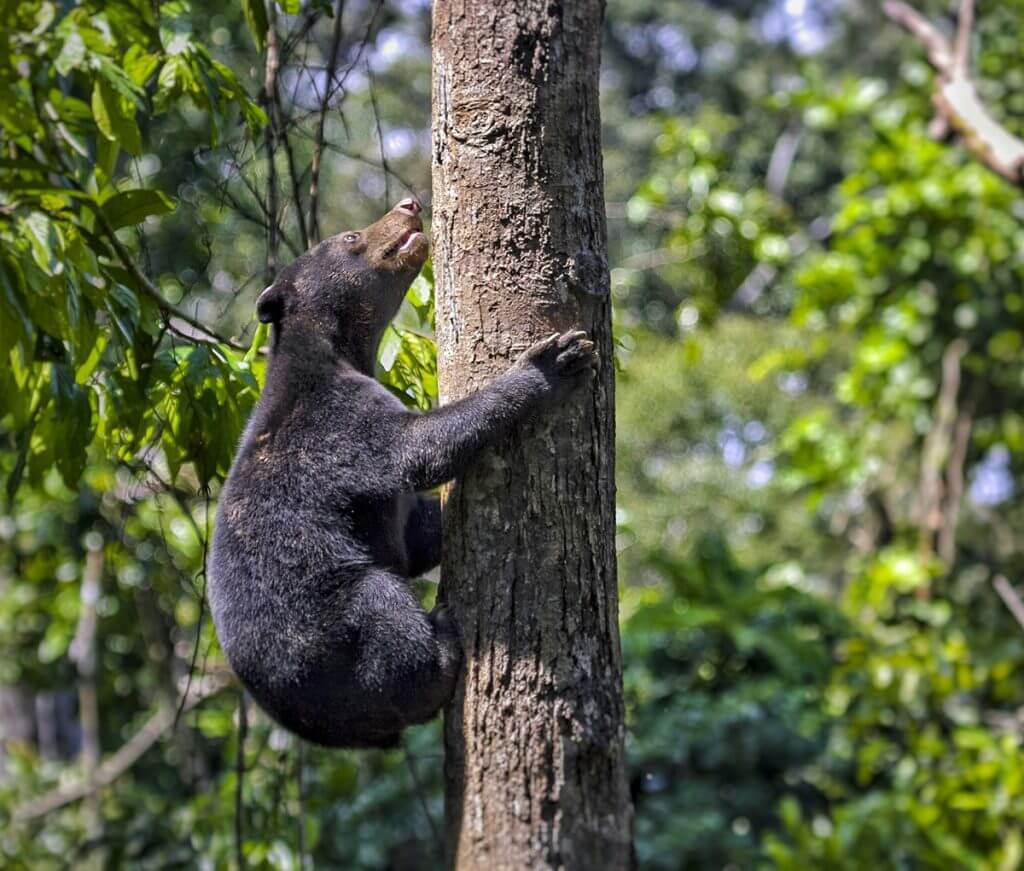
For a few days during the last week of July, a black bear became a North Shelby sensation, earning the young male the sobriquet “Shelby.” Sightings spread quickly across social media pages and neighborhood board posts as residents caught glimpses of the burly creature padding through parking lots and yards, crossing roads, and disappearing as quietly as he arrived.
While the visitor may have raised a few anxious questions among homeowners, the appearance of a black bear in the Birmingham area is far less extraordinary than it seems.
To wildlife biologists, the bear’s presence is not an anomaly. It’s part of a summer routine. “It’s completely natural this time of year to see black bears anywhere in Alabama. There’s nowhere in the state where I would be surprised to hear that there was a black bear sighting in the summertime,” Marianne Gauldin, a wildlife biologist with the Alabama Wildlife and Freshwater Fisheries Division, says. “That’s because in the late spring, throughout the summer months, and sometimes even early fall, young black bears are on the move. These are black bears that are not old enough to breed, and they’re not old enough to hold an established territory. But they are too old to be with their mother.”
Gauldin explains that a young male’s instinct pushes him to leave his mother’s range and wander—sometimes more than 100 miles—before eventually settling on the fringe of another bear’s established territory until he is mature enough to compete for breeding rights. Bears moving through Birmingham are most often 1- to 2-year-old males, while females in that age range generally remain much closer to their birth areas
Every summer, these transient bears quietly weave through forests, creek bottoms, and green corridors, following ancient instincts rather than modern maps. Most pass unnoticed beneath the cover of darkness, slipping through landscapes where people rarely realize wildlife still moves freely. The occasional photograph captured on a Ring camera or the brief glimpse from a car window is a reminder that suburban Alabama remains connected to a much larger natural world. The Birmingham metro area, Gauldin says, has long served as one of those travel corridors. “This dispersal of young male black bears is a phenomenon that occurs every summer,” she says.
For OTM residents wondering whether the bear plans to stay, the answer is no. While a native population lives in North Alabama, the young males seen in other parts of the state are travelers, not settlers. “Typically, black bears get on a semi-westward trajectory, and they kind of stay on that trajectory when they’re coming through the Birmingham area,” Gauldin says.
The big mammals, whose diet includes grasses, roots, berries, nuts, insects, and small or young animals, are following one of nature’s oldest edicts—a seasonal migration of young males searching for their place in the world. The animals usually pass through without anyone noticing. During the hottest hours of the day, bears typically rest in dense shade. “Most of the time, these black bears are moving in the evenings, even when they’re in a well-populated area,” Gauldin explains. “As hot as it is, the bear recently seen is probably just laid up somewhere, resting in the shade, and it’ll move at night and in the evening.”
For homeowners, the best response is often the simplest: give the bear space and allow it to continue its journey. The safest thing to do is make yourself known as loudly as possible. “If you see a black bear, you want to make sure the black bear sees you,” she explained. “Do not approach the bear. Instead, make yourself big, wave your arms, holler, clap your hands, and make sure the bear notices you and recognizes you as a human. A black bear that’s behaving normally will turn tail and move away from you. You don’t want to corner a black bear, and you don’t want to run from a black bear. Slowly back away while making noise and allow him the chance to escape away from you.”
Gauldin explains that people should also keep dogs leashed around bears and avoid placing themselves between a dog and a defensive bear. It’s also important to avoid temptations that might unintentionally invite a bear to linger. “Black bears that are behaving normally will move away from anything that is associated with humans,” Gauldin says. “The way that this gets skewed is when black bears learn to associate humans with food.”
Gauldin explains that unsecured garbage, pet food, bird feeders, deer feeders, and other easy food sources can encourage bears to remain in residential areas. Removing those attractants helps avoid unwanted human-bear interaction.
North Shelby’s latest wildlife celebrity has moved on, leaving behind a collection of stories and blurry photographs. His passage through the area is a reminder that nature makes a way, as it has done for centuries. A few among us were privileged to witness that.