
By Lee Hurley Photo by Jordan Wald
Our founding fathers thought that the pursuit of happiness was so important they included it in the preamble to the Declaration of Independence, right up there with Life and Liberty. The word pursuit was clearly intentional for as we know, happiness can be a fickle friend. Just ask anyone who bought a convertible or gave their son a tie for Christmas.
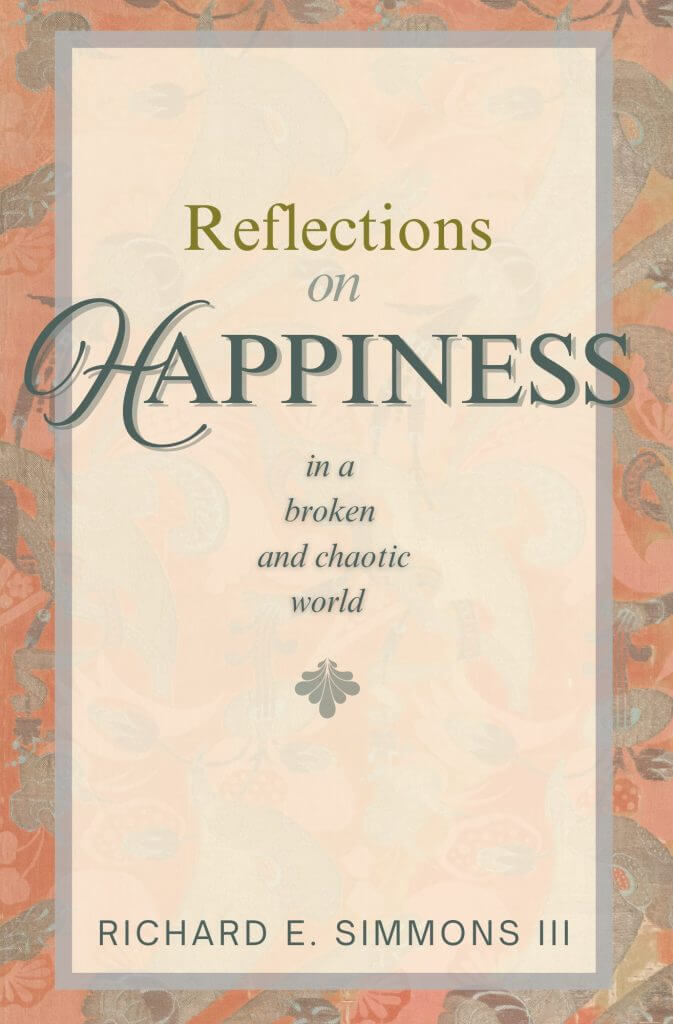
Richard Simmons, founder of The Center for Executive Leadership, which helps men spiritually confront life’s many challenges, has been doing a lot of thinking about happiness. His 11th book, Reflections on Happiness: in a broken and chaotic world explores the contradictions of what we think will makes us happy versus a deeper truth about finding happiness in oneself. We sat down in his conference room and talked.
Lee Hurley: You left a secure insurance job at then Hilb, Rogal & Hamilton as CEO in 2000 to start The Center for Executive Leadership. Why?
Richard E. Simmons III: I got married late in life. My wife Holly and I decided that because of my age—I was 41, she was 27—we needed to have children right away. We had three in 33 months and that became stressful for her, and I was gone a lot. It just put a lot of pressure on our marriage, and I got to a point where I realized something had to go. And it wasn’t going to be my wife or my kids. I enjoy teaching and speaking, so I decided to retire and start what became The Center. That was 25 years ago.
Did money ever worry you?
It worried my father (laughs). He thought I had lost my mind to give up a nice high-paying job with three young kids and start a nonprofit. Holly never worried about it at all.
How many people work for the Center now?
We’ve got 15 in Birmingham and four in our Memphis office. Two are full-time counselors, one deals with marriage, the other tackles depression and addiction. Jimbo Head runs our prison ministry. Several others like Todd Lipscomb lead multiple bible groups and help with life coaching for men.
Let’s talk about happiness. Why this book now?
I read an article in the New York Times years ago about a hugely popular course on happiness taught by Dr Laurie Santos at Yale. She discovered that something was amiss in the lives of her students. They were just not happy. She expanded her research to adults and concluded our mental, emotional and psychological health has plummeted. That encouraged me to teach a series on happiness in 2018 which was well received. Those factors led me into researching and writing this book.
Do you feel like we’re in a happiness crisis?
I do believe it’s a crisis, but that’s why we’re here at The Center. We basically try to help people find themselves and figure out what their purpose in life is. And of course, it always leads to a spiritual answer. One of the conclusions I’ve come to is that people believe happiness is found in pleasure, accomplishment, material possessions and wealth, but in the end that just isn’t fulfilling. There’s no permanence to it, and that’s why I think the most significant message in this book is that ultimately it’s the person that you become and the wisdom you possess to live wisely that leads to happiness.
How do you see the younger generations dealing with this?
Here’s something I’m seeing. A young man graduates from college and sets out on this journey to find a wonderful happy life. Then he gets into his 30s and starts to realize his life hasn’t turned out the way he thought it would. And then he really doesn’t know what to do about it and begins to feel that life is disappointing. Unfortunately, men seem more interested in how much money they will make instead of asking themselves ‘Is this career going to fulfill me and give me the satisfaction and happiness that I desire?’
How do you feel about the use of prescription drugs to combat unhappiness?
Many psychiatrists believe that when you get depressed, there’s a chemical imbalance that can be controlled with certain medications. I quote a guy who says when they first gave him medicine for depression he felt better but then over time, the depression just crept back in, so they upped the dose three or four times. It doesn’t address the core issues. We are not asking why.
You discuss loneliness in the book.
Well, I think when it gets right down to it of all the factors that lead to happiness, it’s our relationships that matter most. We were designed by God to be relational because we’re made in His image. He’s a relational God. We’re relational people. If we weren’t, there’d be no such thing as loneliness, but it’s a huge problem today. Marriage is the most significant relationship in life next to our relationship with God. When we get married, we should do everything possible to guard that relationship, to see it grow and develop and deepen in love and intimacy. Because if you’re in a mediocre marriage I don’t think you can be happy in life.
When you talk with men, can you tell if they are unhappy?
Many men are unhappy and depressed, but they can’t or won’t admit it. Eight out of 10 suicides are white males. I believe it’s because of the false perception that real men don’t get depressed. So they don’t get help. When men get their sense of worth from their work and then measure themselves by how they think others perceive them, that’s where depression and low self-esteem comes from. The number of men struggling with depression is under reported because if they admit they are unhappy it looks like they flunked life.
What do you hope will come from writing and publishing Reflections on Happiness?
My hope is that it will encourage readers, and make a difference in their lives. I aim to help them better understand themselves, particularly the reasons they may struggle to experience happiness. Above all, I want them to recognize how important it is to live wisely in their pursuit of a fulfilling life.