By Anne Ruisi
Vestavia Hills Mayor Ashley C. Curry recalls being an up-and-coming FBI agent more than 40 years ago in Tampa, Florida, when he could have had his pick of assignments anywhere in the country.
That he chose a transfer to Birmingham was at the recommendation of doctors at Tampa’s Shriners Hospital – one of a network of nationally renowned children’s orthopedic medical centers. Curry’s daughter, a baby at the time, was born with a genetic bone disease and the doctors at Shriners told him there was only one place for her to receive the specialized medical care she required: Birmingham.
While Curry’s new assignment as a special agent was in what’s considered a smaller division office by FBI standards, during his tenure in Birmingham, from 1980-2003, he and his fellow agents ended up working on some of the highest-profile federal criminal cases in the Southeast, he told an audience at his June 4 presentation, “My Time in the FBI.”
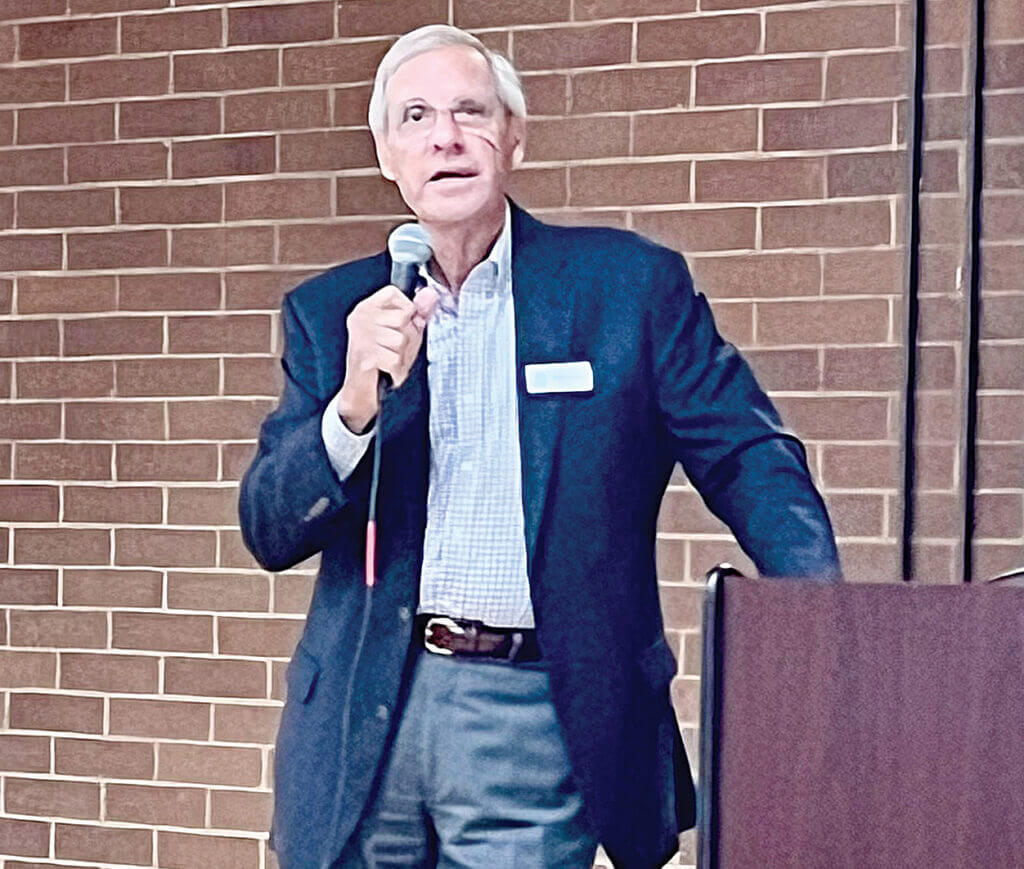
In his talk, held at the Vestavia Civic Center and sponsored by the Osher Lifelong Learning Institute, known as OLLI, at the University of Alabama Greater Birmingham Chapter, the mayor covered a range of cases he has worked, including several that grabbed national headlines.
Atlanta Federal Prison Riot
In 1987, the U.S. State Department worked out a deal with Cuban authorities to repatriate 2,500 incarcerated Cubans who had left their country during the Mariel boatlift. The prisoners were either undocumented or had committed crimes and didn’t want to return – so much so that they staged a bloody riot and took dozens of hostages.
Agents knew the rioters had guns, Molotov cocktails and other weapons, and the prisoners had started a fire that spread and ended up destroying the prison. Curry said he and other FBI agents were outfitted with flame retardant gear in case they were ordered to retake the prison.
After 11 days of negotiations the crisis ended and the hostages were released.
Murder of Judge Robert Vance
In mid-December 1989, Curry and other agents were at an FBI Christmas party when, one by one, their pagers started beeping. They soon learned why: federal Judge Robert Vance had been killed instantly and his wife, Helen, seriously injured when the judge opened a mailed package containing a bomb in their Mountain Brook home.
“I had never seen devastation like that,” Curry said.
Clues found at the scene included a Newnan, Georgia, postmark on a piece of the package, he added.
Two days later, Alanta civil rights lawyer Robert Robinson was killed by a mail bomb and two other mail bombs were sent but intercepted before they were opened. These incidents yielded more clues analyzed by the FBI lab and other authorities in an extensive investigation that eventually lead to the arrest of the man responsible, Walter Leroy Moody, Curry said.
Moody was convicted in federal court and sentenced to life; he was later convicted of Vance’s murder in state court and sentenced to death. He was executed in 2018.
Talladega Prison Riot
In 1991, four years after the Atlanta prison riots, Cuban detainees unwilling to be deported rioted and took nine hostages at the Talladega Federal Correctional Institute. Federal authorities assembled SWAT and hostage rescue teams, which entered the building.
“Would you believe when it was over … the hostages were out in less than two minutes?” Curry asked.
At the same time, law enforcement agents inside the prison heard “bang, bang, bang” noises.
“We couldn’t figure out where the bang, bang, bang was coming from,” Curry said. They soon did.
“It was the Cubans running back to their jail cells, slamming the doors,” shut, he said.
Birmingham Abortion Clinic Bombing
Eric Robert Rudolph became notorious in Birmingham following the January 1998 bombing of an abortion clinic on the city’s Southside that killed an off-duty police officer and seriously injured a nurse. He later was identified as the person responsible for a series of bombings in the Southeast during the 1990s, including the Centennial Park bombing at the 1996 Olympics in Atlanta.
FBI agents were among the multitude of law enforcement officials involved in the investigation and subsequent manhunt for Rudolph.
Investigators had a partial license plate for the pickup truck suspected of being involved in the Birmingham crime and got the rest of the plate number after a woman called in with a tip.
Curry interviewed her. She said she was driving on Interstate 59 when she flipped off the driver of a Toyota pickup truck with North Carolina plates who’d tried to pass her car. The driver of the truck looked at her with no reaction but a stare that the woman said, “just sent chills up my spine,” Curry recalled.
The witness got the plate number, which helped police find it parked at a trailhead in Murphy, North Carolina. Rudolph hid out in the mountains he knew well and was placed on the FBI’s 10 Most Wanted List. It took law enforcement five years to capture him. He was caught rummaging in a dumpster outside a Murphy supermarket.
He pleaded guilty to federal charges stemming from the bombings and is serving multiple life sentences without the possibility of parole, according to the FBI’s website
Levity Helps Balance the Pressure
As Curry shared his experiences, he noted pressure comes with a career in law enforcement.
“If you don’t have a sense of humor in law enforcement, you won’t survive because there’s just too much negative stuff all the time. Jocularity, so to speak, goes a long way in relieving” the stress, Curry said.
Lighthearted moments can come at the most unexpected time. He recounted the time when agents were serving a search warrant at a suspected drug house in Birmingham and a neighbor asked what was going on. They told her why they were there.
“If you want drugs you’ve got to go next door,” she responded.