Allies Against Alzheimer’s:
Friends Join Forces to Deal with Disease
By Keysha Drexel
Journal editor
Barbara and Ted Crane celebrated their 54th wedding anniversary earlier this month, and the North Shelby wife said many people don’t believe her when she says she loves her husband more today than when they were first married.
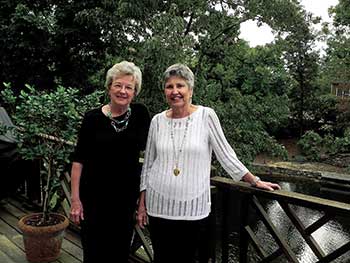
Ted Crane was diagnosed with a rare form of Alzheimer’s in 2006 that has slowly taken away his ability to communicate. But that doesn’t mean his wife can’t understand him.
“This illness takes all the clutter and mundane distractions out of your life,” Barbara said. “Suddenly, it’s just the two of you and every moment is precious. In our case, because there’s no verbal communication, that touch of the hand and the eye contact of those beautiful blue eyes is all I need, and it is truly an overpowering feeling of love.”
And while she feels blessed that her husband is still here to reach out his hand to her and meet her gaze, Barbara said she might never have been able to cope with her husband’s illness without Alzheimer’s of Central Alabama and her longtime friend, Sydie Allen.
Barbara and Sydie are both members of a caregivers’ support group organized by Alzheimer’s of Central Alabama, a nonprofit volunteer organization and resource center headquartered in Mountain Brook and serving Alzheimer’s patients, caregivers and professionals.
The women first met about 35 years ago when Sydie’s husband, Tommy Allen, and Barbara’s husband were doing business together.
Tommy and Ted both graduated from Auburn University with engineering degrees and worked in the paper industry.
“When Tommy and Ted met, they just clicked, and then Sydie and I met and we clicked instantly. We have all been friends for a long time. Sydie and I used to play tennis together, and we were always glad to see each other at different corporate events that we went to with our husbands,” Barbara said.
In 2002, Sydie’s husband was diagnosed with Alzheimer’s.
“Tommy got sick first. It took me a long time to realize what was happening because he has always handles things with humor. That’s how he disguised the little slip-ups that were signs of Alzheimer’s,” Sydie said. “I had no clue he had a problem and looking back now, I can see I was in denial.”
Sydie had every good reason not to want to face what could possibly lie ahead for her husband after his diagnosis.
Alzheimer’s disease is caused by nerve cell death. Once a nerve cell, or brain cell, dies, the function is lost. A person with Alzheimer’s disease becomes increasingly impaired as cells continue to be lost. While no two Alzheimer’s patients are alike, they usually progress from needing supervision to needing custodial care to needing 24-hour a day nursing care.
“I didn’t want to think about how it would progress. I couldn’t stand the thought of losing my soul mate, my best friend, piece by piece. I didn’t know if I could take care of him, and I didn’t know where to turn,” Sydie said.
Barbara said she completely identifies with Sydie’s characterization that she was in denial for a little while about her husband’s diagnosis.
“You don’t want to think that your life is changed forever, but that’s exactly what happens,” Barbara said. “I went through the same emotions after Ted was diagnosed and, like Sydie, I didn’t know where to turn for answers.”
But the women soon found out about the services offered at Alzheimer’s of Central Alabama, including adult day care for Alzheimer’s patients and support groups for their caregivers.
The women went together to investigate the adult day care program and hold each other’s hand during the process of signing their husbands up for the services.
“We went to check it out together, and we sat in the courtyard and we cried together. We both felt so guilty about even investigating the daycare option,” Barbara said. “I think taking Ted to the adult day care on that first day and then going to that first support meeting was one of the most difficult things I did initially.”
Sydie said taking her husband to the adult daycare and joining the caregivers’ support group was difficult for her, too.
“I think we both had a hard time with that because it makes you acknowledge that you have a problem, that this is real,” she said.
But the women said they soon saw the benefits of having a break from caring for their husbands.
“You feel terribly guilty at first, but then you realize that they are getting so much out of the programs at the daycare,” Sydie said. “And you realize how talking about what you’re going through with other people who are going through the same thing can really help you.”
The women said they feel very blessed to have each other as they continue to navigate their journeys as their husbands’ caregivers.
“I always figured Barbara and I would grow old together, but I never imagined we would share this experience,” Sydie said. “Nobody understands it quite like Barbara does, and it’s a great comfort to have her by my side.”
Both women said they have been strengthened by the support of their families and friends and by their faith, and both said they looked at how their husbands handled things to give them an idea how to take on the challenges of Alzheimer’s.
“They were both dynamic, smart, successful men, and I draw on that and think about what Ted would do or want me to do in a given situation. Our husbands took such good care of both of us for so long, and now it is our turn to take care of them,” Barbara said.
The friends said they will lace up their sneakers along with other participants in this weekend’s Alzheimer’s of Central Alabama Walk to Remember at the Riverchase Galleria.
“We want to do everything we can to support Alzheimer’s of Central Alabama because they do so much to help so many people,” Barbara said.
Both women said they feel lucky to still have their husbands and feel that deep inside, the men are the same loving spouses they have always been.
“We’ll celebrate our 50th wedding anniversary in December, and I can’t imagine being without him. I’ve learned a lot through this whole thing, and probably the most important is that love transcends all,” Sydie said.
For more information on the Nov. 2 Walk to Remember fundraiser or Alzheimer’s of Central Alabama, visit www.alzca.org.