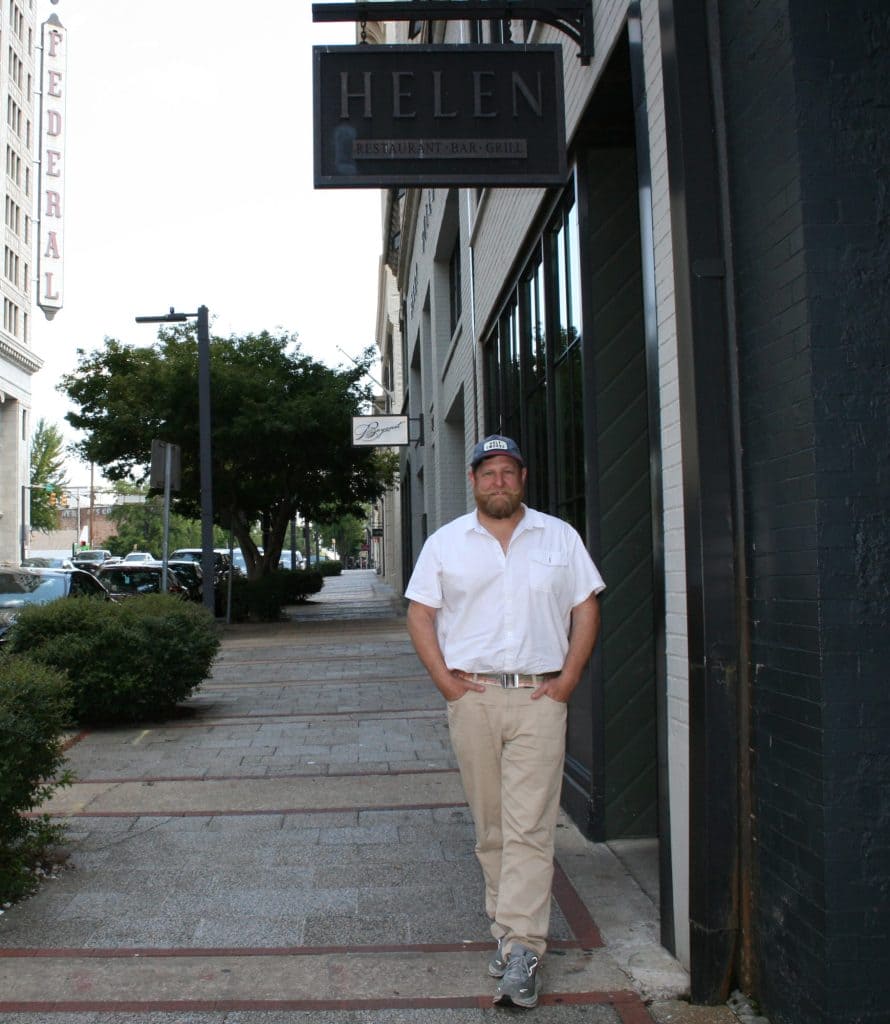
Story and photos by Cara Clark
When acclaimed chef Rob McDaniel opened his second restaurant, he was determined to take a different direction from Helen, his first, named in homage to his grandmother. The new direction began with a name: Bayonet, derived from the Spanish bayonet plant, engineered by nature to survive difficult conditions—heat, drought and the salt of coastal environments.
When McDaniel opened Bayonet in 2025, the name carried an association with strength and resilience. But the restaurant represents something more personal: what happens when a chef takes what he already knows and gives himself permission to make something different.
One of the clearest representations of that shift is nearly hidden in a hall where seafood dishes move from the kitchen to the “pass” for pickup and delivery. On the wall, rice-paper artwork of fresh fish, created by McDaniel, casually adorns the space. It’s a mindful way for the chef-owner to document fish through the centuries old Japanese art of gyotaku. He carefully applies non-toxic ink to a whole fish, then presses fine paper over its surface to capture every scale, fin and contour in a precise, life-sized impression. The result is a refined piece of art that reflects both his culinary craft and his new endeavor.
“When people open a second restaurant, it’s easy to be very similar to the first one that you open because that’s what you know,” McDaniel says. “It can be very difficult to completely switch gears.” McDaniel knew exactly how difficult that switch would be: “From a wood-burning, meat-heavy, vegetable-heavy, home-style big 170-seat restaurant to a 54-seat, basically pescatarian, all-seafood bar,” he says.
Even the paintings tell the story. Created by McDaniel’s friend Roscoe Hall, the works hanging inside the restaurant’s waiting space are painted with food pigments, including ingredients such as sweet potato, hibiscus and turmeric, transformed into color. What begins as something meant to be eaten becomes something meant to be seen and felt.
The restaurant represents a departure from what McDaniel already did well. It is a place where he can take what he knows, turn it over and see what else it can become.
Bayonet itself was not what McDaniel originally intended to build. He envisioned the space as an oyster bar that would provide overflow for Helen, giving guests a place to wait, have a drink or eat something before their table was ready. But building code requirements made that impossible because the space served as an entrance and exit to the building.
What initially looked like a logistical problem became an opportunity. “It was also a blessing in disguise because it made me realize that this size of restaurant is really what I want to be doing,” he says.
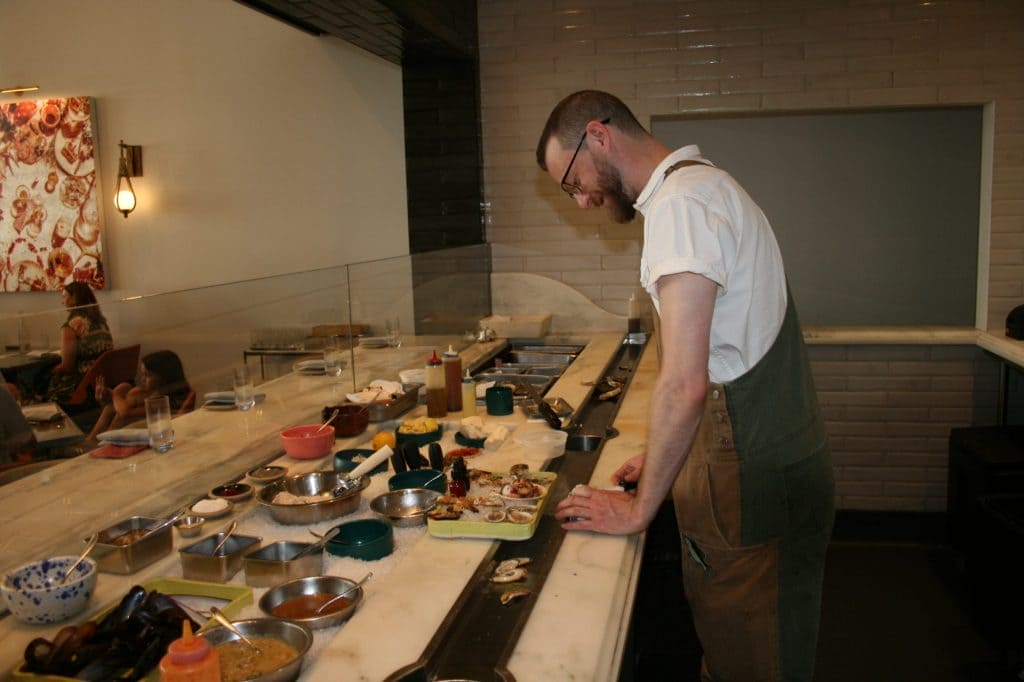
At Bayonet, the smaller footprint has influenced almost everything, including the way McDaniel approaches teamwork. He established a shared tip pool for eligible employees, a system he says has helped remove some of the competition that can creep into restaurant work. “Not many people do that, but it’s turned out to be really good because everybody’s working for the same thing,” he says. “There’s no, ‘You may have gotten more tables than I did,’ or, ‘I did more work than you did.’ Everybody’s working together as a team.”
That idea of shared responsibility has become increasingly important as McDaniel’s own job has changed. For years, his identity was tied primarily to cooking. Now, much of his time is spent running the business—managing people, finances and the systems that keep two restaurants running. “The business side of things is something that you don’t really get fully immersed in until it’s yours to do,” he says. “So, it’s mine to do. I’m fully immersed in it and had to shift gears a little bit.”
The shift has also forced him to think differently about leadership. Earlier in his career, while working at Russell Lands and Spring House, McDaniel was given considerable freedom to develop his own ideas. He was responsible for the fundamentals of running a kitchen, but he was also given room to experiment, fail and figure out what worked. Now he wants to give the people around him that same opportunity.
“We have some of the most amazing team members that generally, you know, love to come to work,” he says. “No job is perfect, and we’re not perfect, and we make mistakes, and we have off days, and we’re just like anybody else. But we try to create and keep an environment that is welcoming to our employees, because I feel like that automatically makes for a better dining experience for our guests.”
The philosophy is easiest to understand through a night when McDaniel wasn’t at Helen. A celebrity guest arrived while McDaniel was away in Auburn for a two-day residency at 1856. The reservation had originally been made under another name, but on the day of the meal, it became clear that the guest was Matthew McConaughey, who was in town filming a movie.
McDaniel’s first reaction was to get in the car. Then he reconsidered. “What kind of message does that send to my team if I come running in for a celebrity?” he says. He stayed in Auburn and trusted his team to handle the evening. “I felt like it sent a more powerful message for me not to show up and let them know that I trusted them to make sure that everything happened the way it did,” he says.
There was another reason the evening stayed with McDaniel. He had listened to McConaughey’s book, Greenlights, while working, and the book had given him a way of thinking about the opportunities that had brought him to restaurant ownership—moments when circumstances seemed to open a path forward. “McConaughey talks about opportunities he had, and green lights for him to move forward,” McDaniel says. “When we first opened Helen, I’d be back in the back rolling angel biscuits, and I was listening to the book and thinking, ‘I am living in my green light moment right now.’”
He never got the chance to tell McConaughey that story directly, but a couple of months after the visit, McConaughey’s wife posted a photograph wearing a Helen hat. The photograph went viral, drawing even more attention to the restaurant. For McDaniel, the synchronicity of those fits into the way he understands his life: an unexpected opportunity appears, you recognize it, and you walk through the door. That idea goes back to the decision that greenlit Helen.
One morning, while sitting alone at Spring House before service, McDaniel’s devotional opened to Deuteronomy 1:6: “You have been on this mountain long enough.” He recalls, “When I read that, you know, I heard, ‘You’ve been at this lake long enough. And I felt like I had summited, and I wasn’t going to be able to climb any higher.”
He had thought about opening his own restaurant for years, but there seemed to be a clear message, and the idea became a possibility. He went home and told Emily. “And Emily said, ‘Well, it sounds like we need to start figuring out our move.’”
They turned in their notices in November 2019. Months later, COVID-19 transformed the restaurant industry. While the pandemic complicated their plans, it also became an unexpected lesson in preparation. When Helen eventually opened, McDaniel chose to bring guests into the dining room. “I didn’t want people’s first experience of a restaurant with my grandmother’s name on it to be out of a to-go box,” he says.
They opened carefully, spacing tables and operating at half capacity for roughly six months. The experience taught McDaniel another lesson he carried into Bayonet: the importance of financial runway and the ability to adapt when circumstances change. “When we first opened, standing there, and then just being like, ‘This is what I prayed for, and we’ve got it,’” he says.
That sense of providence is inseparable from the way McDaniel talks about his career. It is also part of why he describes the restaurants not simply as the result of his own work, but as something made possible by the people who joined him along the way.
McDaniel and his wife, Emily, are raising twin daughters, and fatherhood has changed the way he thinks about his responsibilities. His work remains important, but = he no longer sees it as the center of his life. “I have a bigger obligation besides the obligation that I have with two restaurants and the staff and running them,” he says. “My obligation is bigger than that: one relationship with Christ, two to be a great husband, and three to be a great father. I have to keep those things prioritized.”
He works from home when possible and structures his days around his daughters’ schedules. That same sense of partnership defines his relationship with Emily, who owns 51 percent of the business while McDaniel owns the remaining share. “We never thought that we would be working together,” McDaniel says. “And truth be told, if you had asked us when we were living at the lake, and somebody said, ‘Could y’all work together?’ we would have both said, ‘No, there’s no way.’”
Like a squeeze of lemon over a fresh oyster, Emily and McDaniel bring something different to the same table. The acidity and brightness of the lemon cut through the oyster’s creamy texture and brine, creating a balance that neither provides on its own.
Emily manages much of the infrastructure behind the restaurants, including bills, licenses and relationships with purveyors. She also oversees social media for both restaurants, drawing on her marketing background.
Director of operations Daniel Gosling is another important part of the partnership. He worked with McDaniel at Spring House. With the restaurant world shut down or restricted, much of the planning happened at the McDaniels’ Vestavia Hills home. “We planned out the whole restaurant,” McDaniel says. “We did wine tastings there, coffee tastings there. We tested linens, silverware, glassware and plateware there. I mean, all the things. And he’s been with us since the beginning.”
The common thread is not just the food but the level of trust—trust in those around him and in a higher power. For McDaniel, faith is part of knowing when to make room for that transformation, recognizing the next opportunity, and trusting that he will know when to take it.
Amen.