By Keysha Drexel
Journal editor
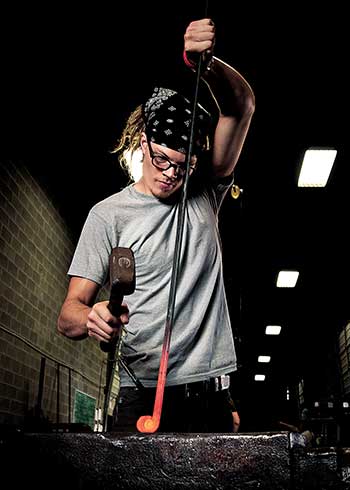 In a workshop on First Avenue South in Birmingham near Sloss Furnaces, where the rise of the Magic City was forged, a group of blacksmiths is creating functional pieces of art through a centuries-old craft.
The staff at Red Mountain Ironworks, a blacksmith and ornamental iron shop headed up by Nolen Graves of Mountain Brook, focuses on creating original, inspired and functional pieces for homes and businesses using the tools and techniques honed by craftsmen for hundreds of years.
Graves, who also owns and operates Frontera Iron Furniture Store, said he has always done custom iron and metal work but about two years ago had the opportunity to expand that side of his business.
“We’ve always done some custom work but just not on this scale. I had an equity partner that helped with the iron works side of it, and we had about a 2,000-square foot shop,” he said. “We started doing more custom work, and he started an iron business and then I purchased his assets and we expanded to this workshop, which is about 15,000 square feet.”
From the design through the installation, the craftsmen at Red Mountain Ironworks work with clients to create one-of-a-kind pieces in iron, steel, bronze, aluminum and a variety of other metals.
The Red Mountain Ironworks staff includes Steve Ledford, who has been a blacksmith for more than 30 years.
“Steve’s a legend. I absolutely consider what he and the other guys do a form of art. It’s not just a craft they’ve perfected, it’s an art,” Graves said.
Ledford said the art of blacksmithing almost died out in this country but saw a revival in the 1960s. He said that luckily, good quality work never goes out of style, and he’s happy to see more customers choosing iron and metal pieces for their homes and businesses.
These days, however, the number of young people interested in learning the craft is dwindling, Ledford said.
“If it doesn’t get carried to the next generation, it will disappear. It makes me feel better that we have some young guys around here who are interested in learning and carrying it forward,” he said.
Brady Jackson, the shop manager, is one of those young guys at the helm of introducing a whole new generation to the art of metalwork.
“We want to continue to use traditional methods to make things that are lasting, things that will be in your life for a long time and the kind of things that you can’t get anywhere else,” Jackson said.
But just because Jackson uses traditional methods doesn’t mean the guys at Red Mountain Ironworks are stuck in the past.
The company has a computer-controlled plasma cutter that it uses in addition to the time-tested metalworking methods that have been passed down through the years.
The company aims to be involved in the kinds of projects that will make spaces special by adding impact, Jackson said.
“A huge part of what we do is attention to detail, and people who like that love our work,” he said.
Jackson said he’s encouraged by a steady flow of business at Red Mountain Ironworks and hopes that means more people are coming to appreciate the kind of quality the company offers.
“The same way people are supporting the local food movement, the local craft beer movement, I think they’re coming to support companies like ours that are taking the materials we have right here and making something that is unique to this area,” he said.
The blacksmiths at Red Mountain Ironworks usually receive the raw materials in 20-foot long sticks of steel. Using bandsaws, shears and the computer-controlled plasma cutter, the team cuts the long sticks into the appropriate sizes for each project.
From there, any forge work is done. The metal is heated and shaped with hammers and anvils of all shapes and sizes. Through this violent and often loud process, the blacksmiths shape the metal into shapes and designs ranging from the clean lines of the railings in Ann Couch’s home to more intricate designs like the curling, looping scrollwork featured on the team’s furniture pieces.
After the forge work is complete, the project is assembled on fabrication tables and then cleaned and finished by hand.
Joseph Harris, another blacksmith at Red Mountain Ironworks, said he began learning the craft because it combines two things he really loves–working with the hands and artistic creativity.
“It is just like working in clay, in some respects, because when you’re working with metal, the possibilities are endless,” he said. “You have to have ability to see the potential in this piece of raw material.”
For more information, visit redmountainiron.com or call 226-9055.