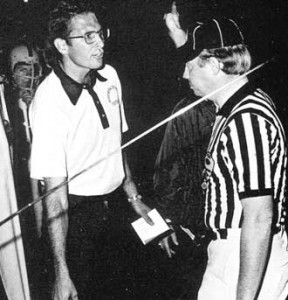
By Lee Davis
Journal Sports Writer
Football was part of Robert Higginbotham’s life almost from the moment he was born.
His father, Morris, was one of the most successful high school coaches in Alabama history. The younger Higginbotham starred at Hueytown and played linebacker and defensive back at the University of Alabama before beginning his own coaching career that spanned four decades.
He began his career as an assistant to the legendary Shorty White at the old Banks High School before becoming head coach at Mountain Brook in 1973. From there, Higginbotham had successful tours at Shades Valley and Tuscaloosa County before finally hanging up his whistle two years ago.
He retired with a cushion full of memories – the vast majority of them good ones.
“I guess the thing that stands out is that my career went for 38 years,” said Higginbotham, when reached by phone last week. “Not everybody who gets into coaching can make that claim. We had a lot of good times along the way.”
Perhaps surprisingly, Higginbotham said he didn’t get empty feelings on Friday nights during his first season away from the game.
“I really didn’t miss it at all,” he admitted. “I enjoyed every minute of coaching, but once it ended, I didn’t look back.”
Higginbotham faced skeptics in his career. The first time may have come early, when he left his attractive assistant’s job at perennial power Banks to take over the Spartan program, which had gone 3-7 the previous year. Some said nobody could win at Mountain Brook, but Higginbotham knew better.
“It was a great community with a lot of good people in it,” said Higginbotham. “It was a great opportunity for me as a young coach at that time.”
After the first season, Higginbotham couldn’t have been blamed for having second thoughts. His maiden voyage at Mountain Brook produced only a single victory. But greatness was just around the corner.
Armed with a profusion of young talent, the Spartans improved to 7-3 in 1974. Then a solid team became a great one, when a highly-regarded running back prospect named Major Ogilvie moved from Vestavia Hills to Mountain Brook at the start of the 1975 season.
Guided by Ogilvie and quarterback Richard Burg, the Spartans rolled to a perfect 13-0 record, climaxed by a 29-23 victory over Dothan at Legion Field to win the state championship.
“That was just an incredible group of guys,” said Higginbotham. “There are a lot of teams with great athletes, but the 1975 team had great chemistry. Everybody practiced and played with great dedication to what we were doing.
“Any team that wins a championship is going to have great chemistry. That’s exactly what happened with Alabama in 2009 and Auburn in 2010.”
Ogilvie, later a star at Alabama and now a successful businessman, said Higginbotham was a highly positive influence in his life as an athlete – and as a young man.
“Coach Higginbotham was one of those coaches that really helped me develop,” said Ogilvie. “Any success I may have had on the football field was in large part due to him. He got me ready to play for Coach Bryant at Alabama.
“But the most important thing about Coach Higginbotham was the way he helped all who played for him prepare for life after football.
“He was the kind of coach that parents could feel comfortable entrusting their sons to play for.”
Higginbotham seemed to be on top of the football world at the end of 1975, but the good times were fleeting. The coach and Mountain Brook parted ways soon afterward, for reasons which still aren’t completely clear.
Ever resilient, Higginbotham moved on to Shades Valley, where he coached well into the 1990s, producing a long line of winners and reaching the state 6A championship game once.
“I really enjoyed playing for Coach Higginbotham,” said former Mountie Todd Fowler, who quarterbacked Shades Valley from 1978-79. “I learned a lot about football and life from him.”
Higginbotham concluded his career at Tuscaloosa County, where he built the Wildcats into consistent state championship contenders.
Looking back over his 38 years in the profession, Higginbotham said that high school football underwent a great evolution during his long tenure.
“The biggest change was the rise of the spread offenses,” he explained. “When I was coaching at Shades Valley, for example, we ran the Wing-T. It was a good offense, but it was hard to move the ball because the defenses could stack a small part of the field and stop you. Once offenses went to the spread, the other team had to defend the entire field, and that made it easier to score.”
The other difference, Higginbotham added, was the sophistication of the coaches.
“There are a lot of really smart guys in high school coaching now,” he said. “Just take a look at the coaches at Mountain Brook today – they are really brilliant guys. When I first started in coaching, we believed that if we just worked hard and were tough, we’d be okay.
“Now it’s a completely different mindset built on technique and skill. The whole thing is so much more sophisticated than when I started.”
Higginbotham isn’t one of those coaches who sit around complaining how much better high school kids were in the “old days.”
“I don’t think kids have changed that much in 38 years,” he said. “They are still willing to work hard and have great passion for the game of football.”
In fact, Higginbotham thinks today’s high school athletes may be even more dedicated than those in the past.
“There is more demanded of them than ever before,” he said. “Between off-season workouts and seven-on-seven camps, kids don’t get much of a summer anymore. There are so many things requiring their time now.”
One negative of that, however, is the near-demise of the traditional high school three-sport athlete who played football, basketball and baseball.
“We used to encourage our football players to play other sports as well,” Higginbotham recalled. “Now, with the overlap of the seasons, that’s so much more difficult to do. If a kid can play just two sports these days, he’s doing pretty well.”
Among Higginbotham’s mentors in coaching were his father – who passed away a few months ago – and his college coach, Paul “Bear” Bryant.
“I learned a lot from both of them, but at the end of the day, a coach has to be himself,” he explained. “A lot of guys got in trouble when they tried to be Coach Bryant or somebody besides who they were.
“Whatever anyone says, I did it my way.”
Higginbotham is enjoying life out of the football spotlight, but he plans to be plenty busy this fall. He’s a regular tailgater at Alabama home games and is planning road trips to the Crimson Tide’s battles against Penn State and Florida.
“I’ve got a bucket list of stadiums I want to visit before I die,” said Higginbotham. “Beaver Stadium at Penn State is definitely one of them.”
When the coach looks back on his career, he can smile.
“I’ve got no regrets about anything,” he said. “I had a ball coaching. I don’t know how I could have been happier.”
One thing’s for sure. Robert Higginbotham did it his way.