By William C. Singleton III
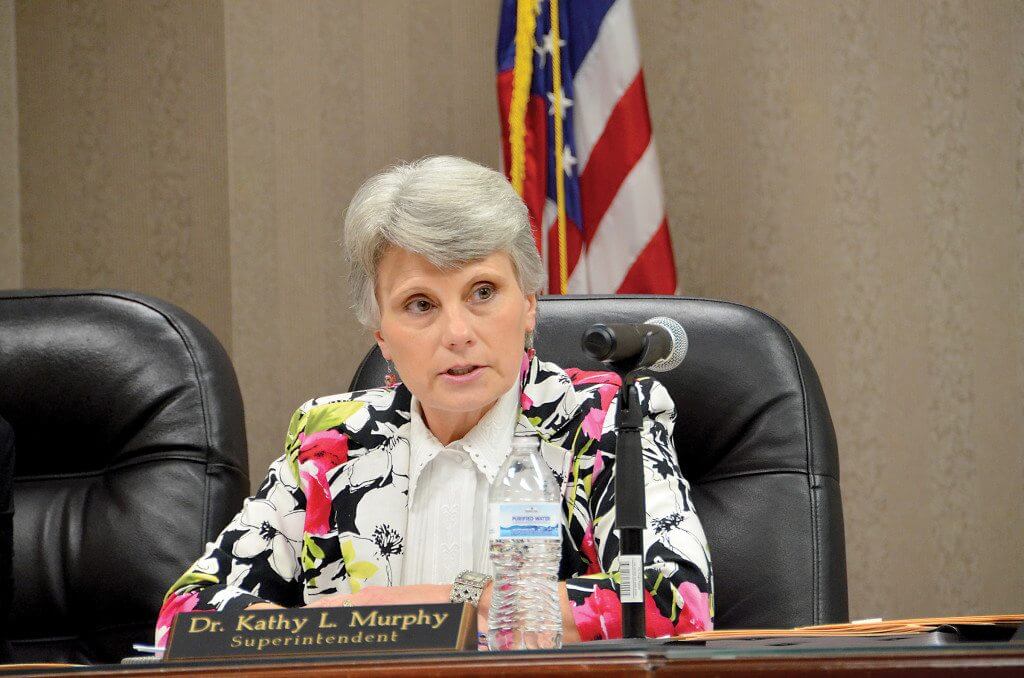
The Hoover City Schools’ new rezoning plan isn’t perfect, but it does try to balance the interests of multiple stakeholders with the current and future needs of the school district, school Superintendent Kathy Murphy said.
The city school board earlier this month approved the controversial plan, which would send nearly 2,300 students to new Hoover schools this upcoming school year. The plan can be reviewed at www.hoovercityschools.net.
If the plan secures approval from U.S. District Judge Madeline Haikala, it will take effect in the 2016-2017 school year.
In deciding how to reallocate the district’s student population and accommodate future students, Hoover school officials had to work with the Department of Justice and the Legal Defense Fund, which are concerned about fairness and diversity within public school systems, as well as work with Hoover parents concerned about how rezoning will affect their families and their children.
The plan had to consider factors such as diversity, community schools, walkability, utilization of school buildings, potential growth, transportation, traffic concerns, academic and sports excellence, special needs students and students who receive free and reduced-price lunches, Murphy said.
“We had to look at a great number of factors and variables,” she said. “This has been no simple task. It’s one with lots of moving parts and pieces.”
The Justice Department and Legal Defense Fund have given their blessings to the latest conceptual plan, Murphy said.
She unveiled a first draft of the system’s rezoning plan at a Feb. 4 meeting, and after five community meetings during which residents voiced their concerns and suggestions, school officials revised it and emerged with the proposal voted on at the March 7 school board meeting.
Some of the revisions included:
- Returning The Preserve neighborhood north of Al Seier Road from Hurricane Branch to Heritage Drive back to the Gwin Elementary zone.
- Returning the Chestnut Ridge, North Ridge, Scott Creek and Lake Trace neighborhoods (all near Brock’s Gap Parkway) back to the Trace Crossing Elementary zone.
- Zoning the Ridge Cross Apartments to Trace Crossing Elementary instead of South Shades Crest Elementary and Brock’s Gap Intermediate.
- Returning the Barrington on the Green Apartments and Chase Lake neighborhood to the Riverchase Elementary zone.
The latest plan still maintains a grandfather provision that allows students now in grades 8-12 to attend the high school for which they are currently zoned. Also, students in the fourth grade would be able to stay in their current school for the fifth grade, but only for one year.
Parents would have to provide their children transportation to school if they opted to stay in a school out of their new districts.
The same grandfather provision would apply to seventh-grade students who wanted to stay at the same school for their eighth-grade year.
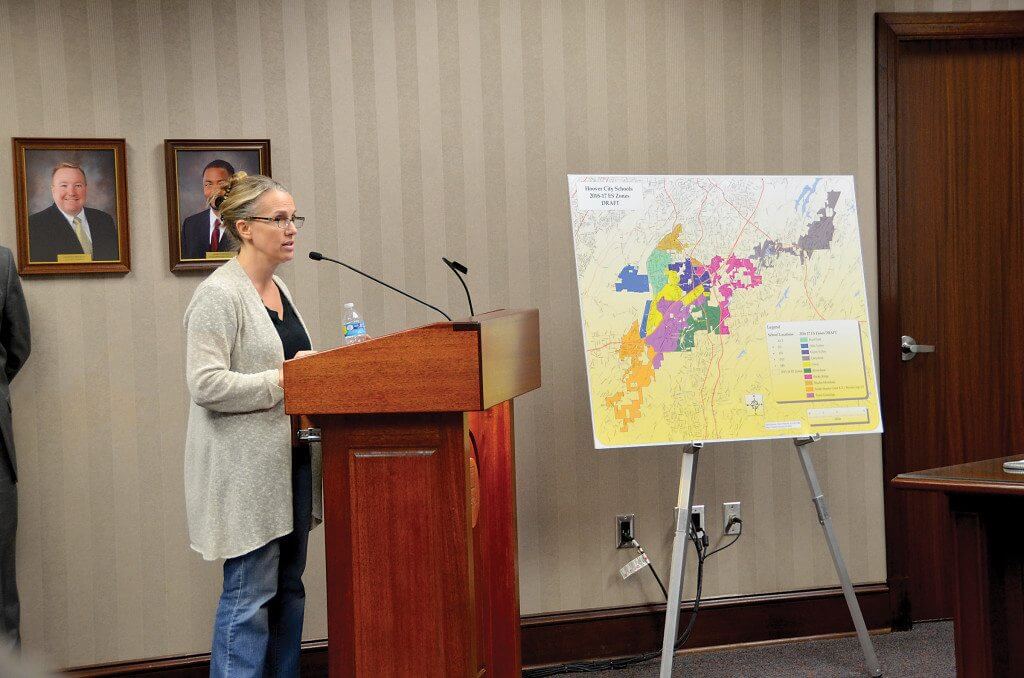
However not all residents are satisfied with the final product. Residents from the Highland Crest neighborhood felt they were unfairly targeted. They said their children shouldn’t have been relocated from Gwin Elementary to Trace Crossing Elementary. They said Gwin Elementary is closer to their neighborhood, and parents living in The Preserve – right next to them – will be able to continue sending their children to Gwin Elementary.
“We’re being singled out as Highland Crest residents,” Shea Maple said. “There are neighborhoods around us, beside us and behind us that are going to Gwin, but we’re having to go to Trace Crossings, and I just don’t think that is fair when we can actually walk to Gwin.”
Ray Faircloth, a Highland Crest resident, said he believes some neighbors will move their children out of the Hoover school system because of the new rezoning plan.
“Prince of Peace Catholic School has already expanded, and they’ve got a big piece of land for additional expansion. If it gets bad, if things deteriorate, we’re going to see more and more people take that option.”
Murphy said school officials didn’t look at a particular street or neighborhood to target, but considered what was in the best interest of the school system overall.
“We are a school district, and by that I mean we’re not planning for one school. Had we been planning for one school, the plan would be different,” she said. “We’re planning for a school district, thus each school, each subdivision and each street contributes to the whole. … The plan that I present to you is reflective of all of our schools.”