By Andrew Cotten
We had agreed to meet at 7 a.m., because it was the only hour all three of us could make the interview work. I arrived a few minutes early, but Mae Dapkus and Olivia Self were already in the parking lot, already catching up with familiar faces, already making use of a morning most people would have spent half asleep. Between AP classes, ACTs, varsity sports, volunteer work, and the fact that teenagers do need sleep, finding an hour to sit down and talk felt like a small miracle.
We shuffled inside and up the stairs toward my classroom, all the while nerding out over their upcoming interview with former Senator Doug Jones. Not the politics so much as the fact that, later that week, two Mountain Brook High School students with physics flashcards in their pockets would be sitting down for an in-depth political interview with a candidate for governor.
It was not that long ago that Dapkus and Self sat in that same room as freshmen. Back then, they were working on TED-style talks and trying to shape ideas that might matter to somebody beyond themselves. Two years later, they are doing public-minded work that already does.
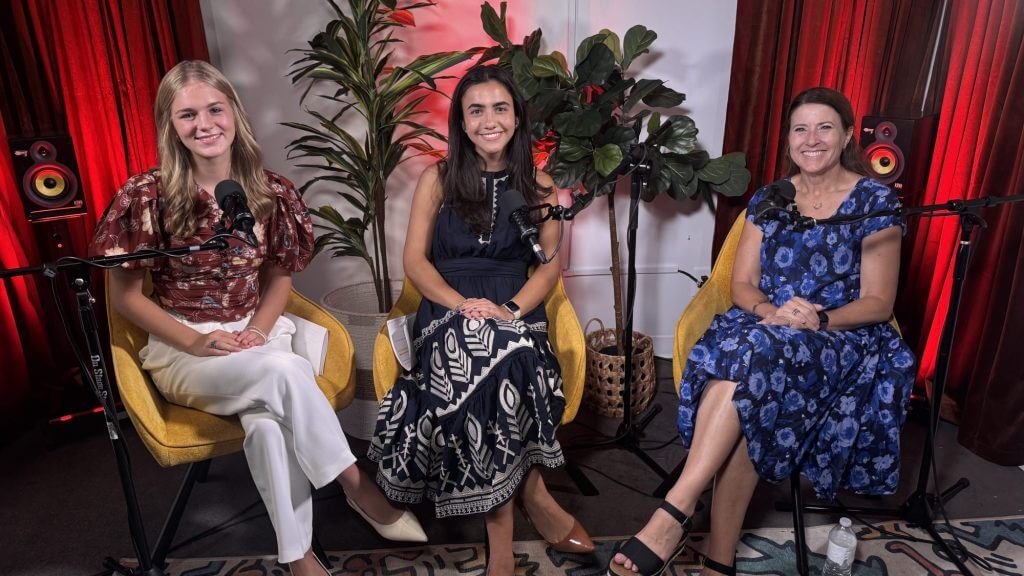
That work is In the Running (ITR), the political interview podcast Dapkus and Self created to help Birmingham-area voters better understand the people running for office around them. The most obvious description of ITR also happens to be the weakest one: two high school students started a podcast; true, but it reduces its value and relevance. In a small but serious way, ITR has become a civic platform. As of May, they had released 18 episodes in less than a year. The range had already stretched from Mountain Brook and Homewood races to Birmingham Mayor Randall Woodfin, and Doug Jones was next on the calendar.
One day, while Self was walking her dogs and dodging dozens of campaign signs lining the sidewalks, she found herself wondering how her neighbors “really know who to vote for? Is it policy, or is it popularity?” The priorities and issues appeared interchangeable, so much so that they blurred together. Yet the way those issues were presented made the differences feel as divided and fierce as the rivalry surrounding the Iron Bowl. One of Self’s best friends, Mae Dapkus, noticed the same thing in her neighborhood, and like Self, Dapkus wondered what anybody really knew about these candidates besides the version planted in a yard.
Naturally curious and eager to contribute, their answer was to build something opposite the yard sign: they set out to build a platform where candidates could speak at length, where the room was not hostile, and where voters might come away with insight rather than incensed. In a time when information is often watered down for simplicity or complicated for confusion, that kind of space and purpose is a genuine service to the community.
The political process works to reduce people to candidates quickly. Complex policies shrink into one-line slogans, and complicated issues get parsed into party loyal attack ads. ITR works against that reduction. Its hosts want to get past what Dapkus called “the packaging used to market a person.” As Self puts it, they want to “showcase the person themselves, not just the color of the yard sign.” To do this, Dapkus says, they make a point of staying “nonpartisan and non-controversial.” Their questions come from curiosity rather than suspicion, and their tone is kind in a way that changes what the room expects.
Unlike many other political media, ITR is meant for reference, not spectacle. The goal is not to clip somebody into internet fodder or to win the interview; it is to foster a friendly yet informative interview. One of its strengths, Self believes, is that it “humanizes the politicians” and helps the candidate sound less like a brochure and more like a neighbor.
Dapkus described former U.S. Senator Doug Jones arriving with prepared points he wanted to hit. That is normal enough for someone at his level and in his field, but what is less ordinary is what had developed by the end of the interview, which, according to Dapkus, no longer felt managed. It felt like “communication…between humans. Not a performance.” Self noticed something similar with Dakarai Larriett, who seemed formal at first but then relaxed enough to tell parts of his story that, she said, “took a lot of bravery.”
Originally, they had expected, or at least hoped, to be helping younger voters. Instead, they found it was mostly adults from in and around their neighborhoods. One friend’s father told Self that hearing one of the interviews “changed my mind on one of the candidates.” Without the podcast, she says, he likely would have gone with what he had picked up from word of mouth or yard signs. Instead, he listened and heard what they had to say. And he’s not alone. According to ITR’s 2025 Spotify Wrapped numbers, the podcast drew more than 1,000 viewers across Spotify and YouTube and ranked in the top 25 percent of Spotify video podcasts. That performance data suggests what Dapkus and Self are offering is not simply access, but a real change in how some people arrive at a vote.
Even candidates are beginning to recognize the podcast’s value. As Dapkus remembers it, one candidate reached out and said a former guest of the show “recommended that [she] go on.” Recognizing that what they offered to listeners was also needed by candidates, they widened their scope. What began with municipal races and mayoral interviews, grew into larger statewide conversations about who’d take office in Montgomery, including the interview with Doug Jones.
Their age has not turned out to be the disadvantage they once feared it might be. Dapkus is quick to point out that, if anything, it has helped. She finds that it is “disarming” and that guests feel less guarded. That matters because candidates have a tendency to come in half-ready to defend themselves before there is even anything to defend. Something about Dapkus and Self seems to interrupt that reflex. At first, they worried their “inexperience in the field” would mean “candidates would [not] want to talk” with them. But they quickly learned that their “edge, in a lot of ways, is us being young.” The partnership matters too, though not for sentimental reasons. Self calls Dapkus “the brains behind everything,” the one who handles scheduling, outreach, and the practical work that keeps the show moving. Dapkus on the other hand says Self can make an interview feel “less like an interview and more like a conversation.” One builds the frame. The other helps it breathe.
The abrupt ringing of the five-minute bell announced that we had gone past the hour we had allocated. I had not covered everything I wanted to cover, but they agreed to a follow-up. Right as I was wishing them luck on their upcoming interview, I remembered some advice I’d pocketed: If Doug Jones came in stiff, they could always ask for a funny story about his late mentor Howell Heflin. Even though I shared it, I knew they wouldn’t need it: they were the right pair to get the best version of that interview; they didn’t need tricks because they already knew how to create the kind of room in which a person might answer honestly.
In a place where party politics and slogans on signs can too easily stand in for knowledge, Dapkus and Self have made something useful to their community. In the Running is not just another political podcast but a better chance to know the person asking for its trust.