By Lee Hurley
Frank S. Buck is a storyteller, litigator, devoted husband, proud father and, last but not least, an avid collector.
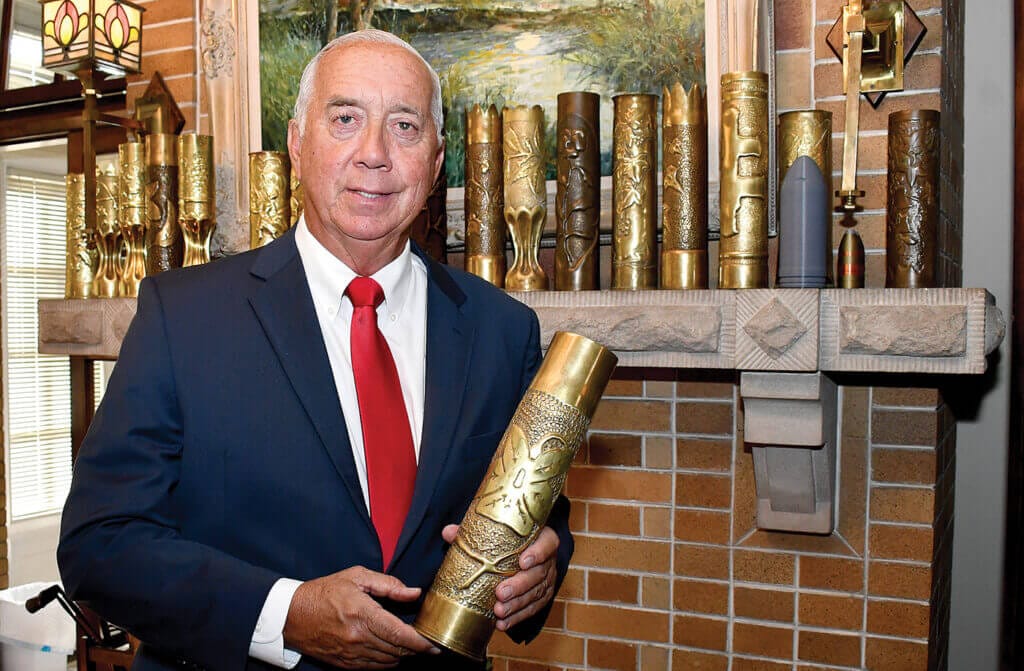
Buck collects mission furniture, steins and quartz for starters, but his most prized collection is called Trench Art. He wagers he has the largest collection in Alabama, and by the looks of his law office, it would be risky to bet against him.
Raised in Ionia, Michigan, Buck graduated from Michigan State and applied to Cumberland School of Law in 1972.
“I came down here to this foreign country,” Buck laughed. “I didn’t know anyone. And when I look back on my life, I figured, well, it had to be the good Lord because of all the places I could have gone. I got this warm weather, my career and I met my future wife of 50 years!”
Buck, who raised his family in Vestavia Hills, has been a successful personal injury lawyer for 45 years. His charismatic daughters, Ashley and Rachel, practice law with him out of a Frank Lloyd Wright-style 1912 house in Southside that doubles as a private museum.
But What Is Trench Art?
Trench Art refers to decorative items made from war debris. During the First World War, soldiers on both sides of the conflict spent countless hours in trenches. While waiting for the inevitable battle, soldiers began making art from the materials around them, as did POWs held in camps.
The bulk of trench art is made from artillery shells, bullets, shell casings and other metal scraps which were ubiquitous on the battlefield. Artillery shells were heated and sculpted, and all sorts of other objects were made, such as pens, lighters, ashtrays, rings, lamps, letter openers and knives.
The Buck Collection
Buck bought his first piece of trench art eight or nine years ago at an antique show, but the bulk of his collection comes from overseas, pieces he bought on the internet.
A couple from Columbus, Georgia, whom he found on Etsy sold him their entire collection for $1,000. A man from Colorado who had worked for the Department of Defense in Europe sold Buck his entire collection, too.
“All in, I’ve probably got 250 shells,” he said. The artillery shells have engravings and often initials, and many come with the history of the area where it was created. How soldiers made these engravings in a trench is somewhat of a mystery, but that’s part of what makes it interesting.
Buck has learned how to be a savvy collector.
“You can go online and pay $800 or $900 for one piece, but I’ve learned to look for the good deal,” he said. “I’d say my average cost is anywhere from $100 to $150 per piece, and I figure the brass alone is worth $100.”
Buck uses brass polish on some shells but otherwise they are in amazing shape.
“People walk in my office and they have no idea what they are seeing,” he smiled. “Sometimes I give one to a client.”
Trench Art serves another important purpose as Veterans Day approaches. It reminds us of the people who came before and the great sacrifices they made.
One shell has the word ARGONNE carved in it. It’s the location in France of one of the bloodiest battles of WWI, with 26,000 American casualties.
Buck believes art that helps us remember those who sacrificed their lives is worthwhile, indeed.