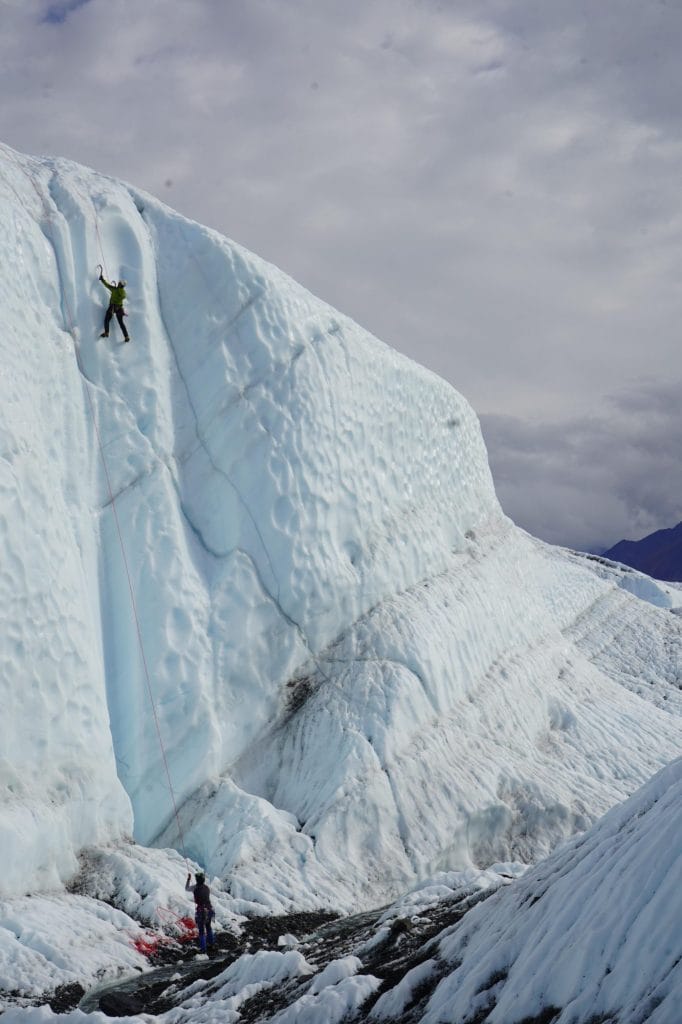
By Ford Boozer
Small chance, but I’ve got a best friend who’s also named Ford. I was halfway to his wedding on the coast of Georgia, searching the internet from some road-side inn for a way to spend the looming summer. I was a graduate student at UAB and could break away from the coursework until September. Ford got married in March, amongst the blooming oaks in Savannah’s square.
Alaska had only existed in my mind as some rugged, mountain novelty, a curious place. Some years before, a friend named Berry worked a summer gig in Seward. She was in between rental homes and spent a few weeks vagabonding; we met while she was tent-living in a a state recreation area outside Bozeman, Montana—Hyalite Canyon—a mountain-scape famous for its world class ice climbing and backcountry skiing.
She raved on the experience, the beauty of it all. Seward is a port town at the furthest reach of the Turnagain Arm, a two lane from Girdwood that connects greater Alaska to its Kenai Peninsula. The road is flanked with glaciers the size of Irondale. To the southeast rolls the navy tide of the Cook Inlet ornamented with the spray of humpbacks, framed by mountains and volcanos crowned with snow fields and hanging glaciers. Her description met me like most travelogues do, the place seemed far off in more ways than one. I had never heard of Seward, Alaska.
The search for summer jobs in the great north turned up opportunities to flip bed sheets at B and Bs in Talkeetna, clean sled-dog kennels in Whittier, work as a barista, a janitor, a fisherman. Alaska: grunt work with a view.
I don’t know how I found it, but there was a listing for a glacier-guiding apprenticeship in Glacier View. I was in the deepest recesses of the search, hours had passed. It was the moment when the internet excites beyond what is sensible, at too-late an hour, about scenes of opportunity that tomorrow would seem unrealistic. I emailed Don, the owner of MICA Guides, expressing interest. Ford’s wedding was the next day. Don emailed back during the rehearsal stating that hiring wrapped up in February and thanked me for applying. What he said next turned it around: one of the apprentices had torn up his knee, and there was one spot left.
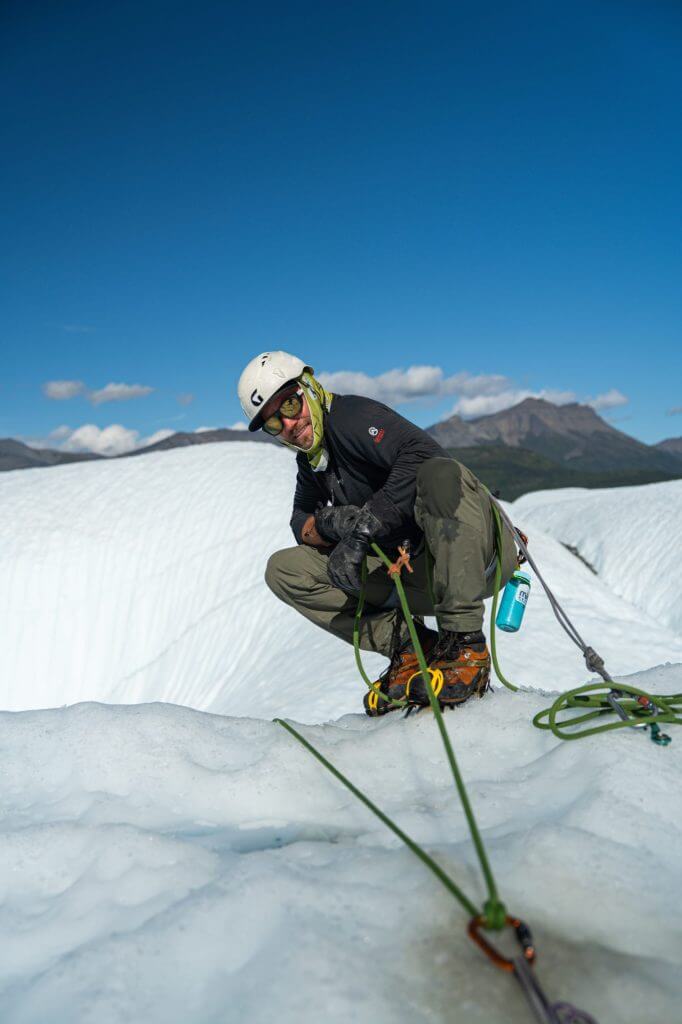
I interviewed; Don was the kind of guy that had attracted me to the outdoor pursuits, in some vague way, a decade earlier. His presence was easy and self-assured, attire of Carhartt and faded flannel. Days later, I landed the final spot in MICA Guides’ 2022 class of apprentices, thanks to grace and the tweaking of an MCL. Sometimes the roads at life’s forks aren’t perceptible at all until you stumble half-blindly onto them.
We were to be ice-climbing guides, living in tents on the flanks of the Matanuska State Recreation Area. This is only months after a friend had introduced me to the vertical world at Birmingham Boulders, an air-conditioned and color-coded climbing gym with soft landings. I was in over my head. I spent my 20s outside, backpacking and riding mountain bikes. Still, experience on ice went as far as the freezer door.
I flew to Anchorage and was picked up alongside the other first years by a couple of senior employees. We spent our first night at a lakeside campsite worthy of an Outdoor Magazine cover, buzzing with that childlike sense of belonging. Nothing was yet at stake, no professionalism to uphold. We laughed and laughed. It felt like I reclaimed something that passed me by at the speed of sound, the eagerness and inspiration and community of youth. Those campfire scenes that look cool in the movies.
Instructions the first night were matter of fact. The senior staff members piled tents on the ground: we were told to pitch them. On the campsite’s picnic table were lain simple ingredients: we were instructed to make dinner. Before bed, “6:30 departure in the morning, have your tent completely put away. Oh, don’t be late.” We were at the front door of what you might call a no-nonsense residence.
As promised, we drove northeast at 6:30 a.m. from the outskirts of Anchorage to MICA Guides basecamp. If you ever have the chance to cruise the Glenn Highway, don’t miss it. A Sprinter van and 12 new friends. Like I mentioned, re-finding a sense of youth at this point. We were driving amongst the biggest and most majestic mountains on the continent, on the way to a job we had all scored from a serendipitous internet search.
Halfway to base, we banked at a pull-out. Some propane stoves and ingredients were assembled on the banks of the Matanuska River, a braided and glacially fed torrent of 32-degree ice water. We were in instructed to make breakfast.
Arrival at base prompted the beginning of G-Week (‘G’ for grit), the company’s ceremonial initiation intended to stress-test, prepare, mature, etc. Early mornings and a 12-hour-a-day, air-tight schedule. An experience to sum up G-Week: the first years went hiking with Don on a newly acquired piece of company land. Bear in mind—we’re the new folks at a well-oiled and highly fruitful guiding operation with well-amassed resources.
He told us a little about his vision for the place going forward, and at the end of the hike we all sat in a loosely fashioned circle on a bluff above the Matanuska River while Don listed out the various threats to our lives that pervaded the area: moose, bears, wolves, the cold (we were to live in tents), the river, lightning, the list went on and on into the night. His point: Alaska is no place for the faint o’ heart. Then he told us with a deadpan nonchalance that we were to stay the night on the bluff—make a fire, find a semblance of shelter, eat. There were Jet-Boils and Mountain House meals staged by the senior staff (we had no idea), alongside enough tarp to put a centimeter of protection between us and the damp tundra. I’ve never been so cold. Awaiting the morning ensemble of birdsong made time stand still.
There was a point, of course. Don values preparedness, taking calculated risks, recreating on the lucid side of the thin line dividing splendor and foolishness. He bought a van and started over in Alaska at 30, purchased land, built a cabin, bought a guide service, summitted Denali on his 40th birthday; listen to one of his stories and find that waltzing with life’s fragility is requisite to admission to the Last Frontier. He wanted us to appreciate that the wildlife that shows up in our backyards will hardly resemble a fox squirrel or the neighbor’s cat.
There was another, less perilous, theme that Don baked into the epic that was the employee experience. It’s informed my life more than having lived nearly half the year since the Covid outbreak with a Coleman tent separating me from the local grizzly bears and 20-degree katabatic winds. At MICA, we fended for ourselves. Glacier View is a town of 375, an hour from the nearest canned Diet-Coke. If the toilet breaks, no one’s coming to fix it. We were the plumbers, laborers and mechanics. “Alaskans are useful people,” Don said. Hard to admit this: a year before I would’ve called the handyman to hang the blinds if the little cellophane baggy components numbered more than ten.
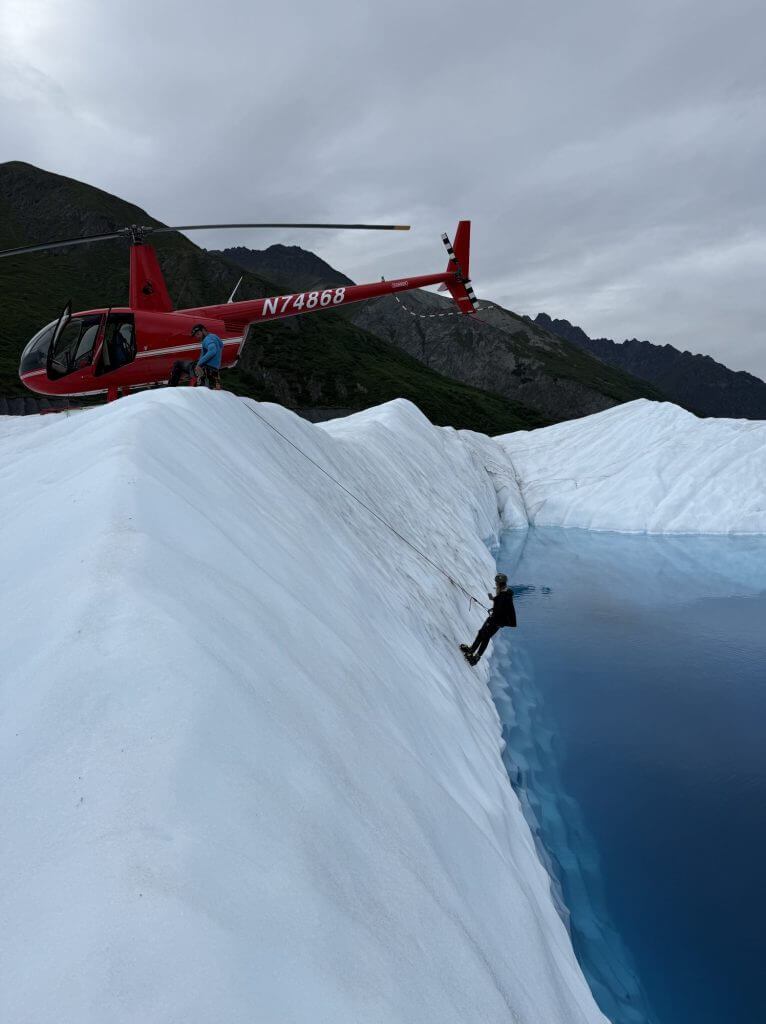
Postscript: I just finished my fourth summer as an ice-climbing guide at MICA. We fly in helicopters with paying customers and drop them into otherwise inhospitable, glacial wilderness that very few people have trod. My role: Senior Glacier Guide—training greener guides in the world of technical ropework, risk management, decision making, etc. The consequence of a mistake on the Matanuska Glacier is injury or death, seldom less. The ‘Mat’ is a 27-mile-long slab of living ice with menacing crevasses and moulins that more closely resemble the moons of Jupiter than anything in Appalachia. You can stand on their flanks and drop a large gneiss stone and count to 10 M-I-S-S-I-S-S-I-P-P-I before hearing contact. The trainees are eager and riddled with imposter syndrome, as if the competencies that so await them lie behind plexiglass in a locked safe. Taking strangers and trainees into the most beautiful landscape on earth always was a grand puzzle with a regal view. A great way to spend a workday is the least of it.
What sticks more than the rolodex of scenery, though, is the satisfaction and confidence that accompanies having lived a life of self-sufficiency. Modern life can go something like this: work all day so that I can pay someone else to do the multitude of other things that are otherwise keeping me alive. The contractor builds the house, the line-cook prepares the food. Not a bad thing; it takes a village. My experience however: get down to the rudiments of what it takes to be human and find satisfaction: harvest food and water, make a shelter, a fire when it’s cold. Fix the power steering pump. I don’t mean to say that we were out hunting moose with arrowheads. But as far as carrying the weight of my own life, it’s the most I’ve ever shouldered. Funny thing to say in 2025, the inconvenience of it all just might hold a clue to solving the riddle of living a life that gratifies.