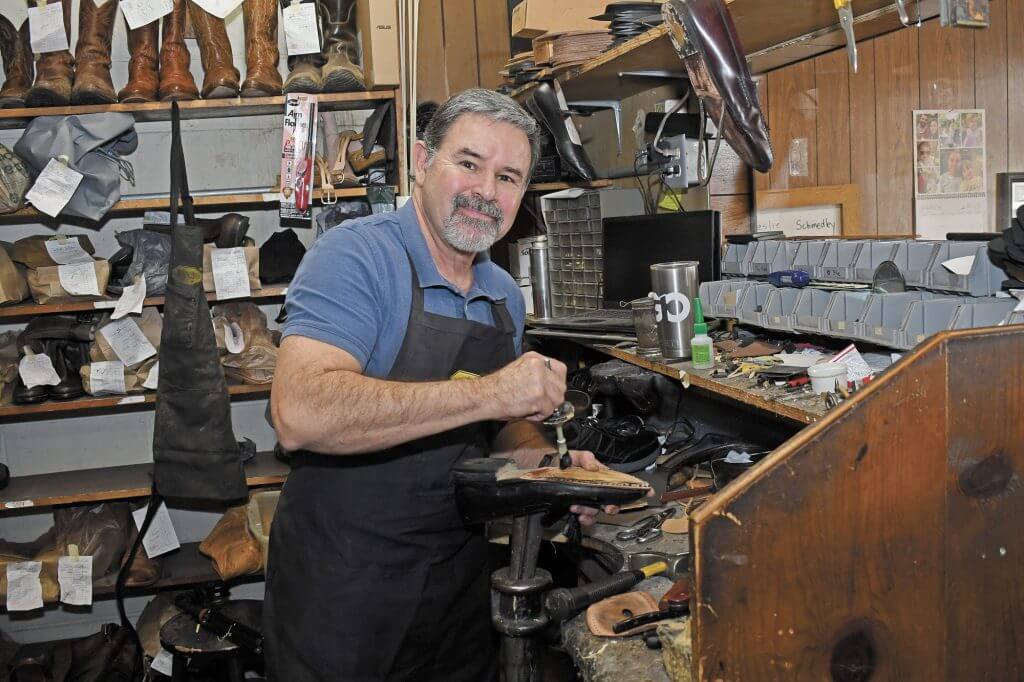
By June Mathews Photos by Jordan Wald
Some say the cobbler trade is declining. But anyone watching the comings and goings at Cahaba Heights Shoe Repair on a recent Tuesday would find that hard to believe. The unassuming storefront in the heart of the Heights was abuzz with customers picking up or dropping off an assortment of shoes, belts and handbags, either newly repaired or in need of fixing.
Despite the flood of activity, the proprietors were courteous to each customer and patient with anyone whose repair issue called for a bit of extra attention. But that’s just how Ken and Marilyn Carbonie roll. Steeped in the community where they both grew up and in their solid faith-and-family values, the couple serves their customers with care.
A third-generation cobbler, Ken learned the business from his dad, who learned it from his dad, who learned it from an uncle who came to the U.S. from Italy. “My grandfather started a shoe repair place in downtown Birmingham, but he was kind of in and out of the business,” says Ken. “He really didn’t like it that much.”
But for Ken and his dad, Jasper, the business became a satisfying way to work with their hands, a means of providing for their families and an opportunity to offer a valuable service to the community.
By the time Jasper died in 2006, he had been in the shoe repair business for 60 years. But his legacy lives on. “Dad opened in Cahaba Heights on December 8, 1960, the day I was born,” says Ken. “My grandfather had to take care of the shop that first day so my dad could be at the hospital with my mom.”
And the business, Ken recalls his dad telling him, started out with a bang. “When he came out here, Highway 280 was still two lanes,” he says. “There wasn’t much here in 1960, if you can imagine that. So, he was a little worried about starting a shop because it was so far out.” And yet, before even opening the door, he had two weeks-worth of work waiting to be done.
Originally located in a freestanding building in front of Western Supermarket in what was then Cahaba Heights Plaza Shopping Center (now The Heights Village), the shoe repair business grew and soon needed more space. So, in the mid-1960s, when a new strip of storefronts was built across the road, Cahaba Heights Shoe Repair became one of its first tenants and has been there ever since.
In the meantime, Ken, who had once considered a career in law enforcement, joined the business in 1980, and learned the cobbling trade on the job. “His mother didn’t want him to do it, and his dad didn’t really encourage it,” says Marilyn. “We wouldn’t encourage our kids to do it. This kind of business is really hard work.”
But it’s work that Ken has thoroughly mastered over the years, making him one of a dwindling number of experts in the field. Cobbling, some say, is a dying art. For one thing, it’s often just as economical to throw away mass-produced shoes made with synthetic materials as it is to have them repaired. For another, becoming a cobbler takes a special brand of dedication to make the grade.
“You have to have a strong work ethic,” says Marilyn, “and a lot of people just don’t have that these days. We’re told all the time that we need an apprentice, but Ken doesn’t have time to slow down and teach anybody, especially somebody who may not really be cut out for it.”
Then there’s this crucial quality called “a knack for fixing things,” which Ken is apparently blessed with. “He’s a Mr. Fix-It,” Marilyn says. “He can fix anything.”
But cobbling, says Ken, is a tough skill to learn, not something anybody can easily pick up and do. “It takes at least two or three years just to learn the different kinds of shoes, and every shoe is different,” he says. “Then you have to work on your own machines, deal with customers and run a business. There’s just a lot to it.”
But for now, neither the lack of a good cobbler nor a lack of business is a problem for Cahaba Heights Shoe Repair. The shop has one of the most experienced shoe repairmen around and plenty of work. Customers come from all over, including Tuscaloosa, Sylacauga, Auburn and some from as far away as Mississippi. Wait time for repairs is currently two to three weeks.
“It’s rare for somebody to be in a small business like this for 45 years,” says Marilyn. “I’m grateful for it, and we give God all the glory. Ken has been faithful to serve God, and God has been faithful to him and our family.”
Married for 43 years, the Carbonies have three daughters and four grandchildren.