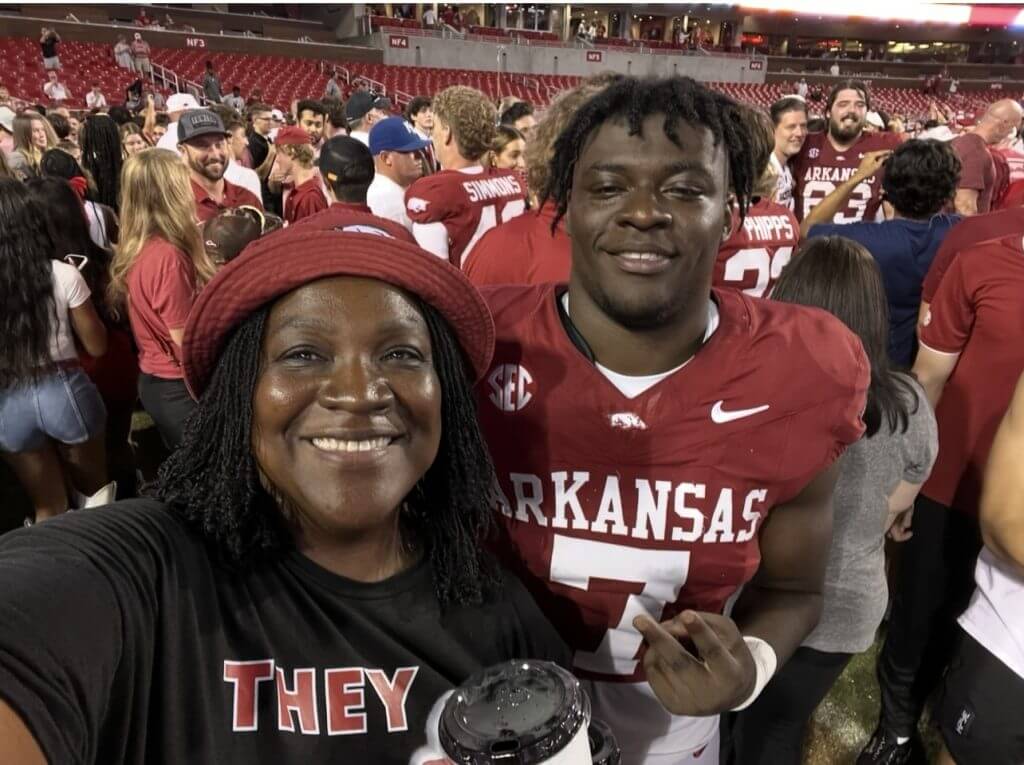
By Andrew Cotten
Every morning at Mountain Brook Junior High, Karen Shaw takes her place at the crosswalk. Rain or shine, she shows up all the same, long before most of her colleagues arrive.
Karen could do the job quietly, with nothing more than a watchful eye, but she never does. A stranger to none and a mother to all, she offers a quick hug or a kind hello to anyone who needs it, even holding traffic for a brief exchange with parents. She greets shy seventh graders by name and picks up conversations with ninth graders she’s come to know.
As a paraprofessional, she doesn’t get enough credit, but she should. She’s the kind of colleague who helps hold the building together in many ways: remembering birthdays or sharing supplies; spotting mistakes and offering solutions; showing up early and staying late. An anchor amidst the turbulence of teenagers, her determined steadiness has a way of settling the ship.
And if you know (or know of) her son Bradley Shaw and all that he did to keep the Arkansas Razorbacks afloat this past season after losing their head coach, you can see where the sophomore linebacker learned the value of steadiness: the same stability Karen brings to our school is the very quality her son carried into the Arkansas locker room navigating change, uncertainty and the long aftermath of a coaching transition.
For nearly two decades, the Shaws’ weekends have been a routine rotation of sporting events, long drives and late dinners under the glow of stadium lights. Three of Bradley’s older siblings were college athletes, so Bradley “was brought up in it,” Karen says. “He was a ballpark boy.”
When it came time for peewee football, Bradley was no stranger to the sport and took to it immediately. Even at a young age, Bradley was bigger than the other players. He could have phoned it in and still physically dominated, but he didn’t: he was dedicated to bettering himself. “As others were playing,” Karen says, “Bradley was out there practicing.”
The coaches knew what to expect when Bradley joined Hoover High School’s powerhouse program—the same one his brothers proudly claim. Karen says they’d see him on the field for the first time and say, “You a Shaw,” half warning, half praise. The name carried weight, and Bradley lived up to it. In 2023, he was named 7A Region 3 All-Region First Team and selected to play in the All-American Bowl. The following year, he was awarded Class 7A Lineman of the Year by the ASWA.
When it came time for recruitment, Bradley was an elite prospect—listed consistently as a top-20 linebacker and top-200 overall. By the end of recruitment, he’d earned more than 25 Division I scholarship offers.
Long before the transfer portal and Name, Image, and Likeness (NIL) economics reshaped college football, recruiting operated more patiently. It was rooted in trust, relational. Coaches visited homes, sat on couches, met with players and parents and promised development over time.
That’s the model the Shaws followed, even amid the sport’s seismic changes. “We kept in touch,” Karen says. “Some of these coaches, we’d been talking to for over a year.” Where Bradley chose to play was less about business and more about relationships, even if that meant passing up prestige, larger programs or more lucrative NIL offers.
Bradley’s recruitment brought visits from dozens of major programs. His final three came down to Clemson, Notre Dame and Arkansas. Compared to Clemson’s national profile or Notre Dame’s storied legacy, Arkansas seemed quieter, less glamorous.
For Bradley, the people in charge and the promises they made were more important than the merits of the past. Recruitment was full of slogans and promises, but sincerity mattered more than salesmanship. Ultimately, Arkansas’ authenticity convinced Bradley that it “was the right fit,” and Karen agreed: “I didn’t have to worry—the coaches got him.”
Bradley’s freshman season confirmed he’d made the right decision. Coaches saw enough potential to forgo redshirting him. Seniority limited his initial playing time, but when linebacker Xavian Sorey was injured, Bradley stepped in. By year’s end, Bradley had 13 tackles and one sack.
Hopeful the next season would be better, optimism surrounded the young defensive core in the off-season, but it didn’t survive the following fall. After three straight non-conference losses, Arkansas fired Head Coach Sam Pittman on September 28. Within days, much of the defensive staff, including Defensive Coordinator Travis Williams and Defensive Line coaches Deke Adams and Marcus Woodson, was gone, too. These were the same coaches who had sat in Karen Shaw’s living room, the ones who had earned the family’s trust.
Bradley’s response to the reality of losing a coach mid-season has been exactly what his upbringing predicted. In a sport now defined by quick exits, Bradley chose to stay. What’s more, he stepped up to help “keep the team together.” By encouraging teammates who were exploring the transfer portal to stay and stand by their commitment, Bradley helped stabilize an Arkansas roster that’s weathered three staff overhauls in two years.
Bradley chose to stay at Arkansas—not out of comfort, but out of conviction. Karen has always told her son, “When you don’t have it, you make your own way.” With a team in flux and a season wobbling, Bradley did exactly that.
When Missouri quarterback Beau Pribula fumbled, Bradley reacted instantly, scooping it up, returning it 32 yards for a touchdown. It briefly shifted momentum in a rivalry game during a season defined by loss after loss.
The scoop-and-score wasn’t just Bradley’s defensive highlight; it was a metaphor for commitment. The fumble didn’t create the moment—it revealed it. The habits Bradley formed long before Arkansas—practicing when others played, staying when leaving was easier—had already prepared him. When the ball came free, he was ready because he’d never stopped preparing.
The day after Bradley scored, Arkansas announced its new head coach: Ryan Silverfield. Before he met with the players or evaluated a single drill, his first snapshot was of No. 7 scooping up a ball most would fall on and outrunning an SEC offense to the end zone. Bradley’s biggest moment was earned in the old fashioned way: by being where he said he’d be and doing what he said he’d do. It’s impossible to know whether transferring could have boosted Bradley’s national profile. But it’s equally impossible to ignore that the play of his season only existed because he stayed rooted in Arkansas’s chaos instead of running from it.
We talk about the long game in football—the slow work of development. But it isn’t slow anymore, and the trust feels obsolete when rosters can reset in weeks, and coaches can vanish mid-season.
Somewhere back in Alabama, though, a mother believes the old truths still matter. There’s something remarkable about that kind of assurance. The confidence of a mother who knows she’s done her part. It’s not ignorance. It’s faith that traits like loyalty and leadership, patience and presence still mean something, even in a sport that seems to forget.
Who knows what next season will bring for the Razorbacks. But, Bradley, whom Karen says has “unfinished business,” will be there, lined up on the strong side, loyal to the team, possibly to a fault.