By Susan Swagler
Spring is in full, glorious bloom, but that’s not the only reason to revel in the outdoors.
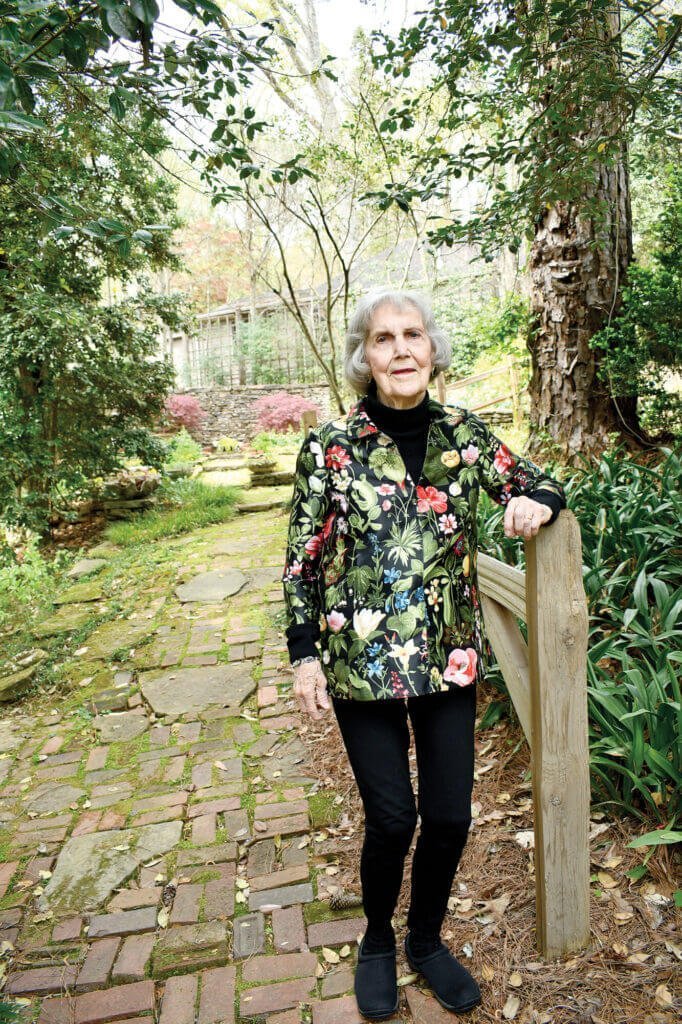
Louise Agee Wrinkle – a prominent local gardener known for inspiring and encouraging native gardening across the country – is being celebrated during a series of events that includes the premiere of a documentary film about her garden; a second printing of “Listen to the Land,” her book on the subject; and exclusive, rare tours of four local gardens – including Wrinkle’s own.
Nearly four decades ago, Louise and John Wrinkle moved into the Beechwood Road house, built by her parents in 1938, where she grew up. The home is on a wooded lot she and her sister once called “the jungle.” When she moved back, it was hardly a jungle, but her goal was to make the 2-plus acres of mixed woodland her own.
“I thought, ‘Well, this is mine now, and I need to do something with it. But I don’t want to impose anything on it. I would rather let it say what it needs to say. I wanted to have it natural,” she said.
This wasn’t just a passing whim.
Wrinkle’s father was a naturalist, and he instilled in her a love of the natural world with its many treasures – from acorns to trees, seashells to rocks. So, she was careful and respectful in how she approached her land.
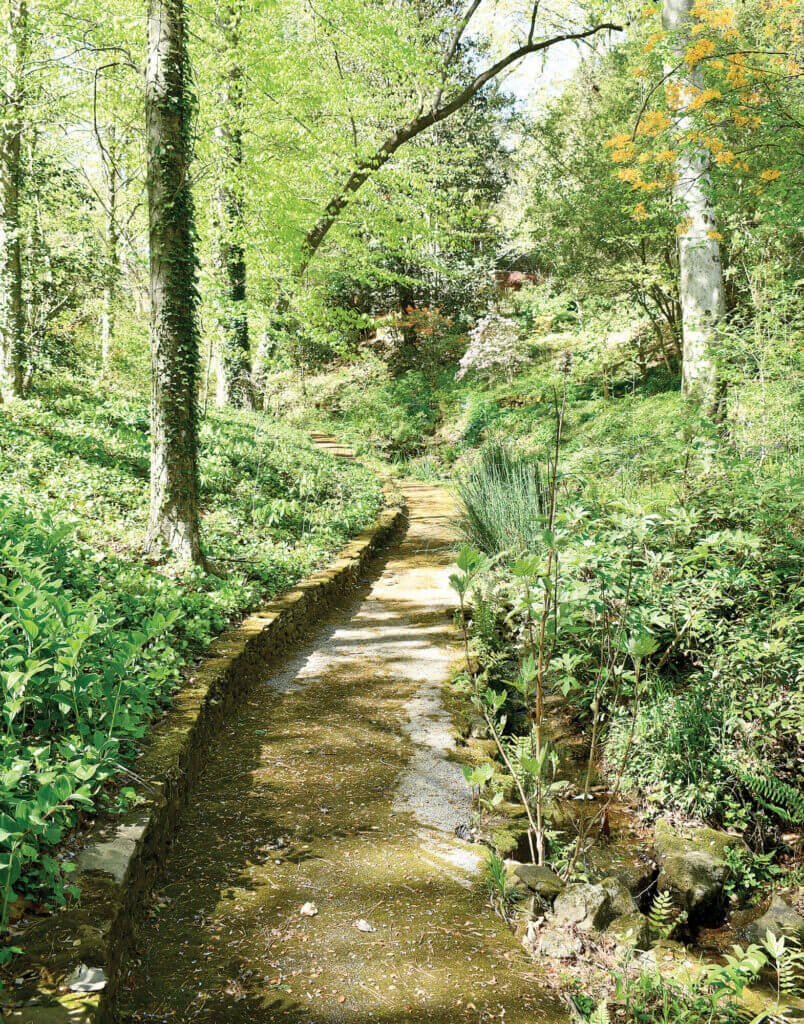
She worked with landscape architect Norman Kent Johnson to create a network of paths and stone walls to better access all areas of the property with its grade changes, rocks and fresh running water.
Today, there is a verdant moss path alongside a natural creek where Wrinkle and her sister caught salamanders when they were children; tiny ferns grow between the stones on stairs; an archway of native crabapple frames a small, sunken parterre of boxwoods and tulips near the house. There are smoke trees, beech trees, Japanese maples, water oaks, evergreen dogwoods, loblolly pines and surprising shapes of fungi fruit in leaf litter. Ferns of all kinds –maidenhair, cinnamon, Japanese painted – cluster in the shade. There are black-eyed Susans, meadow rue, native azaleas, Daphne, camellias, spirea, fairy bells, narcissus and miniature columbine. Sculptural trilliums line walking paths, and hidden benches throughout the property offer places to simply sit and enjoy it all.
Wrinkle relied on Latin learned in high school and college, and she continued her horticultural education through additional college classes at Jefferson State Community College. The more she learned, the more her interests expanded.
“At first, I thought I wanted to stay in natives,” she said. “But then I understood, of course, that there is just a world of other plants out there. If I restricted myself to natives, I would be missing a lot.”
So, she added Asian plants to her mix. She says she sometimes places a native plant and a corresponding Asian variety near each other so she can see them and compare them. She’s done this with a native fringe tree and a Chinese fringe tree; native Solomon’s seal and Japanese Solomon’s seal.
“It’s interesting to see them in comparison,” she said.
Years later, this mix of natives and Asian counterparts, which includes family collections of hollies, azaleas, ranunculus and much more, has enriched the wooded space in a beautiful, intentional and inspirational way.
Film, Book Detail Wrinkle’s Gardening Philosophy
All this is covered in the Garden Conservancy’s latest documentary film, “A Garden in Conversation: Louise Agee Wrinkle’s Southern Woodland Sanctuary,” which premiers May 5 at 3 p.m. at the Virginia Samford Theatre. The film explores the ideas of preservation and conservation and Wrinkle’s own gardening philosophy of “letting plants develop as they will and tend to them in a way that highlights the subtle beauties of texture, rhythm, pattern, repetition.”
After the screening of the documentary, there will be a panel discussion on Southern gardens, native plants and conservation with local and regional garden experts followed by a reception.
Wrinkle’s garden is further detailed in her award-winning book “Listen to the Land: Creating a Southern Woodland Garden.” The book features stunning photographs of plants large and tiny, a handy plant guide with growing information as well as common and Latin names of plants in her garden. She recounts the joys and challenges she’s experienced over the years working her land. The book has been revised and has a new preface by James Brayton Hall, the CEO and president of the Garden Conservancy.
This May 5 film and book event is free, but registration is required. Go to gardenconservancy.org to register.
All this celebration is fitting because Wrinkle has inspired countless gardeners here at home and across the country with her minimalist approach to gardening and her intense appreciation for the natural world.
She said she took what was given and “made the most of it. … But also, you’ve got to sometimes be sort of fierce. I’m big on breathing space. You’ve got to have some breathing spaces.”
‘Leave It Alone Most of the Time.’
Not everyone can create a sanctuary like Wrinkle’s, but we all can learn to better notice and appreciate what’s around us.
“Nature and God,” she said, “know what they’re doing.” Her advice: “Leave it alone most of the time.”
She encourages people to cultivate personal knowledge about what’s growing around them – native species, especially.
“I just wish more people knew more about it so they could appreciate it,” she said. “I mean, they’ve got all this surrounding them, and if they don’t know about it, it’s just sort of a blank wall.”
Wrinkle said she is grateful for the varied beauty in all her garden’s seasons.
“Spring is thrilling, but I love winter, really,” she said. “Everything’s clear. The air is clear, and you can see things; you can see the bones. You can see the lichen on the trees. You’re not distracted. I think a lot of people want nothing but the color and flowers, but I think they’re a distraction to the whole picture. I don’t mean distraction in a bad way. I mean, if that’s what you want, that’s what you see and you don’t see much of anything else.”
That said, her garden will be in beautiful bloom during the weekend festivities.
Open Gardens
Four private, Birmingham-area gardens, including Wrinkle’s woodland sanctuary, will be open for tours during the Garden Conservancy Open Days program on May 4 from 10 a.m. to 4 p.m. This is the first time that has happened here since 2009. Admission is $5 for Garden Conservancy members and $10 for non-members. Tickets are available at gardenconservancy.org/open-days.
The idea behind the Open Days is to introduce gardeners of all levels of experience to a diverse range of garden types, sizes and traditions. Since 1995, Open Days has welcomed more than 1.4 million visitors into thousands of inspired private landscapes – from urban rooftops to organic farms, historic estates to innovative suburban lots – in 41 states.
Wrinkle is a founding member and director emerita of the Garden Conservancy, which is dedicated to preserving, sharing and celebrating America’s gardens and diverse gardening traditions. She also has been a distinguished member of the Garden Club of America for 40 years. She received the Foundation for Landscape Studies Place Maker Award in 2019.
There’s not much in her garden that surprises Wrinkle anymore. Things are constantly changing. Plants bloom early, they bloom late; new plants sprout and spread; trees come down. She takes it all in stride. When one enormous oak fell during a storm last Christmas, Wrinkle fashioned a big bow from ribbon and tied it around the stump much like someone would decorate a mailbox for the holidays.
But there is one specimen on her property that did bring some unexpected delight recently – a handkerchief tree.
“It’s called Davidia. It’s famous for being slow to bloom,” Wrinkle said. “I had one that was here for 30 years before it bloomed. I don’t know whether it’s going to bloom this year or not.” It certainly was thrilling when it did, she said.
“It has what looks like blooms but they’re really bracts. … It looks like handkerchiefs being thrown in the tree.”
She’s quiet as she reflects upon the memory of this, the surprise and sheer enchantment of it.
It’s clear that Wrinkle’s sense of reverence for her land is deep. It guides her. It has guided her all along.
“Respect,” she says, “that’s what I have for the land.”
Garden Conservancy Open Days Offerings
Garden Tours
During the Garden Conservancy Open Days program on May 4 from 10 a.m. to 4 p.m., visitors to the four Birmingham-area gardens can experience these special spaces:
Louise Wrinkle’s Southern Woodland Garden: On Wrinkle’s 2 acres, visitors will see a variety of garden areas including a sunken boxwood parterre framed by a Belgian fence of native crabapple, a cutting garden and a natural brook that flows all year. Follow a network of paths and small stone walls and experience a thoughtful horticultural history that began with natives and extends to colorful Asian counterparts.
Rooms With Views: Garden structure and sculpture, scenic views that extends for miles across Shades Valley to the ridge beyond, and all manner of fragrance and blooms await visitors at this 1-acre garden set within a framework of original walls and terraces. You’ll not want to miss the hedged, almost-secret space for bocce; a portion of the garden devoted to fruits; and the many wonderful areas for al fresco entertainment.
The Butrus Garden: An Italianate garden surrounds a grand house of gray limestone in the middle of a 4-acre mature woodland space. The emphasis is on greenery, stone and water. Look for an antique fountain, many private nooks for entertaining, a greenhouse whose stone base matches the house, an antique copper female figure and a new woodland garden designed by noted Birmingham landscape architect Norman Kent Johnson.
The Dancer: On the down slope of Red Mountain, a 1930s Tudor-style house is home to a beautiful small garden inspired by water, a ballerina and roses. The space is about 2,100 square feet (35 feet by 60 feet) and features two garden “rooms.” The Fountain Garden is centered on the home’s renovated kitchen’s steel-framed glass doors. Adjacent to the Fountain Garden is The Rose/Sculpture Garden, centered on the living room. A display terrace for a beautiful 8-foot-tall bronze ballerina sculpture is surrounded by four Winter King Hawthorns with a colorful, fragrant rose garden beyond.