By June Mathews
Fresh out of college with an art education degree and new to the Birmingham area, Jessica McClurg sought to make connections in the local art world.
She naturally gravitated to the Birmingham Museum of Art, where she currently serves as a teaching artist two nights a week. As opportunities arise, she also teaches in a museum-based after-school program for schools that don’t have art programs or teachers available to teach art on a regular basis.
Then she heard about Cahaba Inspired, a first-time juried art exhibit at Trussville Public Library, and saw it as another way to connect with like-minded individuals and an opportunity to learn more about her new home in the process.
A joint project between the Cahaba River Society and Arts Trussville, Cahaba Inspired was conceived as a way of spotlighting the river, as well as the society’s mission to protect it. Not only is the Cahaba River a source of drinking water for a significant portion of Alabama’s population, but it’s one of the most biodiverse waterways on Earth.
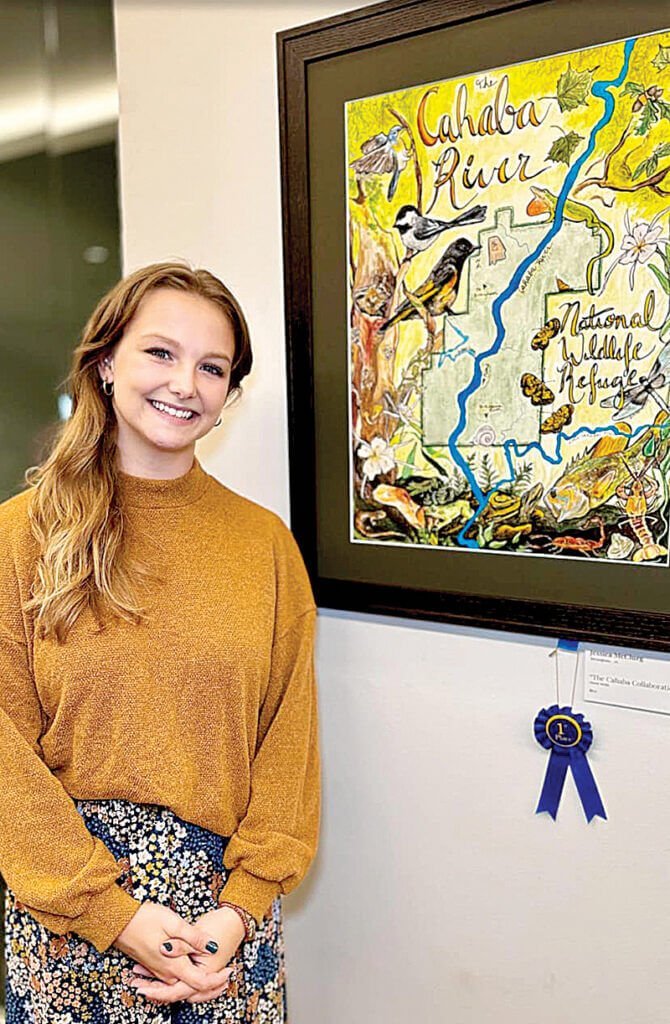
It was that biodiversity that piqued McClurg’s interest and inspired her to submit the work of art that ultimately was proclaimed Best in Show on Nov. 9 at the Cahaba Inspired opening event. But the painting she produced and titled “Cahaba Collaboration” didn’t happen without McClurg first becoming acquainted with the river, personally and in her research.
“I started by visiting the Cahaba, spending time there and swimming in it,” McClurg said. “I also did a couple of plein-air paintings on the banks of the river and made notes of the different things that stood out to me personally while I was there.”
When it came to planning her work, she consulted inaturalist.org, which provided a list of the species supported by the Cahaba. She chose several species that stood out to her then narrowed her choices to ones that seemed the most representative of the river.
One of the river creatures that made McClurg’s cut is the oblong rocksnail, considered extinct until it was rediscovered in the Cahaba River in 2011. Today the rocksnail remains in only about 5 miles of the river and has been proposed for endangered species protection.
“I also included some of the staples like the copperhead snake, frogs, turtles and all those good things,” McClurg said, “and different types of trees, like the oak, maple and others, are represented by their leaves, as well as mushrooms and fungi that grow on the trees. I wasn’t able to include every single organism, but I did try to hit all of the categories and include as many as I could.”
Inspired by maps, McClurg wanted to give her painting the feeling of a National Park illustration, otherwise known as WPA style, without specifically coming across as such. So the style is all her own. The primary medium she utilized was watercolor with touches of paint pen, ink and colored pencil.
Recently graduated from Seton Hill University in Greensburg, Pennsylvania, McClurg grew up in western Maryland, “right on the border of West Virginia.” Soon after graduation, she and her high school sweetheart, Dillon DeWitt, got engaged.
“He asked me to marry him and come with him here, so of course I said yes,” McClurg said. “So, the two of us packed our stuff, set out and here we are. We are hoping to get married next fall. We’ve been together since we were 14, so he’s a huge part of my life.”
She makes no bones about how she and DeWitt feel about Alabama.
“We love it here,” she said. “When we first moved, it was just the two of us – no family or friends here at all – so it was difficult for me, being basically on my own in a whole new place. But I think I’ve found my art people, and I’ve been meeting people and making friends and getting involved. I’m happy that things are coming together.”