By Lee Davis
Pat Sullivan earned a lot of hardware in his days as a star Auburn University quarterback and later as a coach.
Sullivan won the Heisman Trophy as the nation’s outstanding college football player in 1971. In the 1980s, he directed the Tigers’ offense as Auburn won three consecutive Southeastern Conference championships.
But his most prized awards from athletics can’t be put on a mantle or in a glass case.
“The best memories aren’t specific games or victories,” Sullivan said. “What I treasure the most are the relationships. There’s that special bond among my teammates and coaches that’s most important, and it lasts even today. That feeling extends to the guys we played against, too. The friendships stay with you forever.”
An outstanding athlete from the time of his childhood in the late 1950s, Sullivan first gathered public attention as a brilliant quarterback at John Carroll. By the time of his senior season in 1967, he was being heavily recruited by major colleges across the county. Sullivan said the recruiting process – and the hype around it – was very different in the 1960s than it is today.
“Recruiting of course was very important but it had a much lower profile back then,” Sullivan recalled. “At the time, I had a standing time to meet with the Auburn and Alabama coaches who were recruiting and then with the coaches from the other schools that were recruiting me. There wasn’t all the rating services and internet stuff that goes with it today.”
Alabama and Notre Dame recruited Sullivan diligently. But he chose Auburn. “I really liked the atmosphere of the school and the idea of making Auburn a Southern powerhouse again,” he said. “Alabama and Notre Dame had great programs, but Auburn felt right for me at the time.”
But Auburn’s greatest appeal to Sullivan may have been the Tigers’ legendary coach, Ralph “Shug” Jordan.
“Coach Jordan was a tremendous influence on my life,” Sullivan said. “He helped me in so many ways. Coach Jordan made me a better football player – and a better man.”
Freshmen were ineligible for varsity competition in 1968, so Sullivan played on the Auburn freshman team. He made an immediate impact that actually shifted the course of the Auburn-Alabama rivalry. In the final freshman game of the year, the Crimson Tide blasted to a 27-0 lead over Sullivan and his teammates. Sullivan rallied the team to a thrilling 36-27 comeback, giving his class an important psychological edge for the future.
“Auburn had lost to Alabama several years in a row, and the fact that we could beat Alabama – even in a freshman game – gave us confidence that we could beat them at the varsity level,” Sullivan recalled.
As the 1969 season opened, Tiger fans were excited not only about Sullivan’s varsity debut, but also the arrival of a talented receiver from Montgomery’s Robert E. Lee High School named Terry Beasley. Within three years, the names Sullivan and Beasley would become as much a part of Auburn lore as Toomer’s Corner.
Auburn finished the season with an 8-3 record, including a 49-26 rout of Alabama, and Sullivan had established himself as one of college football’s best young quarterbacks.
The next year was even better for Sullivan and Auburn. They posted a 9-2 worksheet, including a second consecutive win over the Crimson Tide. The Tigers fell behind 17-0 before Sullivan and Beasley rallied the team to an exciting 33-28 victory.
“I think the memory of winning that freshman game two years earlier helped us in 1970,” Sullivan said. “We had come from behind to beat Alabama before and we knew we could do it again.”
Sullivan was starting to get more attention from the national media. He led the nation in total offense that season and finished sixth in the Heisman Trophy balloting, receiving more votes than any other junior. Some sportswriters gave him the nickname “Super-Sully.”
Auburn entered the 1971 season as a contender for the national championship. With Sullivan having another outstanding season, the Tigers were 8-0 when they rolled into Athens, Georgia, to face the also-undefeated Bulldogs. In the biggest game of his career, Sullivan was never better, completing 14 of 24 passes for 248 yards and four touchdowns as Auburn smashed Georgia 35-20. The four scores gave Sullivan responsibility for 71 touchdowns by either rushing or passing in a career, tying an NCAA record. Two weeks later, Sullivan won the Heisman Trophy.
“Winning the Heisman was an incredible honor,” Sullivan said. “But it was more about Auburn than it was me. I wish I could have given a piece of it to every player on the team.”
Sullivan, as the first Alabamian ever to win the Heisman Trophy, became a state celebrity. But he never let fame get in his head. Sullivan became active in local charities. He teamed with his close friend and rival, Alabama All-American running back Johnny Musso, to lead a March of Dimes campaign.
The Path to Coaching
After his college career ended, Sullivan played five seasons in the National Football League before retiring to enter private business. Although his business ventures were successful, Sullivan developed a strong desire to enter coaching.
“That was a time where I really missed Coach Jordan,” Sullivan said. “He passed away in 1980, and I really would have loved to have gotten his advice as far as getting into coaching was concerned.”
Sullivan finally got his shot in 1986, when Auburn coach Pat Dye offered him the job of offensive coordinator. Sullivan accepted and helped the Tigers win three consecutive SEC titles from 1987 to 1989.
After six years at Auburn, Sullivan was hired as head coach at TCU in 1992. In 1994, he led the Horned Frogs to their first Southwest Conference championship since 1959.
In 1999, Sullivan returned to Birmingham to serve as offensive coordinator at UAB. While at UAB, he was diagnosed with cancer and began a battle with the disease that has inspired people everywhere.
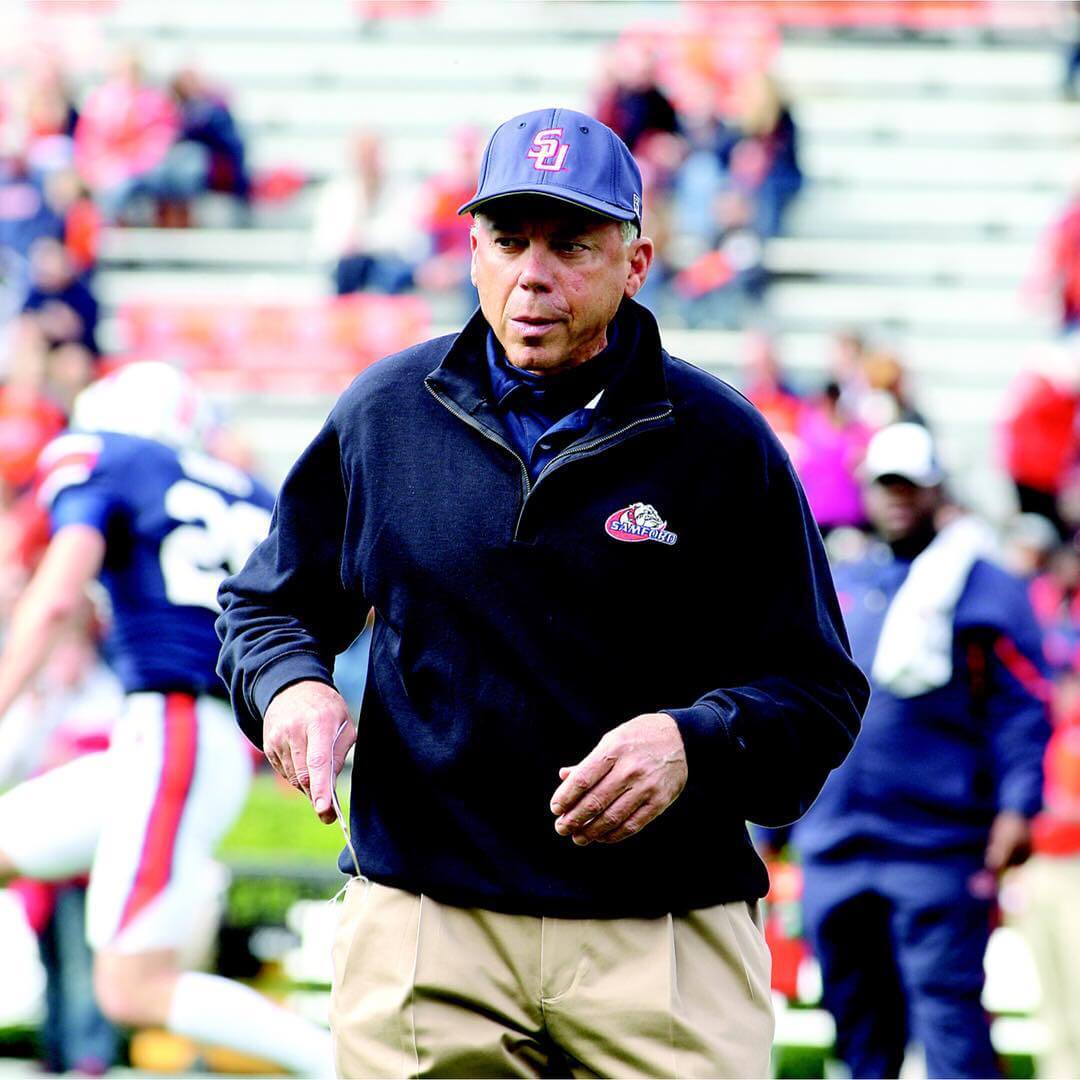
In 2007, Sullivan made his final coaching stop, accepting the head coaching position at Samford University. He piloted the Bulldogs to the Southern Conference title in 2013. A year later, Sullivan announced his retirement from coaching because of continuing health problems.
Now in retirement, Sullivan still attends Samford practices and continues to follow the sport he loves. But he has an even greater appreciation of what’s important.
“Football is a great game, but what makes it so great is the relationships,” Sullivan said. “When you work and sweat with a group of guys – whether you are a player or coach – you build a bond that lasts. Trophies and honors are nice, but it’s the special people you meet along the process that’s the most important thing of all.”
Just like many people his age, Sullivan is reflective when looking at his life. “I’ve been very blessed,” he said. “I’ve got a great family and great friends. What else can a man ask for?”
As a community icon since the 1960s, Pat Sullivan has given far more than he has received.