By Lee Hurley
The millions who have been touched in some way by addiction know that drugs and alcohol are often only the tip of the iceberg.
Most people strung out on fentanyl or vodka have inner demons to wrestle with. As Dudley Moore said in the movie “Arthur,” “Not everyone who drinks is a poet. Some of us drink because we’re not poets.”
Simply stated, the Foundry is a healing place for those who feel broken, useless and spiritually bankrupt from addiction. It’s a place families often turn to after they have exhausted every other attempt to help their loved one. It’s a place that doesn’t turn people away and doesn’t allow money to prevent anyone from hope. And it’s a model studied and copied throughout the South.
The Foundry offers a faith based nine-month program that costs less than $700 per person, with 42% of clients paying nothing at all, and includes housing, food, counseling, education, case management, employment readiness and aftercare programs.
The Foundry’s main campus is in Bessemer, and many Over the Mountain men and women have passed through its doors en route to a new life.
The program has a multi-million-dollar operating budget with 108 employees, many of whom are graduates of the program. Hundreds of men and women graduate every year and go on to live productive lives.
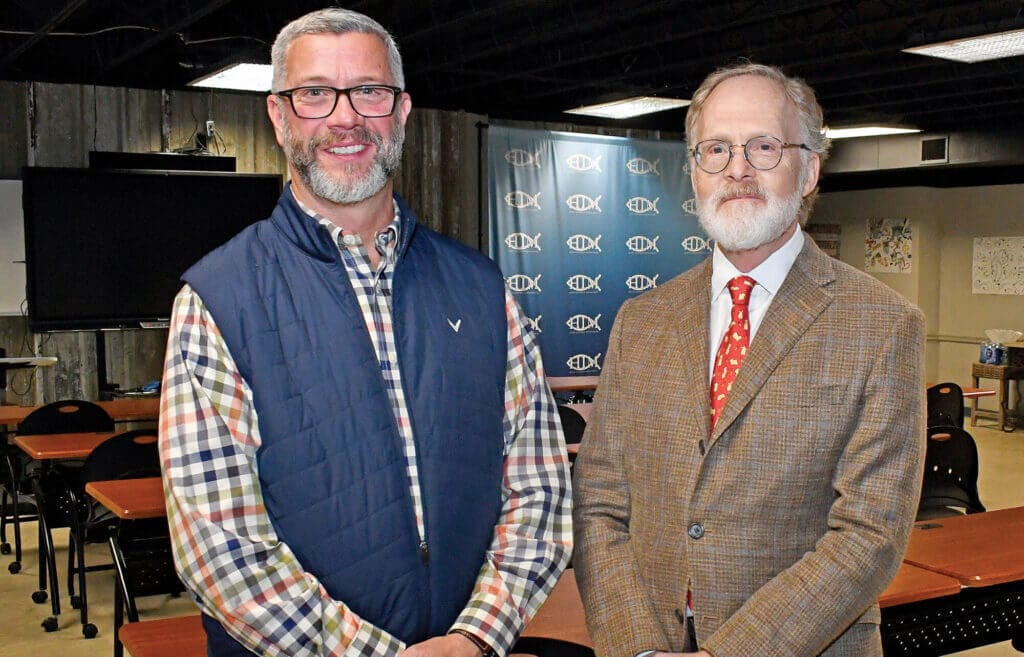
CEO Micah Andrews and board Chair Edmund Perry sat down Nov. 6 for a conversation in Micah’s newly decorated office, a surprise from his staff who purchased furniture from the Foundry’s Thrift stores.
OTMJ: How did you guys find your way to the Foundry?
Perry: I was working for CEO Drayton Neighbors at Protective Life. I was a baby Christian, a foundling believer. I’d been raised in the church, but I had come to faith late in life, age 37. And I felt called to go sit at the Five Points Fountain on Friday nights and mingle with the homeless. And at some point, Drayton said, “have you ever heard of a guy named Bill Hines? He’s head of the Foundry and you need to meet him.” That’s was over two decades ago.
Andrews: I was a youth pastor at the Metropolitan Church of God by Briarwood and Lakeside Baptist, and I had just this moment with the Lord in early 2008 where I just kind of heard him say, if you trust me, step out. I wanted to be known as trusting but I wasn’t so sure about the step out part (laughs). I had a wife, two small children, a mortgage and two car payments. But we took a step of faith and 61 days later I found out about a place called the Foundry. I started on the development staff. My job was to connect the volunteers in community churches.
OTJM: What sorts of people get help from the Foundry?
Andrews: In the last 10 years we’ve had people come to us from 35 states. The vast majority come from Alabama, Georgia and Tennessee. We’ve served men and women as young as 18 and as old as 79 from all walks of life. Some have never had a job, some have owned their own businesses and lost them. All levels of education, master’s degrees, PhDs and GEDs. All drugs of choice. We’re one of those places that says, regardless of your scenario and situation, let’s see how we can figure out how we can help you.
OTJM: The program lasts 9 months. That’s a long time?
Andrews: So, by statistics, we are the fourth or fifth attempt for the average person that walks through our door. Most places offer 30, 45 or 90 -day programs. Being a nine-month program, typically the person’s going to have burned every other option prior to us. And it’s hard to fix a 20-or-more-year drug habit in 30 days.
OTMJ: Edmund, what would you say is your role here?
Perry: I see my role as being Micah’s cheerleader, supporter and encourager. They don’t need a heavy hand from me. They need prayer, support and encouragement. We’ve got the greatest leadership team you’ve ever seen. It’s just a privilege to get a front row seat to watch what God’s doing through these guys.
OTMJ: Why does the Foundry succeed when so many others don’t?
Andrews: Well, there’s no magic to it. What we do is messy but it’s so worth it. You have to be consistent, you have to be there and you have to love … . The Foundry does all those things really well. You’ve also got to be a little bit tough. Our chief program officer, Brandon, uses this phrase, “We’re not a hand up, we’re not a hand out, we’re a handshake.” There’s a lot of sadness that revolves around recovery. I’ve been to and officiated more funerals than I can even keep up with. But what we know is when men and women walk through our doors, they’re at a point of desperation. And we have an opportunity to show them and be the love of Jesus. And we let him do the work that we could never do. That’s the way it works.
Perry: I love the way Micah has phrased it. Our job is to set the table, prepare the feast and the opportunity for the participants to decide whether they want to partake. It’s really important that people understand we are totally and explicitly dependent on Jesus as Lord, savior, healer. However, you are welcome here regardless of what you believe, and even if you reject that completely, you are welcome here.
OTMJ: What happens around Thanksgiving at the Foundry?
Andrews: Thanksgiving is unique for us because our staff prepares and serves the meal. We make it truly about how thankful we are that they’re here because nobody has told them in a long time that they were thankful for their presence, and that in and of itself is more important than the meal. I asked our women participants last year after Thanksgiving dinner, “How many of you have haven’t had a Thanksgiving meal like ours in a long time?” The whole room raised their hand. I said, “Where were you this time last year?” Seven of the 29 were in jail. That’s a mother who missed Thanksgiving with her kids because of drug use. So, we’re going to pull out all the stops to make them feel loved.
OTMJ: Raising $9 million dollars a year has to be a challenge?
Perry: We raise money in creative ways. Our thrift stores, one in Cullman and one in Pelham, generated 61% of our operating revenue last year. And by the way, we always need more items to sell in the thrift store, especially this time of year. Our truck will come pick it up. Just give us a call!
Andrews: So, what we do, we don’t do for money, but what we do requires money. Scott Dawson told me that 10 years ago, and I was like, that’s it, man. In our fundraising efforts we want to be interactional not transactional. We know that when people usually come to supporting the Foundry with either their time, their talent or their treasure, it’s because they have some kind of connection.
Perry: I’ll tell you something else that my wife, Ann, and I have done. We’ve established memorial and honorary scholarships in honor of our family, which basically covers an entrance fee for someone to come into the Foundry. In the scheme of things, it’s really not much money, and it helps.
OTMJ: Why is it called the Foundry?
Andrews: The steel industry terminology of a foundry is where the discarded scraps of metal that have been deemed no longer useful are melted and reshaped into something useful again. When everyone has said to these addicts that they are no longer of use, we want to help reshape them by the hands of God into something very significant.