By Lee Davis
What do Leo Wright, Gary Rutledge and Gary Fleming have in common?
Give up? Here’s the answer: They were all head coaches of Over the Mountain schools when 28-year-old Buddy Anderson coached his first season at Vestavia Hills in 1978.
One of those coaches actually defeated Anderson that year. Wright led Mountain Brook to a 3-0 upset of the Rebels on opening night.
In the years that followed, Wright, Rutledge and Fleming–all fine coaches in their own right–went on to other things. Anderson stayed at Vestavia and did little else except win.
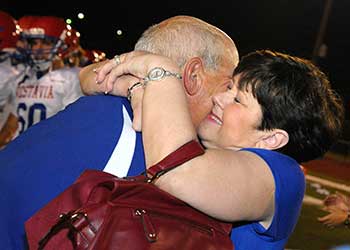
The venerated coach earned his 300th career victory with a 30-8 rout of Huffman on Thursday night, provoking a highly-justified celebration among Rebel fans. Anderson now stands only nine wins away from tying longtime Fayette County coach Waldon Tucker’s record as the all-time winningest coach in Alabama high school history
Anderson and Vestavia have been successful for so long that it’s easy to take their winning as preordained. In reality, the Rebel program struggled mightily in its early years.
Anderson had been a Vestavia assistant coach since 1972 before being promoted to the top job six years later. In the seven years before Anderson took over, Vestavia had enjoyed just one winning season and was going through a revolving door of head coaches.
And while many Rebel boosters were insisting on a “big name” coach, Athletic Director Mutt Reynolds and the city’s school board saw something special in the dark-haired assistant and made the hire that forever changed the course of Vestavia–and Alabama high school–football.
Once Anderson was brought in, there were more doubters when the season began. The Rebels followed the Mountain Brook loss with yet another defeat, this time against Walker and five-star running back Linnie Patrick. Anderson’s first career win came in game 3, as Vestavia shut out Hewitt-Trussville 14-0.
The Rebels’ season had reached an important crossroad, and the next two games–against Minor and Berry–would be pivotal. Vestavia staged a dramatic comeback to take a 15-14 win over the Tigers to square its record to 2-2.
The next week, the Rebels thoroughly outplayed Coach Bob Finley’s defending state champions before falling 21-14. Despite the defeat, the Rebels knew they were on the cusp of greatness.
“Berry won the game, but they didn’t physically beat us,” said a member of that Vestavia team who asked not to be identified. “I think in the past, some of our teams may have been a little intimidated by them. We weren’t afraid of Berry, and we weren’t afraid of anybody.”
Armed with a new confidence, the Rebels won the final five games of the regular season to earn Vestavia’s second-ever playoff berth.
In the postseason, the Rebels rolled all the way to the Class 4A championship finals, losing 21-7 to Jeff Davis at Legion Field. A highlight of the run was a dramatic 27-26 overtime win over gigantic J.O. Johnson at Huntsville’s Milton Frank Stadium.
Vestavia’s 0-2 start had turned into a 10-4 championship season.
Anderson and his team were on their way. The Rebels would reach the finals again in 1979, losing a heartbreaking 14-13 decision to Enterprise.
Two years into Anderson’s tenure, Vestavia had done everything except defeat Berry and win the state championship. The Rebels did both in 1980. They rolled through the regular season with a 9-1 record, losing only to the Bucs 21-7.
As fate would have it, however, the rivals met again in the first round of the playoffs. This time, Vestavia won 7-0. Three weeks later, the Rebels slipped by Parker 15-13 to win the first of two state championships it would earn under Anderson.
Thirty-three years later–on Sept. 12, 2013–the coach chalked up win number 300.
How has Anderson done it? As is the case with almost anything, there’s no single answer. Certainly Vestavia has great resources, financial and otherwise, that are essential for a program’s long-term prosperity. But many programs possess great resources, and they don’t have coaches that stay 35 years and win 300 games.
The real answer is more complicated–and at the same time, simple. For Anderson and Vestavia, it’s about basic truths, both in football and in life. Things like fundamentals, loyalty that goes both ways and the importance of neighborhoods and families.
Anderson has never forgotten that he is not only a coach but also a teacher and leader of young men. The coach unashamedly tears up when talking about an email or letter he received from a former player–whether that former Rebel was a star or benchwarmer–who may have just gotten married, graduated from law school or deployed to Afghanistan. Anderson can easily recite what virtually every player from his 1978 roster is doing now and where he is living. He can do the same for almost every other player who was under his tutelage as well.
On the field, Anderson believes in football’s most basic truth: If your team can run the ball effectively and stop the other team from running effectively, you are going to win far more often than you will lose. Over the years, some critics have brayed that the Rebels are too predictable, but those armchair quarterbacks aren’t going to win 300 games.
In an era where scapegoating and quick-fixes are trendy at all levels of football, Anderson’s loyalty is nothing short of historic. Coaches such as Rick Grammer and George Hatchett began working with Anderson in the late 1970s. And Peter Braasch has been at the head coach’s side for every game Anderson has ever coached.
Anderson is also rock-solid in his belief that neighborhood, community rivalries are the backbone of high school athletics. While other coaches might look for high-profile games against out-of-state powerhouses, Anderson believes it’s more important to emphasize games between schools whose players, parents and fans may intermingle at church, in the workplace or socially.
For example, with Vestavia playing a rugged slate in Class 6A’s Region 6, Anderson isn’t required to play tough non-region traditional rivals Homewood and Hoover. He keeps those games on the Rebel schedule because his fan base wants to see them. And nobody has had more success against the Patriots and even the Bucs over the years than Anderson and Vestavia.
I don’t know when Anderson will retire. He isn’t a hunter or a fisherman, and his only real non-football related activities revolve around his faith and his family, which now includes grandchildren. At 63, Anderson doesn’t give the vibes of a man looking to hang up his whistle anytime soon.
Time has passed Anderson by in some ways. He’ll be the first to say that he doesn’t really like email, computers, texting or especially Facebook. The important thing is that Buddy Anderson still likes football. As long as he does, expect Vestavia to keep winning.