By June Mathews
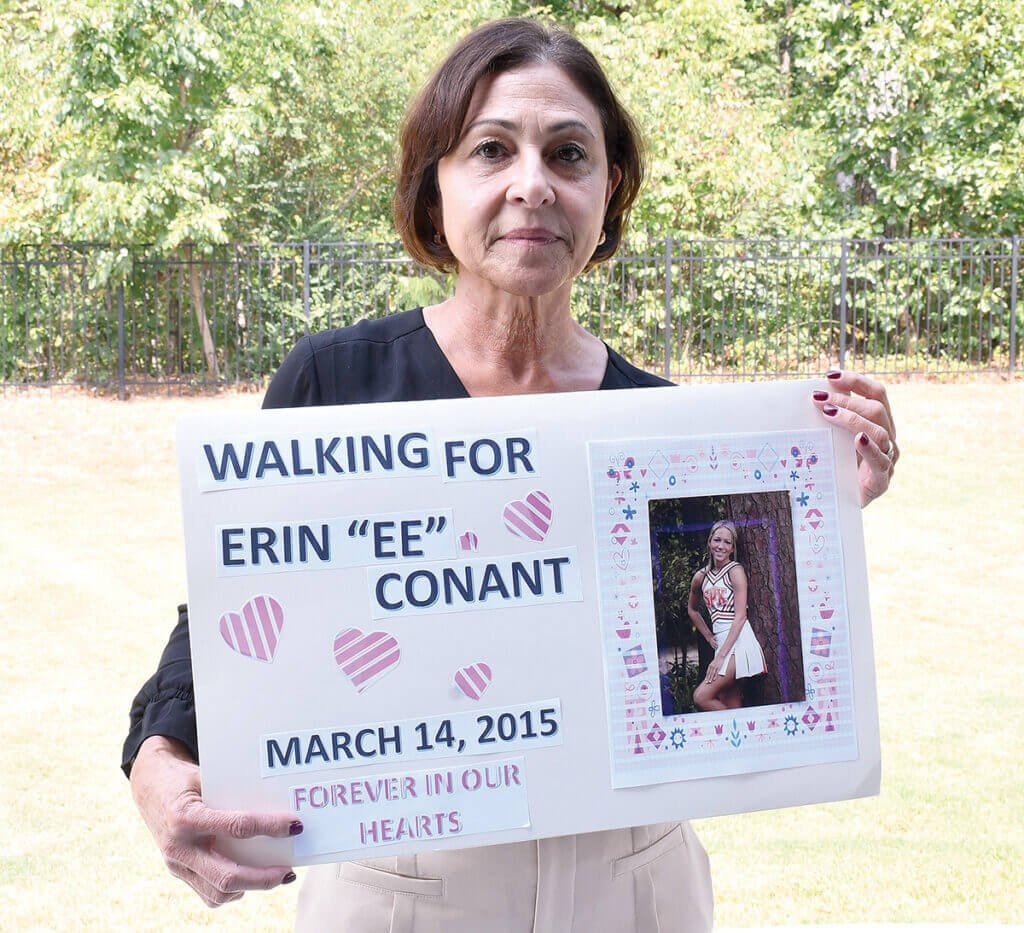
Eight years ago, Angie LaCour lost her 27-year-old daughter, Erin, to suicide.
“She was studying for her doctorate in clinical psychology and was in her last year before clinicals when she was diagnosed bipolar,” LaCour said. “It changed her life completely. She had to leave school and move back home with me.”
Several months of manic behavior was followed by depression. Though Erin’s education had taught her about the illness, the medications and the prognosis, she felt utterly hopeless, mentally crippled by the disorder that held her in its grip. Her family tried to help but were unable to find the kind of resources Erin needed.
Four months later, she attempted suicide with pills.
“I found her and got her to the hospital, of course,” said LaCour. “But that’s the thing about mental illness. You don’t have a lot of resources. Maybe seven days in the hospital and, ‘OK, you can go now, here’s some medicine.’ That type of thing.”
Efforts to get Erin into longer-term facilities failed. Most residential programs were for addicts. Expense was another barrier.
“So much of what she needed was available only to those with very deep pockets,” LaCour said.
In the meantime, Erin attempted suicide a second time. Then a third.
On her fourth attempt, she succeeded.
“She hung herself,” LaCour said, matter-of-factly. “She was just determined that her life was hopeless, and she didn’t want to live that way. She didn’t want to be that person. She was brilliant and beautiful, pursuing her education and her career, and we lost her.”
Thus began LaCour’s post-suicide journey on a road often filled with second guesses, survivors’ guilt and regret.
“As a parent, you always think, ‘I wish I knew more, I wish I had done things differently. I should have made this decision, I should have done that,’” she said. “So many things go through your mind. Everyone tells you that you did everything you could and that it’s not your fault. But for a parent, that just doesn’t work.
Turning to Suicide Prevention Foundation
Immediately following Erin’s death, LaCour and her family got involved with the American Foundation for Suicide Prevention and requested donations to the organization in lieu of flowers. Within a week or so, more than $10,000 had been raised in Erin’s memory, money that went toward furthering the AFSP’s mission of educating people about mental illness and trying to reduce the number of people who die by suicide.
“Little by little, I got more involved with AFSP, particularly in their Out of the Darkness Walks, which is their biggest fundraiser,” said La Cour. “The walks are done all over the country, and that’s what I did for a while. I did attend some support meetings, and they have chapters that offer support for families to go and talk things through. But mostly what I did was the walks.”
About a year ago, LaCour moved from Louisiana to Hoover, and one of the first things she did was inquire about volunteer opportunities with the Birmingham chapter of AFSP. She learned that committee members were needed to make the local walk happen this year, so she jumped right in.
Set for Nov. 5 at Veterans Park in Hoover, the Out of the Darkness Walk Birmingham will draw attention to the importance of suicide prevention. As she has in so many other such events, LaCour will be walking, joined by many others who, like her, have been personally affected by suicide.
The course of the walk is about three miles long, LaCour said, with walkers taking signs along to honor family members or friends lost to suicide. Some walk on their own; others walk in groups.
Last year, more than 570 Out of the Darkness Walks took place in communities and campuses across the U.S., attended by nearly a quarter of a million people.
“The movement is growing,” she said. “Our goal is to spread awareness of what is currently the 12th leading cause of death in the U.S. and let others know they are not alone.”
Out of the Darkness Walk Birmingham will take place Nov. 5 at Veterans Park in Hoover. Pre-walk festivities begin at 1:00 p.m.; opening ceremonies begin at 2:30. Pre-register at supporting.afsp.org. For more information, visit www.afsp.org or contact walk chair Marissa Grayson at 205-613-6630 or [email protected].